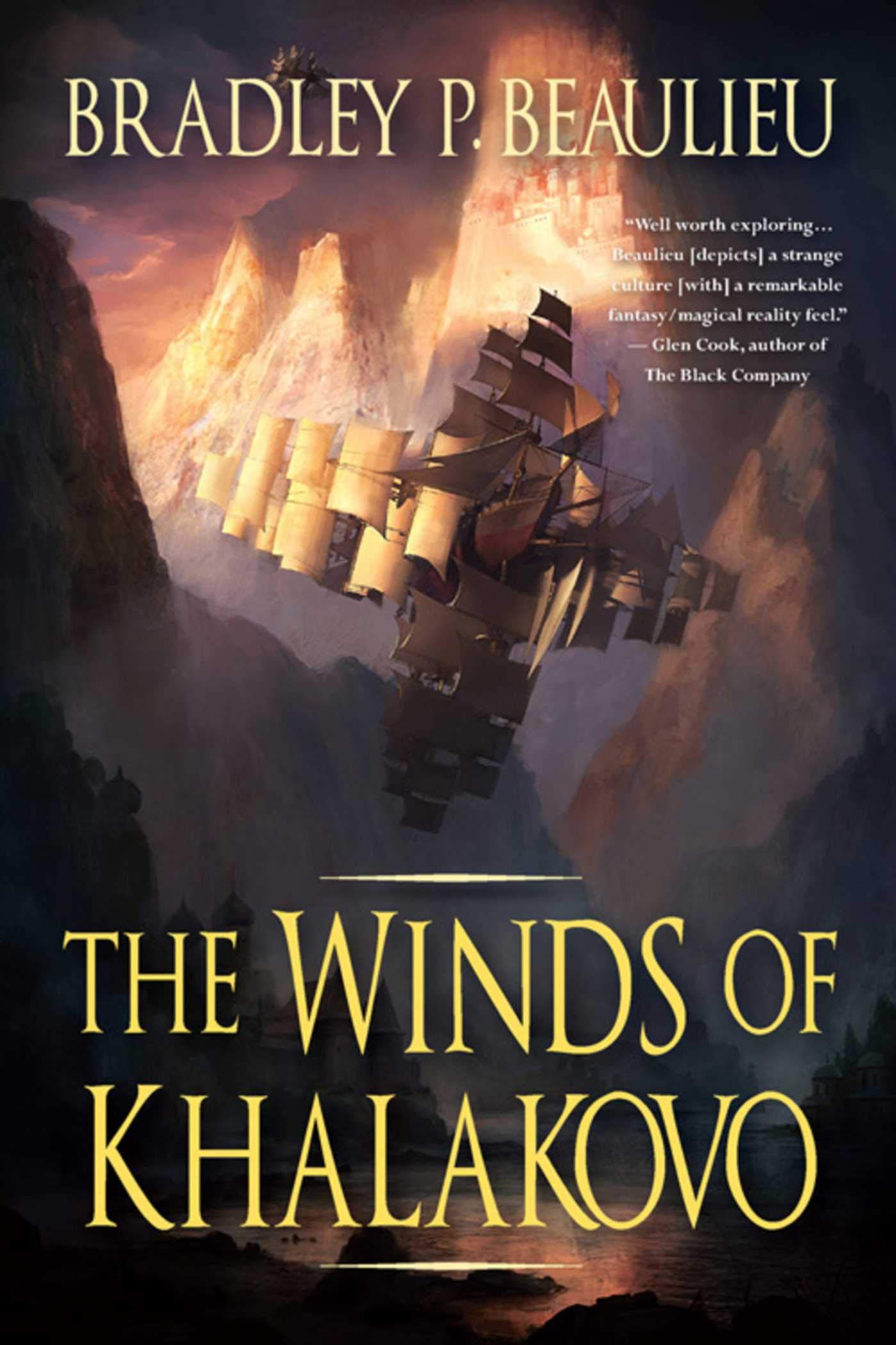



Among inhospitable and unforgiving seas stands Khalakovo, a mountainous archipelago of seven islands, its prominent eyrie stretching a thousand feet into the sky. Serviced by windships bearing goods and dignitaries, Khalakovo's eyrie stands at the crossroads of world trade. But all is not well in Khalakovo. Conflict has erupted between the ruling Landed, the indigenous Aramahn, and the fanatical Maharraht, and a wasting disease has grown rampant over the past decade. Now, Khalakovo is to play host to the Nine Dukes, a meeting which will weigh heavily upon Khalakovo's future. When an elemental spirit attacks an incoming windship, murdering the Grand Duke and his retinue, Prince Nikandr, heir to the scepter of Khalakovo, is tasked with finding the child prodigy believed to be behind the summoning. However, Nikandr discovers that the boy is an autistic savant who may hold the key to lifting the blight that has been sweeping the islands. Can the Dukes, thirsty for revenge, be held at bay? Can Khalakovo be saved? The elusive answer drifts upon the Winds of Khalakovo... The Winds of Khalokovo is filled with clean prose, intelligent language, and brilliant imagination. Reading this fantasy was like sinking my teeth into a rich and exotic dessert. --Orson Scott Card's Intergalactic Medicine Show Elegantly crafted, refreshingly creative. --C.S. Friedman, Bestselling author of The Coldfire Trilogy Well worth exploring... --Glen Cook, Bestselling author of The Black Company The boldly imagined new world and sharply drawn characters will pull you into The Winds of Khalakovo and won't let you go until the last page. --Michael A. Stackpole, New York Times bestselling author of I, Jedi Exactly the kind of fantasy I like to read. --Kevin J. Anderson, New York Times bestselling author of The Saga of the Seven Suns The Winds of Khalakovo is a story set in a world that has elements of George R.R. Martin's Song of Ice and Fire as well as Ursula K. Le Guin's Earthsea . The genesis of the book is actually from a series of postcards of fine art that I picked up in Edinburgh, Scotland. (I posted about it on my website if you're curious to hear more about that.) I used that artwork to first generate and then crystallize my thoughts about the book. Initially, I tried not to let any one thing rule the brainstorming I would do from time to time. I didn't even know who the main characters were at first. I was quite taken by the picture of the three sisters, though, and I knew right away, the moment I laid eyes on the original in the National Gallery, that they would play a major part in the novel. But in the end it was the picture of the boy with the flaming brand that kept leaping out at me, calling for attention. The artist is Godfried Schalcken, and the piece is called "A Boy Blowing on a Firebrand to Light a Candle." This character eventually became Nasim, the autistic savant. As I was studying the characters, I began to realize that this boy was not going to be a point-of-view character, but he was going to be a prime mover. In the end, he embodies much of what Winds is about. The story truly does revolve around him and his unique powers. The brand that he holds in the painting also came into play. I didn't know what the magic was going to be about. I hardly had a single preconception about the book going in. I just wanted the artwork to speak to me, to advise me as to what the story was going to be--from the characters to the world to the magic. The boy blowing on the brand got me to thinking about elemental magic, and I realized that Nasim was one who could do this without even thinking. It came as naturally to him as did breathing. That's a difficult place to put a character, however. As a writer, you have to be careful of all-powerful things, and so I needed something to balance Nasim's abilities. And this, of course, is where his disconnection from the world came from. Nasim, as written in the book, is often lost. He has difficulty relating to others in even the smallest of ways. This both limited his power and made him in some ways more dangerous and more scary than a calculating villain, simply because of the unpredictability. I'd be remiss if I didn't also mention Rehada, who started out as a somewhat minor character but grew into the most complex and perhaps the most compelling of my three main characters. Rehada came from Andrew Geddes' "Hagar." It's another beautiful painting, filled with emotion. I was drawn to the fact that she was crying. I wondered why. I spent a lot of time answering that one question. After knowing that her people were essentially pacifists, I realized that Rehada was not. She felt she had betrayed her people and their ways because she had taken to the path of violence. It was from this, from that one single tear, that the entirety of the Maharraht--the fanatical splinter group that came to embrace violence as a means to an end--was born. Bradley P. Beaulieu is the autho