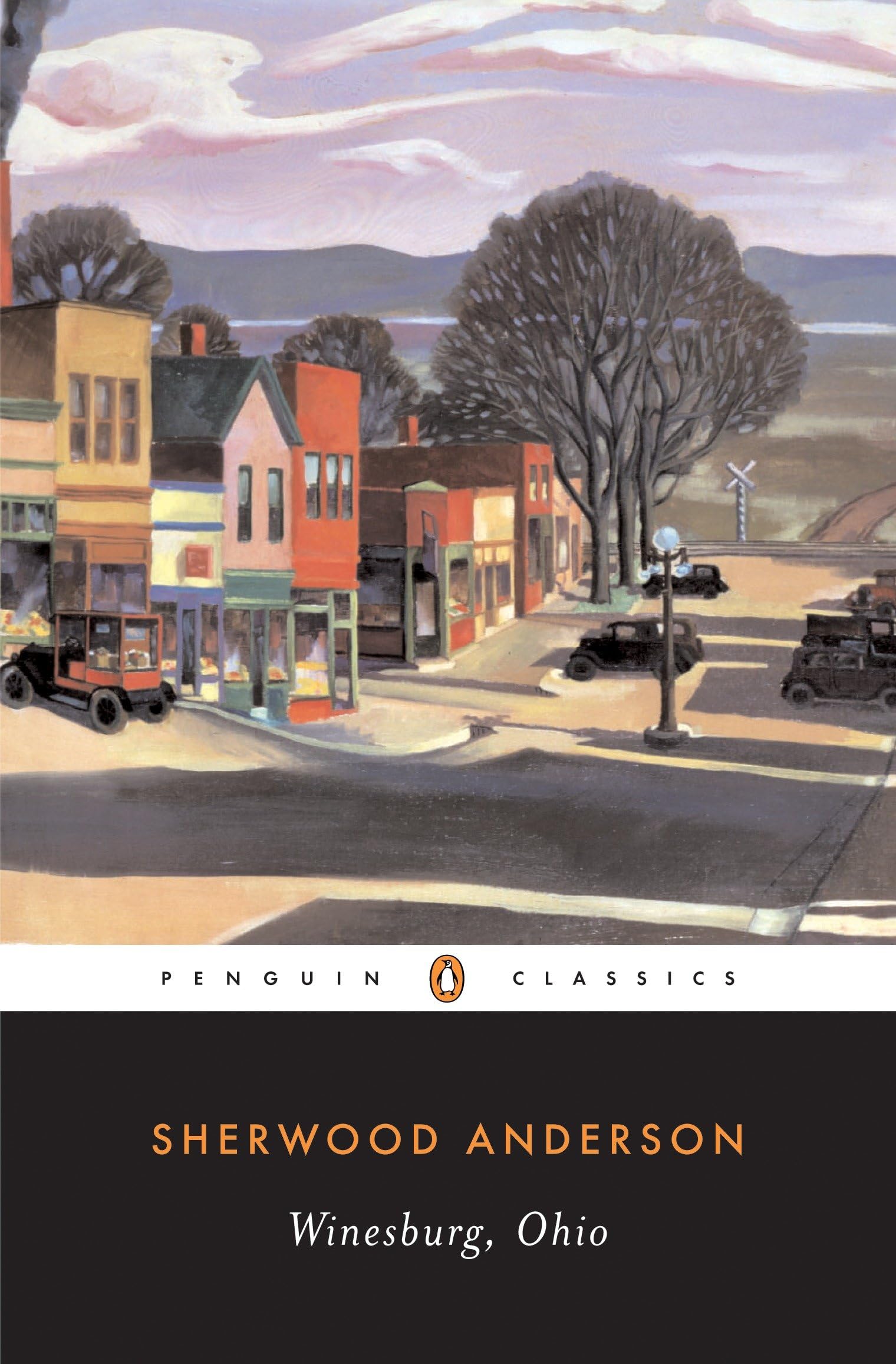



George Willard is a young reporter on the Winesburg Eagle to whom, one by one, the inhabitants of Winesburg, Ohio, confide their hopes, their dreams, and their fears. This town of friendly but solitary people comes to life as Anderson's special talent exposes the emotional undercurrents that bind its people together. In this timeless cycle of short stories, he lays bare the life of a small town in the American Midwest. For more than seventy years, Penguin has been the leading publisher of classic literature in the English-speaking world. With more than 1,700 titles, Penguin Classics represents a global bookshelf of the best works throughout history and across genres and disciplines. Readers trust the series to provide authoritative texts enhanced by introductions and notes by distinguished scholars and contemporary authors, as well as up-to-date translations by award-winning translators. "When he calls himself a 'poor scribbler' don't believe him. He is not a poor scribbler . . . he is a very great writer."--Ernest Hemingway "Winesburg, Ohio, when it first appeared, kept me up a whole night in a steady crescendo of emotion."--Hart Crane "As a rule, first books show more bravado than anything else, unless it be tediousness. But there is neither of these qualities in Winesburg, Ohio. . . . These people live and breathe: they are beautiful."--E. M. Forster "Winesburg, Ohio is an extraordinarily good book. But it is not fiction. It is poetry."--Rebecca West Born in 1876, Sherwood Anderson grew up in a small town in Ohio—an experience that was the basis of his greatest achievements as a writer. He served in the Spanish-American War, worked as an advertising man, and managed an Ohio paint factory before abandoning both job and family to embark on a literary career in Chicago. His first novel, Windy McPherson's Son , was published in 1916; his second, Marching Men , a characteristic study of the individual in conflict with industrial society, appeared in 1917. But it is Winesburg, Ohio (1919), with its disillusioned view of small-town lives, that is generally considered his masterpiece. Later novels— Poor White , Many Marriages , and Dark Laughter —continued to depict the spiritual poverty of the machine age. Anderson died in 1941. Malcolm Cowley (1898–1989) a leadiing literary figure of his time, wrote numerous books of literary criticism, essays, and poetry. PENGUIN CLASSICS WINESBURG, OHIO Born in 1876, SHERWOOD ANDERSON grew up in a small town in Ohio—an experience that was the basis of his greatest achievements as a writer. He served in the Spanish-American War, worked as an advertising man, and managed an Ohio paint factory before abandoning both job and family to embark on a literary career in Chicago. His first novel, Windy McPherson’s Son, was published in 1916; his second, Marching Men, a characteristic study of the individual in conflict with industrial society, appeared in 1917. But it is Winesburg, Ohio (1919), with its disillusioned view of small-town lives, that is generally considered his masterpiece. Later novels— Poor White, Many Marriages, and Dark Laughter —continued to depict the spiritual poverty of the machine age. Anderson died in 1941. Longtime literary editor of The New Republic, MALCOLM COWLEY (1898–1989) served as president of the National Institute of Arts and Letters in the ‘50s and ‘60s, and was Chancellor of the American Academy of Arts and Letters from 1966 to 1976. The author of numerous works of criticism, essays, and poetry, Cowley’s books include Exile’s Return, A Second Flowering, and The Literary Situation. SHERWOOD ANDERSON Winesburg, Ohio With an Introduction by MALCOLM COWLEY PENGUIN BOOKS INTRODUCTION Rereading Sherwood Anderson after many years, one feels again that his work is desperately uneven, but one is gratified to find that the best of it is as new and springlike as ever. There are many authors younger in years—he was born in 1876—who made a great noise in their time, but whose books already belong among the horseless carriages in Henry Ford’s museum at Greenfield Village. Anderson made a great noise too, when he published Winesburg, Ohio in 1919. The older critics scolded him, the younger ones praised him, as a man of the changing hour, yet he managed in that early work and others to be relatively timeless. There are moments in American life to which he gave not only the first but the final expression. He soon became a writer’s writer, the only story teller of his generation who left his mark on the style and vision of the generation that followed. Hemingway, Faulkner, Wolfe, Steinbeck, Caldwell, Saroyan, Henry Miller …each of these owes an unmistakable debt to Anderson, and their names might stand for dozens of others. Hemingway was regarded as his disciple in 1920, when both men were living on the Near North Side of Chicago. Faulkner says that he had written very little, “poems and just amateur things,” before meeting Anderson i