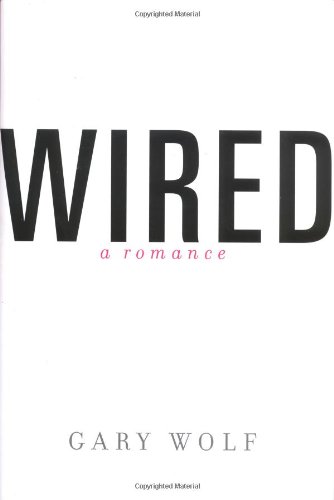



The Electric Kool-Aid Acid Test for our own age, the story of a dreamer who turned American media upside down—and suffered the consequences Louis Rossetto had no money, no home, no job. Five years later he owned the hottest magazine in America and was poised to become an international tycoon, with America’s most powerful financiers by his side. Rossetto was the founder and editor of Wired, whose hyperactive Day-Glo pages proclaimed that every American institution was obsolete. Instantly, Wired, was everywhere—on television, passed around the halls of Congress, displayed in the office of the president of the United States. Wired, ’s headquarters in San Francisco became a pilgrimage site for everybody who wanted to be at the white-hot center of the digital revolution. Not since the early days of Jann Wenner and Rolling Stone had anybody so brilliantly channeled the enthusiasms of his era. But this was only the beginning. Wired cast an uncanny spell, creating a feedback loop that grew stunningly out of control. Wired, ’s online site, HotWired, designed and sold the first banner advertisements for the World Wide Web, unleashing a commercial frenzy. Wired, reached for empire, with a book-publishing company, a broadcast division, and foreign editions all over the globe. But as the market’s enthusiasm outstripped the limits of reason, Rossetto faced a battle over the fate of Wired that would prove the ultimate test of his radical ideas. Gary Wolf, one of Wired, ’s most popular writers, takes no prisoners in this insider’s account, telling a story that is alternately thrilling, hilarious, heartbreaking, and absurd. Now that bumper stickers read-ing please god–just one more bubble have been sighted on the highways of California, Wired—A Romance goes beyond the dot.com clichés and paints a deeply affecting portrait of the boom. Wolf, a contributor to such magazines as Wired, tells the story of Louis Rossetto, who, with his companion, Jane Metcalfe, sets out on an adventure to prove that computers would make every existing authority obsolete. The saga begins with the two of them developing Wired magazine and then expanding their efforts into the Internet arena. Rossetto was driven by ideology, commitment, and rank stubbornness, which ultimately earned them $30 million when the whole enterprise was sold in 1999 for $390 million. We can consider this a "morality play" with intrigue and lengthy battles involving greed, betrayal, and many other human-nature characteristics. It is a story of winners and losers, of bitter struggles and politics involving former and current employees, investors, and other board members, and readers will decide for themselves who acted admirably and who did not. Rossetto's risk-taking odyssey with Wired is just one of many tales about the highs and lows experienced by players in the Internet bubble of the late 1990s. Mary Whaley Copyright © American Library Association. All rights reserved “Of all the writers who emerged from the San Francisco scene in the 1990s, no one has rendered the characters and contours of digital culture with more spirit and nuance than Gary Wolf. Here he turns his sharp eye, nimble pen, and sly sense of humor on a story he knows from the inside out -- the story not simply of the most influential American magazine since Rolling Stone, but of the strange, exhilirating, singular era that magazine did so much to interpret and define -- and the result is captivating. Wired: A Romance is a terrific tale, well told.” - John Heilemann, author of Pride Before the Fall: The Trials of Bill Gates and the End of the Microsoft Era “Louis Rossetto’s Wired was that rarest of birds: a magazine that actually changed the way people thought about the world. Gary Wolf brilliantly brings to life the romance of Wired ’s early days, the sheer audaciousness of Rossetto in action, and the galvanizing effect of the magazine’s overamped, self-consciously revolutionary vision of technology. At the same time, he shows how ill-equipped Wired was to deal with success, and how the magazine got swept away by the excesses of the very boom it had helped create. Wolf captures the sheer exhilaration of working on a labor of love, and the exhaustion that sets in when you realize that love isn’t enough. In the process, he helps us understand the dream that was at the heart of the nineties boom, and why, even after the bubble has burst, it remains so hard to abandon.” -James Surowiecki, business columnist for The New Yorker “Every happy business is alike, and every unhappy business is unhappy in its own way; Wired was apparently both. Gary Wolf has produced a smart, knowing, tough-minded, virtually Tolstoyan chronicle of the media incarnation of the digital revolution. Like so many recent entrepreneurial rise-and-fall stories, it's a feverish tale of idealism and selfishness, brilliant intuitions and dumbfounding hubris, global ambitions and parochia