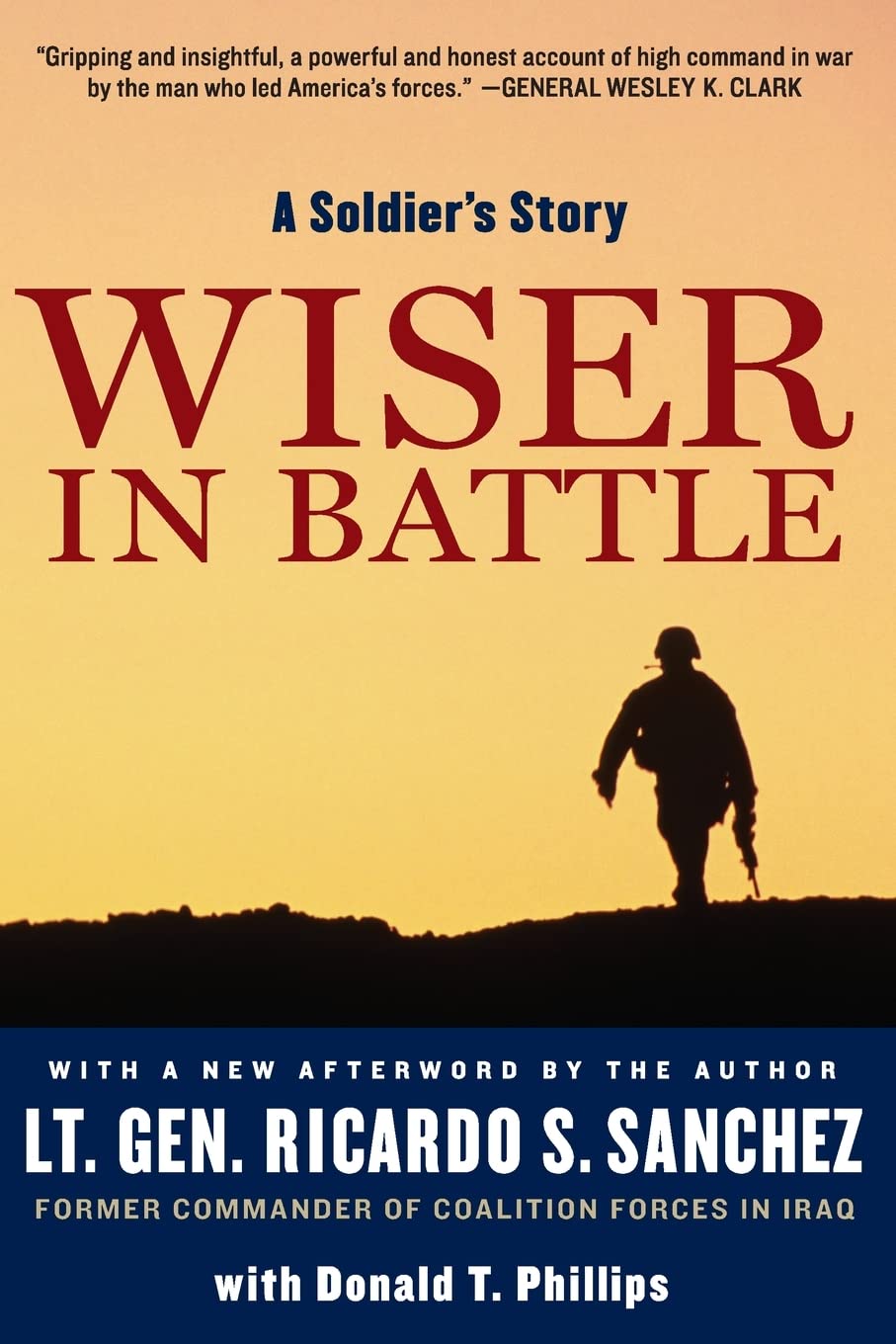
Wiser in Battle: A Soldier's Story – A Commander's Insider Account of Iraq's Civil War and Abu Ghraib
$13.59
by Ricardo S. Sanchez



The former commander of coalition forces in Iraq reports back from the front lines of the global war on terror to provide a comprehensive and chilling exploration of America's historic military and foreign-policy blunder. With unflinching candor, Lieutenant General Ricardo S. Sanchez describes the chaos on the Iraqi battlefield caused by the Bush administration's misguided command of the military, as well as his own struggle to set the coalition on the path toward victory. Sanchez shows how minor insurgent attacks grew into synchronized operations that finally ignited into a major insurgency and all-out civil war. He provides an insider's account of the Abu Ghraib prison scandal, explaining the circumstances that led to the abuses, who perpetrated them, and what the formal investigations revealed. Sanchez also details the cynical use of the Iraq War for political gain in Washington and shows how the pressure of an around-the-clock news cycle drove and distorted critical battle decisions. The first book written by a former on-site commander in Iraq, Wiser in Battle is essential reading for all who wish to understand the Iraqi incursion and the role of America's military in the new century. “Bracingly candid.” - Texas Monthly The former commander of coalition forces in Iraq reports back from the front lines of the global war on terror to provide a comprehensive and chilling exploration of America's historic military and foreign-policy blunder. With unflinching candor, Lieutenant General Ricardo S. Sanchez describes the chaos on the Iraqi battlefield caused by the Bush administration's misguided command of the military, as well as his own struggle to set the coalition on the path toward victory. Sanchez shows how minor insurgent attacks grew into synchronized operations that finally ignited into a major insurgency and all-out civil war. He provides an insider's account of the Abu Ghraib prison scandal, explaining the circumstances that led to the abuses, who perpetrated them, and what the formal investigations revealed. Sanchez also details the cynical use of the Iraq War for political gain in Washington and shows how the pressure of an around-the-clock news cycle drove and distorted critical battle decisions. The first book written by a former on-site commander in Iraq, Wiser in Battle is essential reading for all who wish to understand the Iraqi incursion and the role of America's military in the new century. Former United States Army Lieutenant General Ricardo S. Sanchez served as commander of coalition ground forces in Iraq from June 2003 to June 2004. When he retired on November 1, 2006, Sanchez was the highest-ranking Hispanic in the U.S. Army, culminating thirty-three years of military service. He now lives in his home state of Texas. Ricardo S. Sánchez es teniente general retirado del Ejército de los Estados Unidos y sirvió como comandante de la coalición de tropas en Irak de junio de 2003 a junio de 2004. Era el hispano de mayor rango en la Armada cuando se retiró el 1ro de noviembre de 2006, culminando treinta y tres años al servicio del Ejército de los Estados Unidos. Actualmente, Sánchez vive en Texas. Donald T. Phillips is the author of twenty books, including Lincoln on Leadership . He lives in Illinois. Donald T. Phillips ha sido el autor de veinte libros, incluyendo Lincoln on Leadership , y vive en Illinois. Wiser in Battle A Soldier's Story By Ricardo Sanchez HarperCollins Publishers, Inc. Copyright © 2009 Ricardo Sanchez All right reserved. ISBN: 9780061562433 Chapter One The Rio Grande Valley My soul is anchored in a poverty-stricken town on the desolate banks of the Rio Grande River—an international boundary that separates a superpower from a country still struggling to make its way out of the Third World. Less than a hundred miles down the road are the Texas cities of McAllen, Harlingen, and Brownsville. But just on the other side of the river, some 1,200 meters to the south, is Mexico. The flowing water, itself, provides an oasis of life in the dusty, desert landscape—nourishing the plants, animals, and people gathered along its meandering path. Rio Grande City, where I was born in 1951, is one of the oldest settlements in South Texas. It flourished around Fort Ringgold, a military outpost established in 1848 in the wake of the United States?Mexico War. Occupied by Confederate forces during the Civil War, and the federal cavalry afterward, Fort Ringgold was eventually closed, but was reactivated for brief periods of service during World War I and World War II. Despite the continuing presence of the U.S. military, Rio Grande City had a checkered history marked by ethnic hatred and racial intolerance. I grew up in a Hispanic community among people who possessed little of material value. My own family was among the worst off in the neighborhood. But our poverty was balanced by a tight-knit network of extended relatives steeped in faith, tradition, and the str