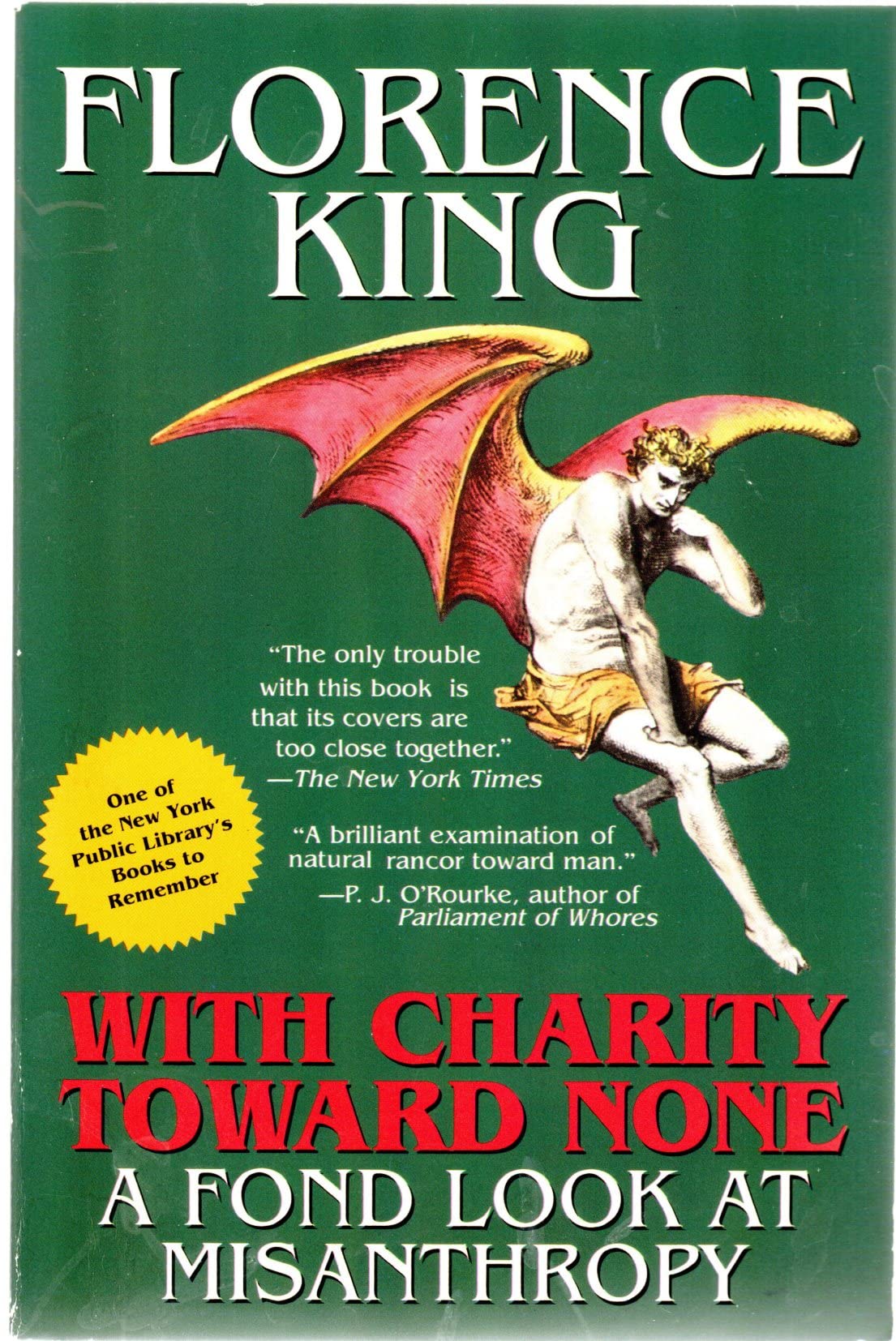



The unreconstructed people-hater offers her piece de resistance: a guided tour of the misanthropic life, and an inspirational handbook for Americans grown tired of "goo-goo humanitarianism and sensitivity that never sleeps." "The only trouble with this book is that its covers are too close together."--The New York Times. With Charity Toward None AUTHOR'S NOTE From The American Heritage Dictionary: "misanthrope also misanthropist n. A person who hates or scorns mankind. [Fr. misanthropos, hating mankind: misein, to hate + anthropos, man.]" Firsthand, behind-the-scenes information is the kind America likes. Not unmindful of other portions of the equine anatomy, we are the land of the horse's mouth. Alcoholics write books about alcoholism, drug addicts write books about drug addiction, brothel keepers write books about brothel keeping, so I have written a book about misanthropy.As with repressed Victorians and sex, friendly Americans harbor a secret fascination for the forbidden subject of misanthropy. It reared its head when I told certain people that I was writing this book. Their first response was a hungry-sounding "Ohhh," followed by eager suggestions of whom to put in it.The name proffered most often by intellectual men was Franz Kafka, accompanied by a supporting quotation that they all seem to have underlined: "Nervous states of the worst sort control me without pause. Everything that is not literature bores me and I hate it. I lack all aptitude for family life."My own favorite Kafkaisms are "A friendship without disruption of one's daily life is unthinkable," and "All that I have accomplished is the result of being alone." As heartwarming as these sentiments are, Kafka's life suggests that his real problem was not so much misanthropy as emotional pulverization by a misanthropic father. According to Franz, the elder Kafka possessed "a knowledge of people and a distrust of most of them," and manifested "aloofness, self-confidence and dissatisfaction with everyone else."Kafka's free-floating guilt included guilt over his unsociable nature, which he tried to change--something no self-respecting misanthrope would ever do. As a student he took on what we would call extracurricular activities, joining political clubs and even a seance. But despite interesting associates that included Max Brod and Franz Werfel, Kafka never felt comfortable in groups. Writes Louis Untermeyer: "After an hour of talk his nerves would give way, his lips would twitch, his extraordinary black eyes would burn, and he would be racked with headaches."I know the feeling well, but it is not misanthropy in the strict sense. It is what comes over a touring writer who is too tired to hate. Kafka's whole life was a book tour, which is another way of saying that he was temporarily haunted on a permanent basis. It takes energy to be a misanthrope but Kafka was so overwhelmed by people that he had no strength left to hate them.My consultants recommended several nihilists and existentialists but I rejected them all. A black turtleneck sweater does not a misanthrope make. Nihilists and existentialists tend to bebohemians, who invariably run in packs; despite their alienated stance they have always struck me as a sociable lot who surround themselves with people because they are forever saying "Nothing matters," and they need someone to say it to.I have also eliminated pessimists and fatalists such as Oswald Spengler and T.S. Eliot. If we take as one definition of a misanthrope, "Someone who does not suffer fools and likes to see fools suffer," we realize at once that we are dealing with an individual who has something to look forward to. Misanthropes have the "vision thing" down pat. Anticipating the spectacle of seeing fools suffer makes us wake up in the morning with a song in our hearts, even when the suffering fool is an American president with the power to drag us all down with him. A misanthropic Philistine no doubt would have said, "Hey, wouldn't it be a gas if we could get this guy Samson to come over to the temple?" No matter what wastelands we must endure, our motto is: It was worth it .Every woman who volunteered names recommended Dorothy Parker, but she is not to be found herein. A romantic masquerading as a cynic, Parker hated to be alone, and attempted suicide several times after broken romances. Misanthropes love to be alone, and our attitude toward broken romances is the flip side of America's favorite maxim: "A lover is a stranger you haven't met yet."One woman suggested Jane Austen based on the quotation: "I do not want people to be agreeable, as it saves me the trouble of liking them." This remark bespeaks a standard occupational hazard in an otherwise outgoing lady. Writers are more interested in people than fond of them; life is a laboratory and people are the mice, but it does not follow that all writers are misanthropes. Austen became a writer because people fascinated her,arts and all. I became a writer so I coul