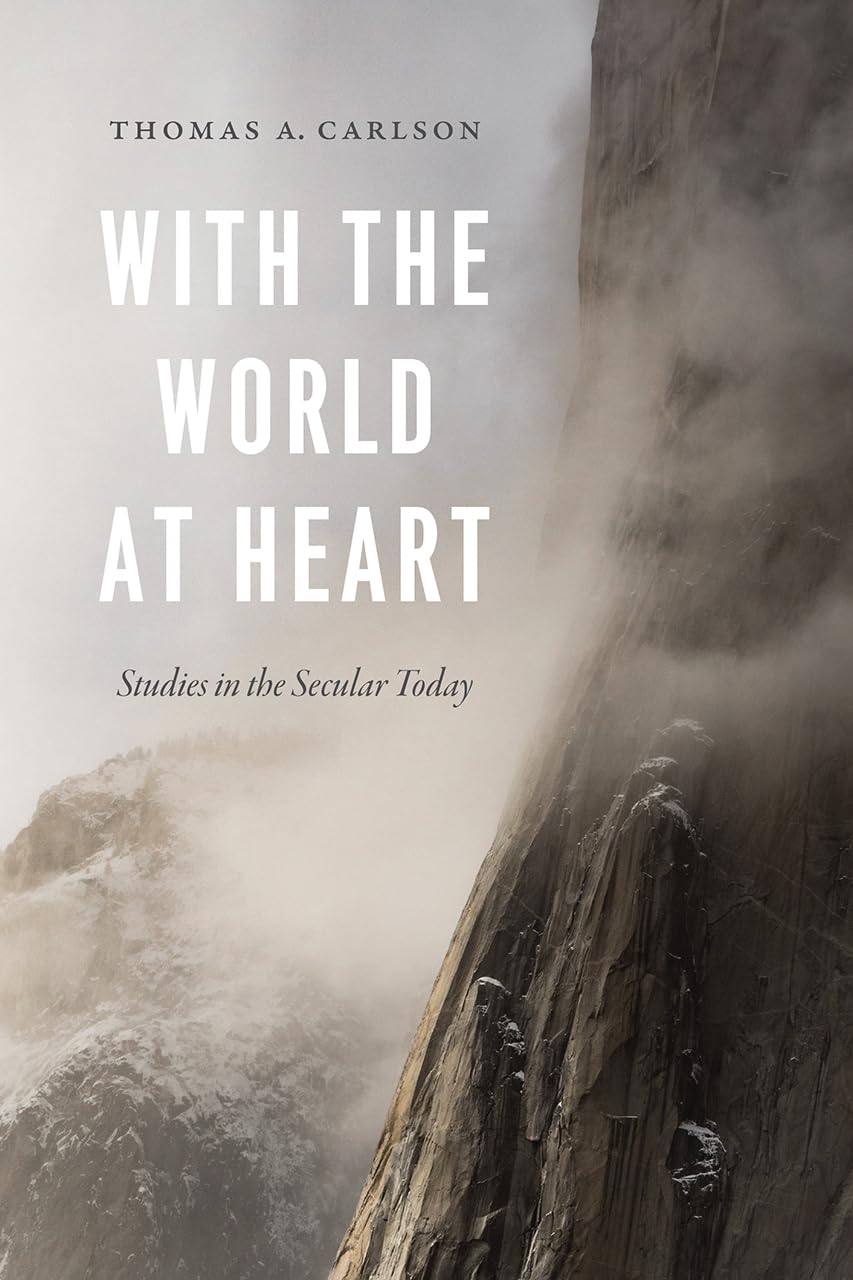
With the World at Heart: Studies in the Secular Today
$28.89
by Professor Thomas A. Carlson



What is the role of love in opening and sustaining the temporal worlds we inhabit? One of the leading scholars in philosophy and the history of religious thought, Thomas A. Carlson here traces this question through Christian theology, twentieth-century phenomenological and deconstructive philosophy, and nineteenth-century individualism. Revising Augustine’s insight that when we love a place, we dwell there in the heart, Carlson also pointedly resists lines of thought that seek to transcend loss and its grief by loving all things within the realm of the eternal. Through masterful readings of Heidegger, Derrida, Marion, Nancy, Emerson, and Nietzsche, Carlson shows that the fragility and sorrow of mortal existence in its transience do not, in fact, contradict love, but instead empower love to create a world. “Carlson… does an excellent job of explaining the notoriously difficult thinkers that he reads in this meditation on the meaning of love in a secular age.” ― Reading Religion “Thomas Carlson’s With the World at Heart is masterful. With exceptional clarity, conceptual rigor, and creative thinking, Carlson brings one phase of the Continental philosophy of religion to culmination and opens up new avenues for future work.” -- Tyler Roberts, author of Encountering Religion: Responsibility and Criticism after Secularism “This is a work of Continental philosophy at its best—erudite, historical, analytical, and insightful. In deep dialogue with some of the most interesting thinkers of the past half century, Carlson offers nothing less than a ‘philosophy of spirit’ for our age, where spirit appears as the world-forming power of love as well as the love-preserving power of world. A major contribution to our understanding of human finitude in its existential openness to time and world.” -- Robert Pogue Harrison, author of Juvenescence: A Cultural History of Our Age Thomas A. Carlson is professor of religious studies and founding director of the Humanities and Social Change Center at the University of California, Santa Barbara. He is the author of Indiscretion: Finitude and the Naming of God and The Indiscrete Image: Infinitude and Creation of the Human , both also published by the University of Chicago Press. With the World at Heart Studies in the Secular Today By Thomas A. Carlson The University of Chicago Press Copyright © 2019 The University of Chicago All rights reserved. ISBN: 978-0-226-61753-4 Contents Acknowledgments, Abbreviations of Main Texts Cited, Preview: The Demands of the Day, 1 When We Love — A Place: World's End with Cormac McCarthy, 2 Mourning Places and Time in Augustine, 3 The Conversion of Time to the Time of Conversion: Augustine with Marion, 4 The Time of His Syllables: Dying Together with Derrida and Augustine, 5 Thinking Love and Mortality with Heidegger, 6 World Loss or Heart Failure: Pedagogies of Estrangement in Harrison and Nancy, 7 Ages of Learning ... the Secular Today with Emerson and Nietzsche, Last Look, Bibliography, Index, Footnotes, CHAPTER 1 When We Love — A Place: World's End with Cormac McCarthy To live "with the world at heart," according to the immeasurably influential turn that Christian thought takes with Augustine of Hippo (354–430), to dwell in the world in one's heart (habitare corde in mundo) rather than merely in one's flesh (carne), is to be in truth already dead. If I live with the world at heart, I inhabit what Augustine calls in his Confessions a "living death" or a "dead life." In such a living death — which, so long as we live it, we do not know or even suspect to be a death — we are closed off from the only true life, and thus from the only true happiness, because we are bound in our affections to change, dispersion, and loss. According to Augustine, genuine happiness and its distinctive life suffer, by definition, no loss, and thus we enjoy real life and its happiness only when we are freed of loss, in the one and immutable God. In light of his teleological and eudaemonistic construal of human existence, according to which the end of love is enjoyment, Augustine presents us with a stark decision: "What do you want? To have temporal things and to pass away together with time, or not to love the world and to live forever with God?" Through his inheritance of the New Testament writings of John and Paul, Augustine understands "world" not simply as created fabric of the heavens and the earth, or something akin to the "natural world" we might conjure in thinking today of world or creation; "world" here refers more importantly to the distinctive turn of human love in its alienation from God, a misdirected turn of love, or a perversion of the heart that determines our fundamental way of being-in the world as a being-away from God. "For the world," as Augustine writes in his Second Tractate on the First Epistle of John (407), is a designation not only of this structure that God made, the sky and the earth,