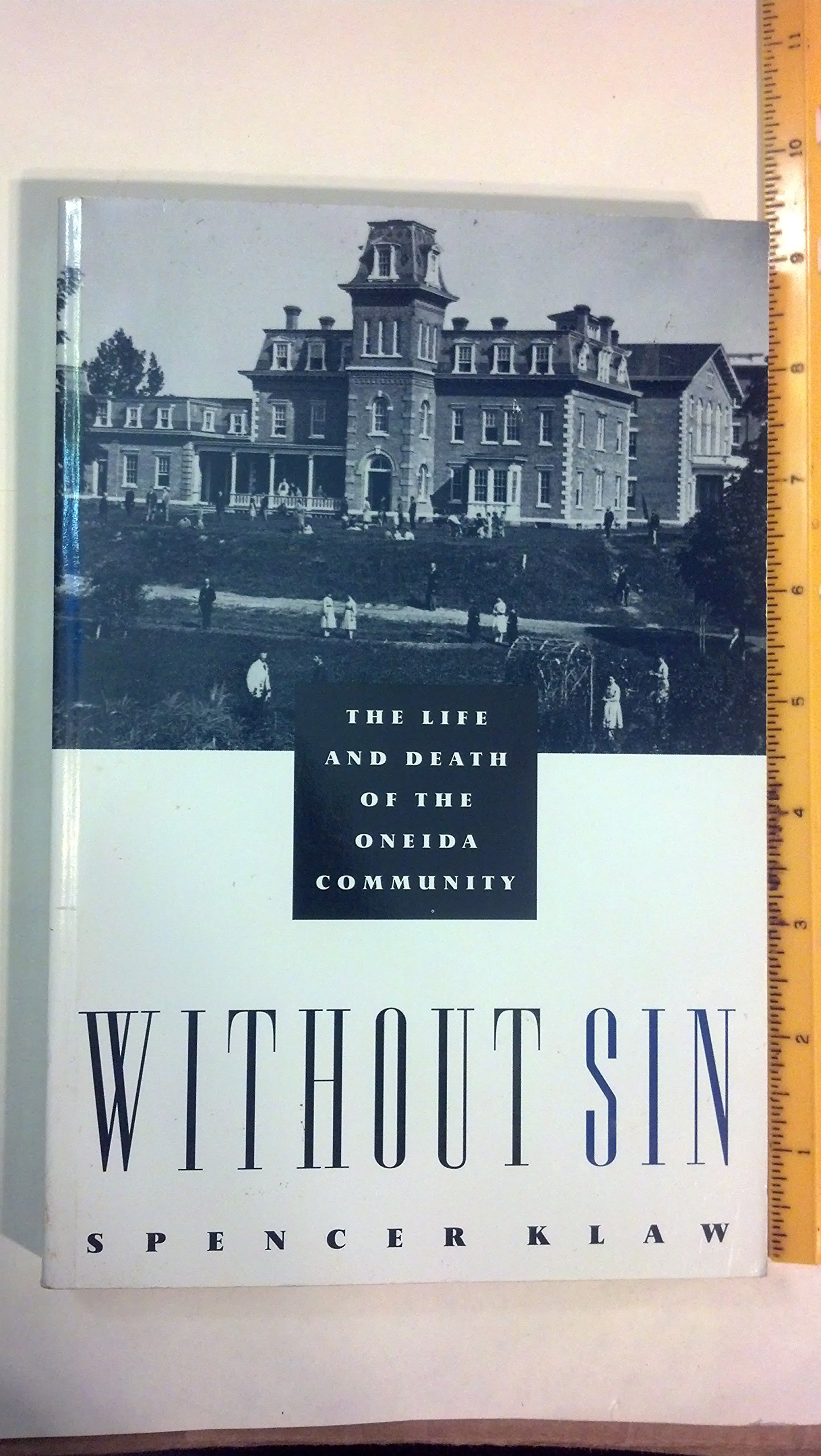



Spencer Klaw's Without Sin chronicles the rise and fall of nineteenth-century America's most successful experiment in Utopian living: the Oneida Community in upstate New York. Founded in 1848 by a small band of Christian Perfectionists under the leadership of John Humphrey Noyes, the Community flourished for more than thirty years. Before it was finally destroyed by a fierce internal dispute - as well as external attacks by a legion of self-appointed "guardians of public morals" - Oneida could boast some three hundred practicing members who, following the tenets of Noyes's "Bible Communism," collectively owned and operated a number of profitable factories and mills and drew thousands of curious visitors to see how they lived. Perhaps the most distinctive aspect of life at Oneida was the highly unorthodox sexual regimen prescribed by its founder, who believed that in a community of true Christians, God did not intend love between men and women to be confined to the narrow channels of conventional matrimony. In the Oneidan system of "complex marriage," every woman in the Community was considered to be married to every man, resulting in a virtually constant exchange of sexual partners. Oneidan men were required to practice a special technique of birth control, freeing the women from the burden of bearing unwanted children. Child-rearing, like most work at Oneida, was shared by the Community's men and women. According to Noyes's view, work, like sex, was intended to be joyous: Oneidans were encouraged to change jobs often to prevent boredom, and whenever possible hard and monotonous work was transformed into a game or social occasion. Working for more than a decade from the letters and diaries - many previously unpublished - of Oneida's own members, Spencer Klaw has rescued a largely forgotten chapter in American history, reminding us of one of the most successful attempts ever made to build a society in which men and women could live together harmoniously sharing with absolute equality the fruits of their common labor. As one of the children born and raised at Oneida would write years after the Community had disappeared, "I have the faith to believe that here a great example of unselfishness was set for the world for all time, and that the future will find that out." Disturbing tale of a 19th-century utopian community. Klaw (The Great American Medicine Show, 1975, etc.) wrote this with the cooperation of descendants of the Oneida Community, who granted him access to unpublished memoirs and letters. The result is a thorough if somewhat blinkered look at a daring experiment in social and biological engineering, a sort of Victorian brave new world. Oneida was the brainchild of John Humphrey Noyes, a preacher and writer who believed himself to be God's chosen instrument. Like other utopians, Noyes taught the perfectibility of the human being; more controversially, he also condemned monogamy in favor of sexual libertinism. After some false starts--including an arrest on morals charges--Noyes put his theories to the test in 1848 by establishing his own Eden in Oneida, New York. At first, the community flourished. Inventions poured out, including the stainless-steel cutlery still manufactured today; members enjoyed courses in languages and science, as well as equality in food, clothing, and shelter. But too often Noyes's activities seemed a forerunner of China's cultural revolution. Romantic love and celibacy were banned; at 13 or 14, girls lost their virginity, usually to Noyes himself in sessions known as ``interviews.'' Privacy was nonexistent, and members were subjected to scathing public criticism of their every fault. Noyes ruled as absolute dictator, wielding power by manipulating sexual privileges. His social experiments reached their nadir with ``stirpiculture,'' an attempt to produce superior human beings (with Noyes blood involved, if possible) through breeding experiments. Predictably, the community's idealism faded rapidly, and, by the 1880's, Oneida was more or less defunct. Effectively told, although Klaw is too busy praising Oneida life for its liberalness to grasp the parallels to modern religious cults, including the Branch Davidians. (Eight pages of b&w photographs--not seen) -- Copyright ©1993, Kirkus Associates, LP. All rights reserved. Used Book in Good Condition