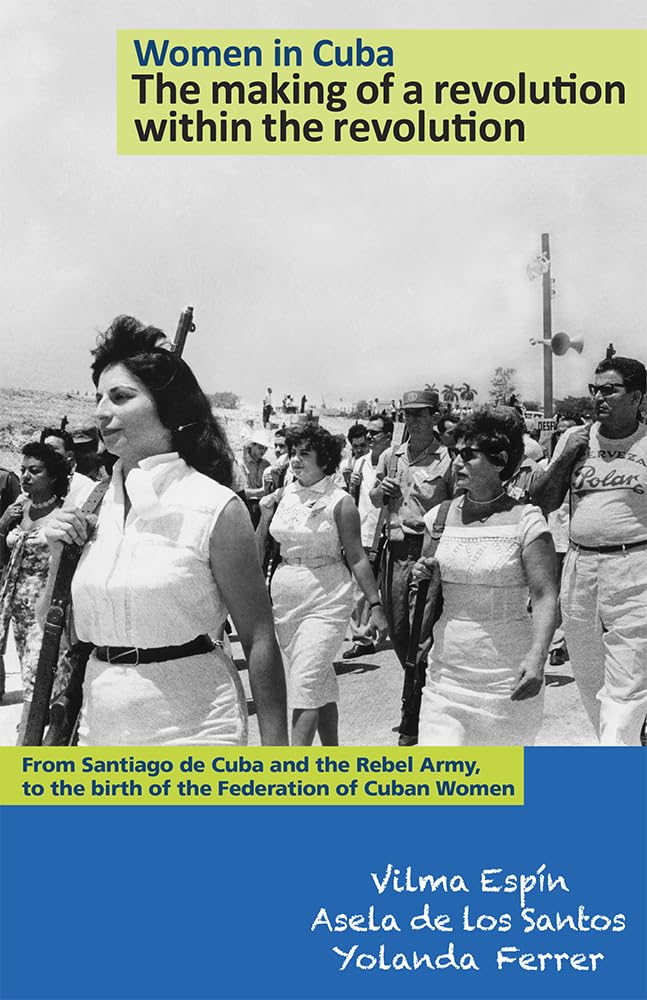
Women in Cuba: The making of a revolution within the revolution. From Santiago de Cuba and the Rebel Army, to the birth of the Federation of Cuban
$17.00
by Vilma Espín



The social revolution that in 1959 brought down the bloody Batista dictatorship began in the streets of cities like Santiago de Cuba and the Rebel Army's liberated mountain zones of eastern Cuba. The unprecedented integration of women in the ranks and leadership of this struggle was a true measure of the revolutionary course it has followed to this day. Here, in firsthand accounts by women who helped make it, is the story of that revolution—and "the revolution within." Also available in Spanish (ISBN: 9781604880373), Farsi (ISBN: 9789645783608), Greek (ISBN: 9786185130039). “What was achieved by and for women during and after the Cuban Revolution was nothing less than remarkable.…American readers of Women in Cuba are escorted to the “prohibited” land of Cuba without State Department permission or scrutiny. And thus they are given the freedom to arrive at conclusions of their own regarding the island nation and its women.” —Foreword Reviews “What was achieved by and for women during and after the Cuban Revolution was nothing less than remarkable.…American readers of Women in Cuba are escorted to the “prohibited” land of Cuba without State Department permission or scrutiny. And thus they are given the freedom to arrive at conclusions of their own regarding the island nation and its women.” —Foreword Reviews "Although women are the focus of the book, the underlying idea is the relationship between masses of workers and the revolutionary process, with women as an integral, cohesive part, not a special population." —Journal of Third World Studies "This well researched book would be of interest to anyone studying Cuban history, Latin American history, the history of the women's liberation movement on a global scale and anyone who enjoys reading about history. Recommended for all libraries and bookstores." —REFORMA "Details the way that Cuban women's lives changed in the 196s through the socialist revolution as millions were brought out of poverty, prostitution and patriarchal subordination." —Book News "Books like Women in Cuba ...are all part of opening the doors between our nations and provide the basis for free and respectful exchanges between the United States and Cuban feminists and social workers." —Affilia: Journal of Women and Social Work Vilma Espín (1930–2007) was a founding member of the Communist Party of Cuba and its Central Committee from its founding in 1965 until her death. She was a member of the party's Political Bureau from 1980 to 1991, a member of the Council of State from 1976, and the president and principal leader of the Federation of Cuban Women from its founding in August 1990 until her death. In 1955 Espín became one of the first members of the July 26 Movement. In February 1957, she took part in the first national leadership meeting of the July 26 Movement held in the Sierra Maestra mountains. In June 1958, she joined the Rebel Army’s Frank País Second Eastern Front, where combatants under Raúl Castro began to establish a civilian governmental structure. There Espín's responsibilities included serving as an instructor in the school training combatants as teachers. After the triumph on January 1, 1959, Espín led the efforts to launch the Federation of Cuban Women. She was director of the National Center on Sex Education, founded in 1989, and the National Commission for Attention to and Prevention of Social Problems, founded in 1986. Espín is a coauthor of Women in Cuba: The Making of a Revolution within the Revolution (2012). Asela de Los Santos (1929–2020) was a founding member of the Cuban Communist Party in 1965 and served on its Central Committee from 1975 to 1991. From 1960 she was a leader of the Federation of Cuban Women. From 1966 to 1970, she was director of education for the Revolutionary Armed Forces, holding the rank of captain. She was vice minister of education from 1974 to 1979 and minister from 1979 to 1981. De los Santos joined the July 26 Movement in 1955. In August 1958, she joined the Rebel Army and was placed in charge of the schools being organized in its Second Eastern Front. After the revolutionary victory of January 1, 1959, she accepted responsibility for education in all of Oriente province. She is a coauthor of Women in Cuba: The Making of a Revolution Within the Revolution (2012) and Women and Revolution: The Living Example of the Cuban Revolution (2013). Yolanda Ferrer (María Yolanda Ferrer Gómez) (1946– ) was general secretary of the Federation of Cuban Women (FMC) from 1990 to 2012. She has been a member of the Communist Party of Cuba since 1976 and served on its Central Committee from 1980 to 2016. She has been a deputy to the National Assembly of People’s Power since 1986. In 1960, at age fourteen, Ferrer joined the FMC. She was a founding member of the revolutionary militias and a participant in the 1961 national literacy campaign. She is a coauthor of Women in Cuba: The Making of a Revolution within the Revolu