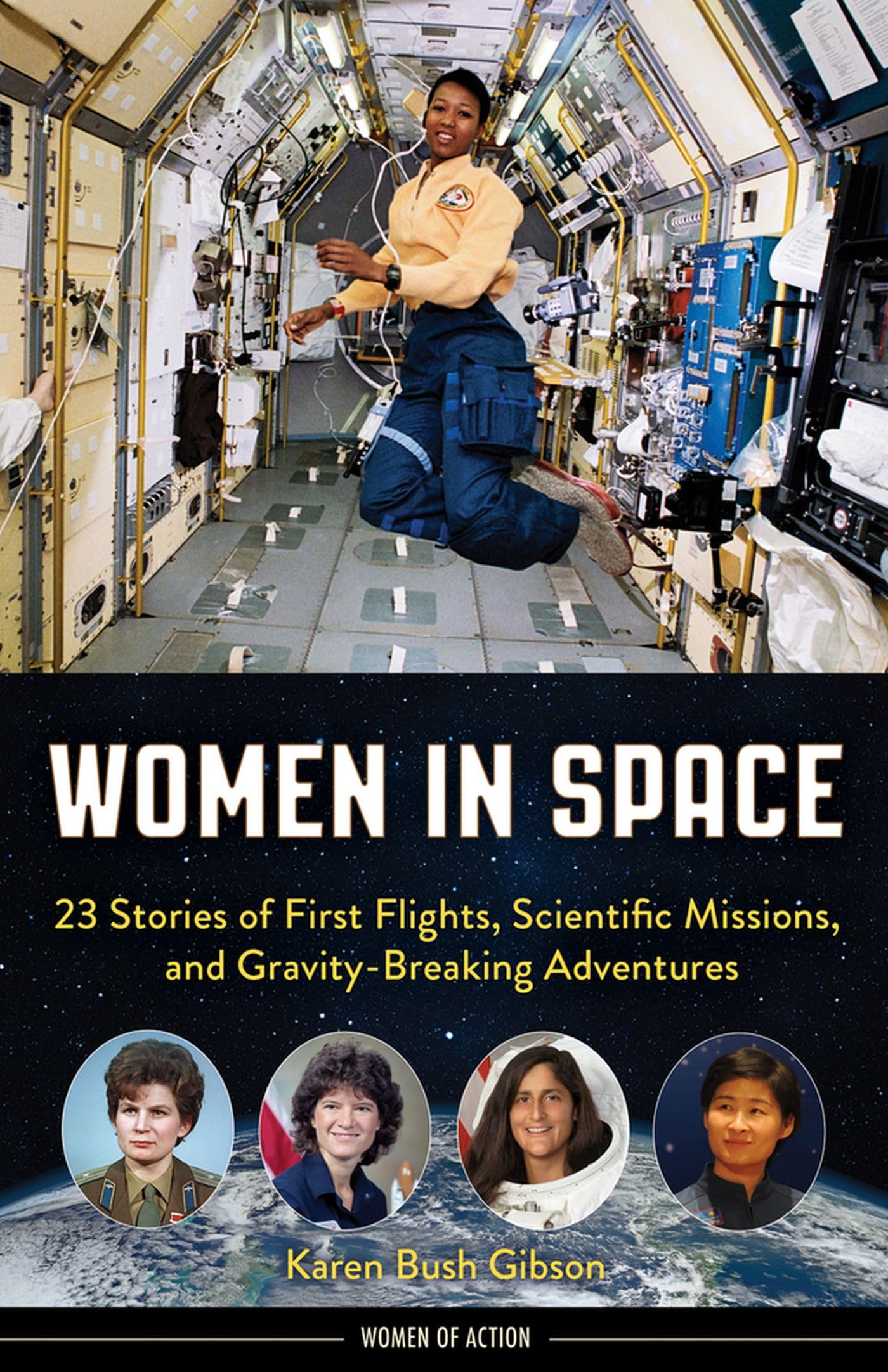
Women in Space: 23 Stories of First Flights, Scientific Missions, and Gravity-Breaking Adventures (7) (Women of Action)
$15.04
by Karen Bush Gibson



When Valentina Tereshkova blasted off aboard Vostok 6 on June 16, 1963, she became the first woman to rocket into space. It would be 19 years before another woman got a chance—cosmonaut Svetlana Savitskaya in 1982—followed by American astronaut Sally Ride a year later. By breaking the stratospheric ceiling, these women forged a path for many female astronauts, cosmonauts, and mission specialists to follow. Women in Space profiles 23 pioneers, including Eileen Collins, the first woman to command the space shuttle; Peggy Whitson, who logged more than a year in orbit aboard the International Space Station; and Mae Jemison, the first African American woman in space; as well as astronauts from Japan, Canada, Italy, South Korea, France, and more. Readers will also learn about the Mercury 13, American women selected by NASA in the late 1950s to train for spaceflight. Though they matched and sometimes surpassed their male counterparts in performance, they were ultimately denied the opportunity to head out to the launching pad. Their story, and the stories of the pilots, physicists, and doctors who followed them, demonstrate the vital role women have played in the quest for scientific understanding. Gr 7–10—In the space race between the Soviet Union and the United States, the first woman in space was the Soviet, Valentina Tereshkova, in 1963. America's first female astronaut, Sally Ride, went into space in 1983. This book details the stories of 19 others from across the globe who overcame obstacles of prejudice to fly in space. They include four Soviet women, Canadian astronaut Roberta Bondar, Japanese doctor Chiaki Mukai, French astronaut Claude Andre-Deshays Haignere, and Yi Soyeon, the first Korean in space. The story of the Mercury 13 is fascinating; 15 women were selected by NASA in the late 1950s. Successful pilots and scientists, they trained, as did the (male) crew of the Mercury 7, but then were not allowed to travel. Each chapter contains photographs and "Learn More" suggested readings. Sidebars are scattered throughout the book. This volume is a companion to the author's Women Aviators (Chicago Review, 2013) and an important addition to women's-history collections.—Patricia Ann Owens, formerly with Illinois Eastern Community Colls., Mt. Carmel Gibson follows up Women Aviators (2013) with a similar, international gallery of pioneering women who reached for the stars (or, in the notorious case of the Mercury 13, were deliberately prevented from doing so). As in the previous title, she incorporates thorough research and a strong feminist message into her accounts, covering her subjects’ specific accomplishments on earth and in space, while also surveying the general history of space flight and astronaut training with a special focus on the gender prejudice that had to be battled and (mostly) overcome. Along with the usual suspects, such as Sally Ride and Mae Jemison, there are many lesser-known women, from Svetlana Savitskaya (the second Russian woman in space) to Kalpana Chawla, who died aboard the space shuttle Columbia, and a number of other women from a variety of countries. This illuminating gathering of role models is also bolstered with sheaves of source notes and useful references to further resources. Grades 6-9. --John Peters “An informative and hopeful overview of underrecognized scientists and explorers in a male-dominated field.” — Publishers Weekly “Valuable… an informative introductory overview of the many important contributions women have made to space exploration.” — Kirkus Reviews "An important addition to women’s-history collections." — School Library Journal "[Gibson] incorporates thorough research and a strong feminist message into her accounts...This illuminating gathering of role models is also bolstered with sheaves of source notes and useful references to further resources." — Booklist "With a plethora of information, Women in Space will be an asset to any library and will be useful for those choosing to learn about unsung heroes by combining both biographical and historical information in one handy volume." — VOYA "Very highly recommended reading and will prove to be an enduringly popular addition to both school and community library collections." — The Midwest Book Review When Valentina Tereshkova blasted off aboard Vostok 6 on June 16, 1963, she became the first woman to rocket into space. It would be 19 years before another woman got a chance--cosmonaut Svetlana Savitskaya in 1982--followed by American astronaut Sally Ride a year later. By breaking the stratospheric ceiling, these women forged a path for many female astronauts, cosmonauts, and mission specialists to follow. Women in Space profiles 23 pioneers, including Eileen Collins, the first woman to command the space shuttle; Peggy Whitson, who logged more than a year in orbit aboard the International Space Station; and Mae Jemison, the first African American woman in space; as well as astro