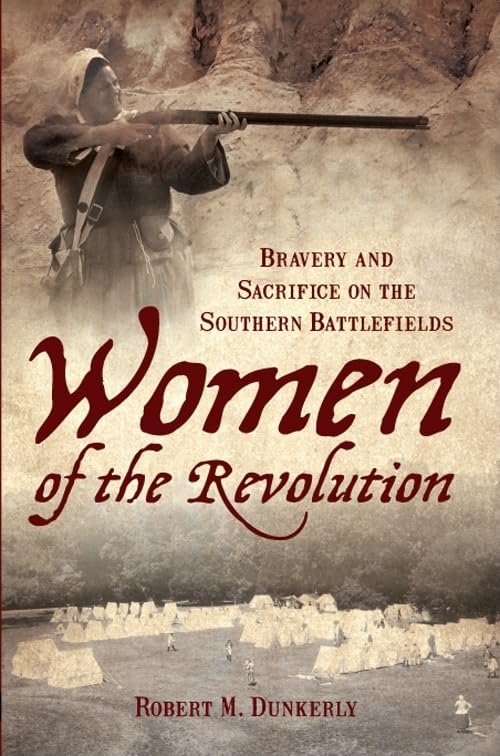
Women of the Revolution: Bravery and Sacrifice on the Southern Battlefields (American Heritage)
$21.99
by Robert M. Dunkerly



Discover the lasting legacy of Southern Women during the Revolutionary War whether they were on the sidelines or on the battlefield. Each of the Southern Revolutionary battlefields holds the history of soldiers and legends of women. From the wooded slopes of Kings Mountain to the fields of Cowpens, to the lesser-known sites like Fishing Creek and Hanging Rock, author Robert M. Dunkerly uncovers the stories and legends surrounding the women who were caught up in the struggle. This book serves not only as a study of the battles, but also as a chronicle of the experiences of women in the eighteenth century. Some were camp followers attached to the armies, while others were civilians caught in the line of fire. Women were present on nearly every battlefield, and their stories are told here for the first time. Robert M. Dunkerly is currently Chief Ranger of Moores Creek National Battlefield near Wilmington, NC. He holds a degree in History from St. Vincent College and a Masters in Historic Preservation from Middle Tennessee State University. He has worked at eight historic sites, and written several books and articles on the Revolution, Civil War, and historical commemoration. He is active in historic preservation, and has visited nearly 300 battlefields worldwide. Robert M. Dunkerly is an avid historian who has also published two previous titles with The History Press--Old Ninety Six and The Battle of Kings Mountain. Women of the Revolution Bravery and Sacrifice on the Southern Battlefields By Robert Dunkerly The History Press Copyright © 2007 Robert M. Dunkerly All rights reserved. ISBN: 978-1-59629-389-2 Contents Acknowledgements, Introduction, Part I. Setting Time and Place, The Values of the Eighteenth-century World, The Eighteenth-century Woman, Part II. Early Battles, Moores Creek, North Carolina, Savannah, Georgia, Part III. Spring and Summer 1780, Charleston, South Carolina, Brattonsville, South Carolina (Williamson's Plantation), Hanging Rock, South Carolina, Camden, South Carolina, Fishing Creek, South Carolina, Stallions, South Carolina, Part IV. Fall 1780, Kings Mountain, South Carolina, Part V. Winter 1780–81, Cowpens, South Carolina, Guilford Courthouse, North Carolina, Part VI. Spring and Summer 1781, Fort Motte, South Carolina, Ninety Six, South Carolina, Alston House, North Carolina (House in the Horseshoe), Eutaw Springs, South Carolina, Lindley's Mill, North Carolina, Southeastern North Carolina, Bacon's Bridge, South Carolina, Conclusion, Preserving the Past, Notes, Bibliography, About the Author, CHAPTER 1 Part I Setting Time and Place The Values of the Eighteenth-century World The scene was repeated time and time again on battlefields: as the smoke clears and the firing ceases, soldiers move out across a battlefield littered with dead and wounded. Dismounted cannons, abandoned wagons, dead horses and the debris of battle: broken muskets, abandoned packs and overturned fences litter the area. Amid the exhausted soldiers, here and there, are women. They are part of the army, and they have experienced the battle as well. Before going into detail about the women and their battlefields, we must first understand them and their world. During the Revolution, large areas of Georgia and the Carolinas were divided in sentiment. The fighting that erupted here was brutal and bitter. While Continental and British units were active in the region, much of the fighting was done by rival American and Loyalist militias. Women were actively involved in this fighting, and in support roles: spying, making ammunition and working for the armies. Warfare, especially that which erupted across the Carolinas and Georgia, formed an environment where social norms broke down. Removed from the constraints of "normal" society, women were able to move into more nontraditional arenas. In an emergency situation, women were accepted in ways and in places that they may normally not have been. Yet while gender roles may have blurred, they did not break. Gender roles were clearly defined in this society that placed an emphasis on standing and class. The traditional female realm was "housekeeping," as the term they used, meaning child care, food preparation and making clothing, as well as tending crops, running the store, raising the animals and whatever other chores existed. When a woman moved outside of this sphere, both women and men generally considered it a temporary situation. Her normal realm was domestic space. Misconceptions surround the legal rights of women in colonial America. Single women or widows enjoyed many privileges such as making contracts, bringing lawsuits and managing estates. Many a widow ran her husband's business or farm as an independent businessperson. A female who married, however, immediately found her rights superseded by those of her husband. These women lost their legal voice, as once joined to a husband, the woman's independent st