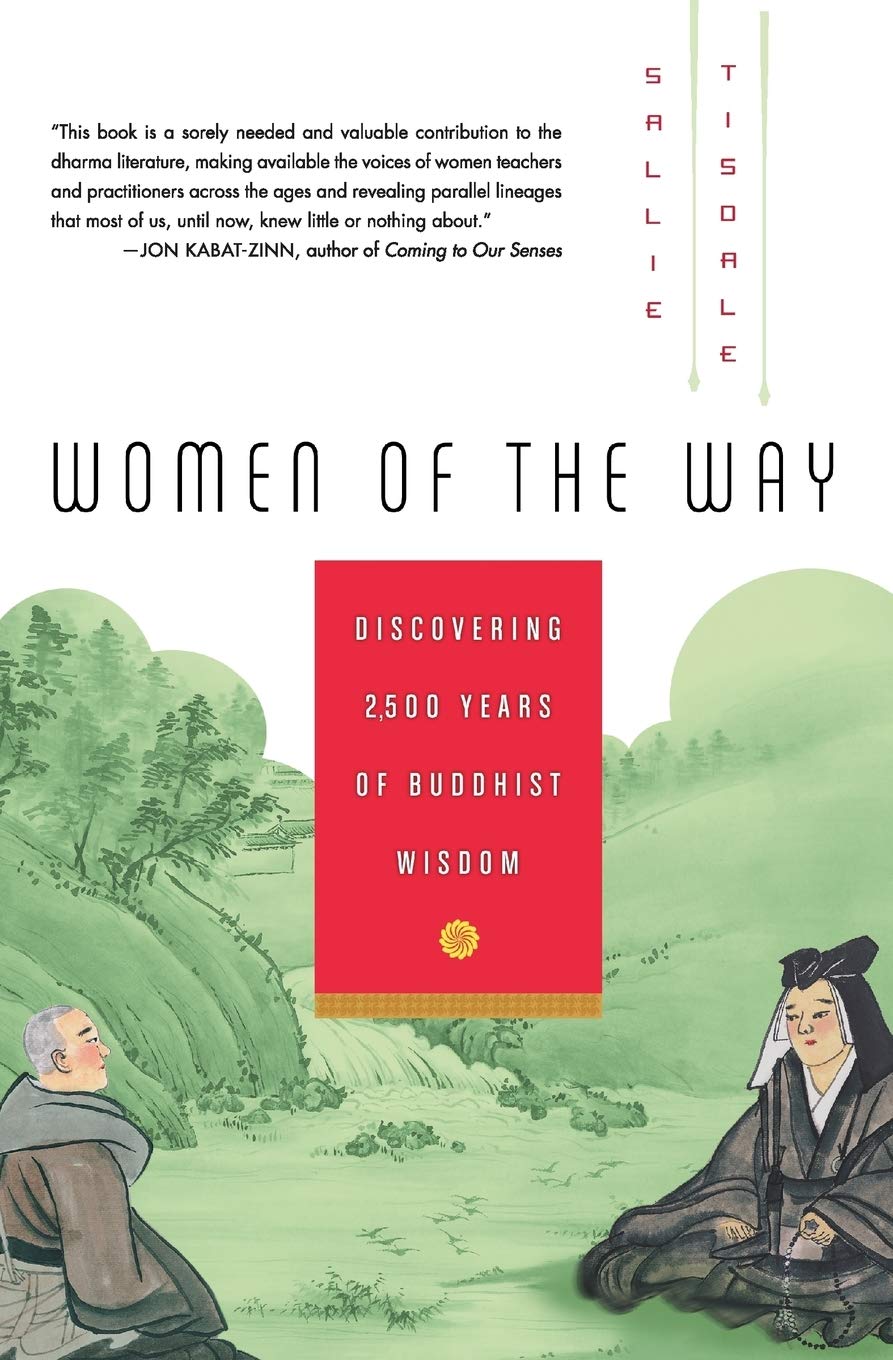
Women of the Way: Discovering 2,500 Years of Buddhist Wisdom – A Groundbreaking Work Bringing Narratives of Ancestral Teachers to Life Through
$11.99
by Sallie Tisdale



In this groundbreaking work, Sallie Tisdale traces women Buddhist masters and teachers across continents and centuries, drawing upon historical, cultural, and Buddhist records to bring to life these narratives of ancestral Buddhist women. “Scholarly, warm, and magnetically well-written, this capacious collection of Buddhist women’s stories extends our understanding of the dharma in essential ways. It is an enlivening and indispensable volume.” - Jane Hirshfield, author of Women in Praise of the Sacred “An enlivening and indispensable volume.” - Jane Hirshfield, author of Women in Praise of the Sacred: 43 Centuries of Spiritual Poetry by Women “Tisdale’s descriptive writing is especially imaginative.” - Publishers Weekly “[A] beautifully crafted volume. The universal wisdom and enlightened thinking preserved in this collection transcend gender.” - Booklist “A much-needed account of feminine teachers and leaders in Buddhism.” - Kansas City Star “A well-written, deeply moving collection of stories…. Fanciful and eminently readable.” - Buddhadharma “With her frank and thoughtful writing style, Tisdale takes the reader on a philosophical adventure….” - East West Woman In this groundbreaking work, Sallie Tisdale traces women Buddhist masters and teachers across continents and centuries, drawing upon historical, cultural, and Buddhist records to bring to life these narratives of ancestral Buddhist women. Sallie Tisdale is the author of several books, including The Best Thing I Ever Tasted and Talk Dirty to Me . She is a consulting editor at Tricycle . Her work has appeared in numerous publications, including Harper 's, the New Yorker, New Republic, Allure, Outside, Vogue, Tin House, Antioch Review, and Creative Nonfiction . Tisdale is currently training as a priest at Dharma Rain Zen Center in Portland, Oregon. Women of the Way Discovering 2,500 Years of Buddhist Wisdom By Sallie Tisdale HarperCollins Publishers, Inc. Copyright © 2007 Sallie Tisdale All right reserved. ISBN: 9780061146596 Chapter One Mythical Ancestors The Buddhist canon in its entirety fills hundreds of volumes. Much of this is taken up by sutras, which traditionally means the words of a buddha, a fully enlightened being. Many of the sutras are short, simple stories or lectures, often called discourses, told by the historical buddha to his followers. They arose from an oral tradition and were used to expound and explain the teaching. Sutras are intended to invoke awe and faith as well as understanding, to comfort and instruct, to affirm and inspire. Buddhist belief includes the existence of uncountable buddhas in uncountable buddha realms, both before and after this particular world and its buddha, and some of the great sutras take place in this universe. An extraordinary ease with unbounded space and time marks many of these sutras, which may be the most blissful and miraculous of all religious literature. Sutras are marked by particular qualities, though within those qualities they vary a great deal. The language of the sutras is formal. Some are funny, and most are filled with deliberate (and sometimes mind-boggling) repetition. The central concern is always the nature of enlightenment itself. Most include lessons or lists, some are oral histories of debates and events, and some use archetypal and mythical imagery, including the kind of everyday miracles common to religious myth. Certain characters appear again and again, fulfilling particular roles. Sariputra is often presented as a dull fellow who needs to be instructed repeatedly in order to understand the teaching. Mañjusri represents wisdom. Ananda sometimes speaks for the Buddha, in his role as living memory. The blurred boundaries of concrete reality and the world of the formless fill and define the great Mahayana sutras, which describe a universe of flexible time and space. The Buddha easily appears in multiple worlds, in many places and times, sometimes in many worlds at once. He walks in the air, levitates his audience, builds temples in the sky, or transforms the environment in order to make a point. Flowers rain from the heavens; music fills the world. There is little or no barrier between the human world and the worlds occupied by other beings, such as dragons, demons, gods, and bodhisattvas. The characters in sutras move readily from form to form, life to life, world to world, appearing in each other's places and times effortlessly. Their names evoke great qualities -- Energetic Power, Lion's Foot, Diamond Matrix, Forest of Virtues. Prophecies are made, predictions fulfilled, and the merit of many lifetimes comes to fruit. In such a malleable literature, Maya, whose story is told in several places, including the very long Avatamsaka Sutra , is able to die in the human world and later appear elsewhere, in the world of the gods. (The Avatamsaka Sutra is so long and repetitious that its main stories are collected in a separate appended chapt