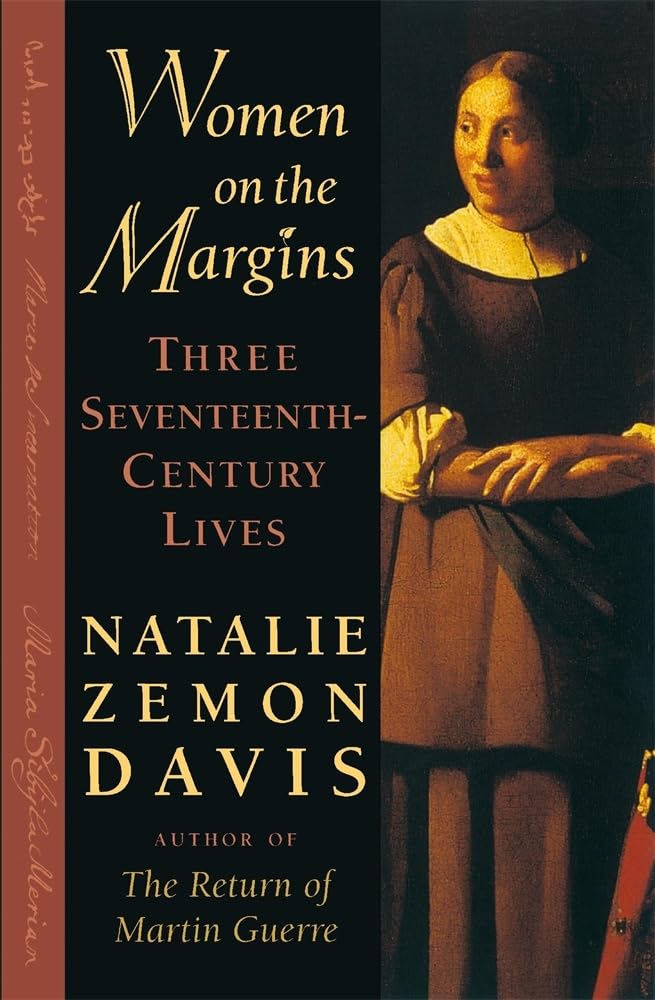



As she did in The Return of Martin Guerre , Natalie Zemon Davis here retrieves individual lives from historical obscurity to give us a window onto the early modern world. As women living in the seventeenth century, Glikl bas Judah Leib, Marie de l’Incarnation, and Maria Sibylla Merian, equally remarkable though very different, were not queens or noblewomen, their every move publicly noted. Rather, they were living “on the margins” in seventeenth-century Europe, North America, and South America. Yet these women―one Jewish, one Catholic, one Protestant―left behind memoirs and writings that make for a spellbinding tale and that, in Davis’ deft narrative, tell us more about the life of early modern Europe than many an official history. All these women were originally city folk. Glikl bas Judah Leib was a merchant of Hamburg and Metz whose Yiddish autobiography blends folktales with anecdotes about her two marriages, her twelve children, and her business. Marie de l’Incarnation, widowed young, became a mystic visionary among the Ursuline sisters and cofounder of the first Christian school for Amerindian women in North America. Her letters are a rich source of information about the Huron, Algonquin, Montagnais, and Iroquois peoples of Quebec. Maria Sibylla Merian, a German painter and naturalist, produced an innovative work on tropical insects based on lore she gathered from the Carib, Arawak, and African women of Suriname. Along the way she abandoned her husband to join a radical Protestant sect in the Netherlands. Drawing on Glikl’s memoirs, Marie’s autobiography and correspondence, and Maria’s writings on entomology and botany, Davis brings these women to vibrant life. She reconstructs the divergent paths their stories took, and at the same time shows us each amid the common challenges and influences of the time―childrearing, religion, an outpouring of vernacular literature―and in relation to men. The resulting triptych suggests the range of experience, self-consciousness, and expression possible in seventeenth-century Europe and its outposts. It also shows how persons removed from the centers of power and learning ventured in novel directions, modifying in their own way Europe’s troubled and ambivalent relations with other “marginal” peoples. “Davis’s work has always reached beyond fashionable trends to communicate with a wider audience. Where feminist historians have often inveighed against writing women’s history in order to supply us with heroines, Davis gives us three rounded portraits of strong early modern women with whom we are certainly encouraged to identify, and whose dilemmas are not unlike our own. Where early modern historians insist on the ubiquity of patriarchy, Davis presents us with hard-working, bread-winning women, never submerged in motherhood and never obliterated as wives… All that Davis writes springs from careful, critical consideration of the mass of theoretical writing that has recently appeared on women’s writing and historical anthropology: none of it clutters her text… For Davis, the historian is a teller of stories. Her book can be read as a way of writing history which does not collar the reader with direct argument or interpretation, but which seeks instead to provoke the imagination. Davis begins with a fictitious dialogue between herself and the three women whose lives she has chronicled, an imaginative risk few scholars would care to take. This is the sort of book that lingers in the mind. In time, one realizes that what Natalie Zemon Davis has accomplished is a new way of thinking about the relations between the Old World and the New, between women and men, mothers and children; and a vast opening up of the territory of the historian.” ― Lyndal Roper , Times Literary Supplement “One of the most inspired historians of early modern France has pushed out the usual borders of female blazons by choosing three women who weren’t muses, mistresses or martyrs… Davis has chosen three personalities of singular gifts and appetite for self-transformation, and the strength of character to achieve it.” ― Marina Warner , The Independent on Sunday “A treasure. Davis has written a scholarly…and multilayered history… Her three subjects come alive.” ― Ruth Johnstone Wales , Christian Science Monitor “Davis’s finely wrought book works as a triptych; each life is closely observed, but thrown into relief by its relation to the others.” ― Ben Rogers , The Guardian “A marvelous book.” ― Lorna Sage , Los Angeles Times Book Review “[This] stylishly sketched seventeenth- and eighteenth-century biographical triptych is yet another exploration of how the modest in early modern Europe strove to fashion identities for themselves, but it is also more.” ― Arthur Quinn , New York Times Book Review “A splendid reconstruction of the particular worlds of three 17th-century women… [Natalie Zemon Davis] makes these lives shimmer… She also puts together a formidable history with the kind of sc