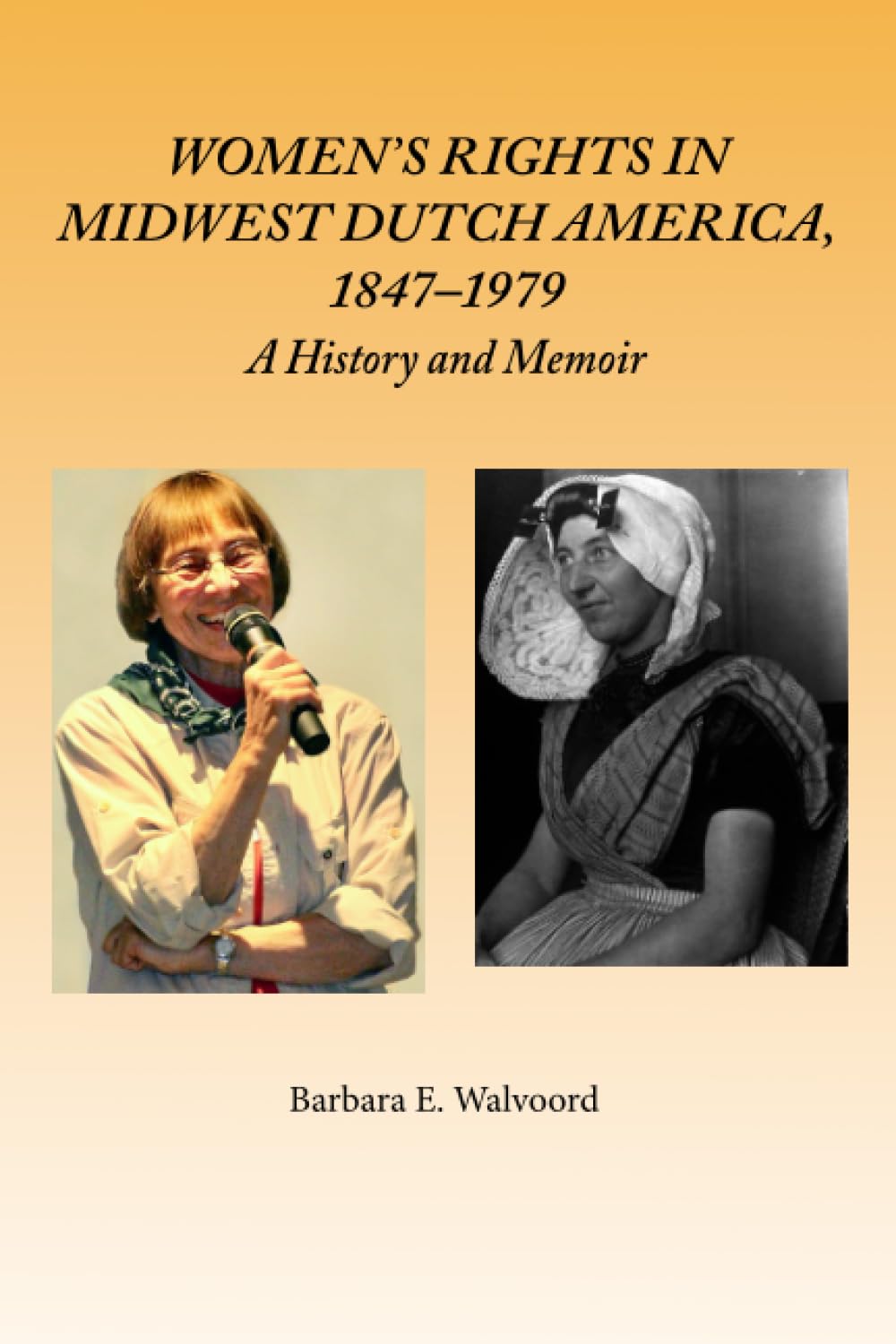
Women's Rights in Midwest Dutch America, 1847-1979: A History and Memoir
$24.95
by Barbara E. Walvoord



A profoundly personal story set within an historical context, enriched with the stories of other women’s lives, Walvoord’s history and memoir is a must-read for anyone interested in the history of women's rights; the history of Dutch-American towns, churches, and colleges; and the strategies women have used to gain a measure of power within a patriarchal culture. Walvoord’s personal struggle will resonate with anyone who has faced discrimination in trying to achieve a goal. As a participant and observer, with a nuanced understanding of the complexity of her subject, her voice is personal, poetic, analytic, informative, reflective, or wryly amused. She writes as a genuine person confiding her own struggles, a gifted writer and poet, a wise elder looking back on a long and rich life, and a scholar trained in research and cultural analysis. Memoir and history are seamlessly interwoven. She recounts her childhood as a “good girl” minister’s daughter in the Reformed Church in America, in Holland, Michigan in the 1950s. She seeks a direction for her life at Hope College, which presents both limitations and opportunities to women, 1959-1963. She struggles to earn her doctoral degree in the face of daunting gender discrimination. After what she terms her years of wandering in the wilderness, she becomes a faculty member and feminist activist at Central College in the Dutch immigrant town of Pella, Iowa during the height of the women’s movement, 1966-1979. She learns to overcome her own internalized conviction that a woman must follow her husband even at the expense of her own career aspirations; to integrate the roles of wife and mother with her professional development; to both appreciate and challenge Dutch-American culture; to address issues of race and sexual orientation; to find spiritual direction within the Calvinist religion of her community; to move from individual struggle to cooperative action; and to bring her feminist values to her divorce and remarriage. Enriching her story are the stories of other women—early Dutch settlers, the Indian women who lived among them, homesteading women, teachers, college deans, missionaries, farm women, artists, businesswomen, homemakers, heterosexual women, and lesbians With scholarly rigor and a deep understanding of the complexities of gender boundaries and bias, her study brings a much-needed focus on women’s roles to the scholarship on Midwest Dutch America. She identifies fourteen strategies that women in Dutch-American cultures have used to try to achieve a measure of power and freedom. She examines how her grandmother, a farm wife with a fifth-grade education, uses the strategies in South Holland, Illinois. Her mother uses the strategies to work for women’s rights in the Reformed Church in America. A valuable addition to the scholarship of higher education is the comparison of her mother’s experiences (1930-1934) and her own (1959-1963) as women students at Hope College. Walvoord recounts the history of women’s rights in Pella, Iowa, and Central College from their earliest days, through the temperance movement and the suffrage movement, which played out very differently in that Dutch-American culture. She details the strategies used to work for women’s rights there during her own days, 1966-1979, at the height of the feminist movement. In a time when women’s rights, religious freedom, higher education, the meaning of ethnicity, and the fate of rural America are at the forefront of national debate, it is critical to understand our own history. This memoir and history is a powerful testament to the strength and resilience of women in the face of adversity. It is a call to action for anyone who believes in true gender equality and who is interested in the history of the women’s rights movement, the fascinating changes in Dutch immigrant culture, or the compelling story of a woman’s journey.