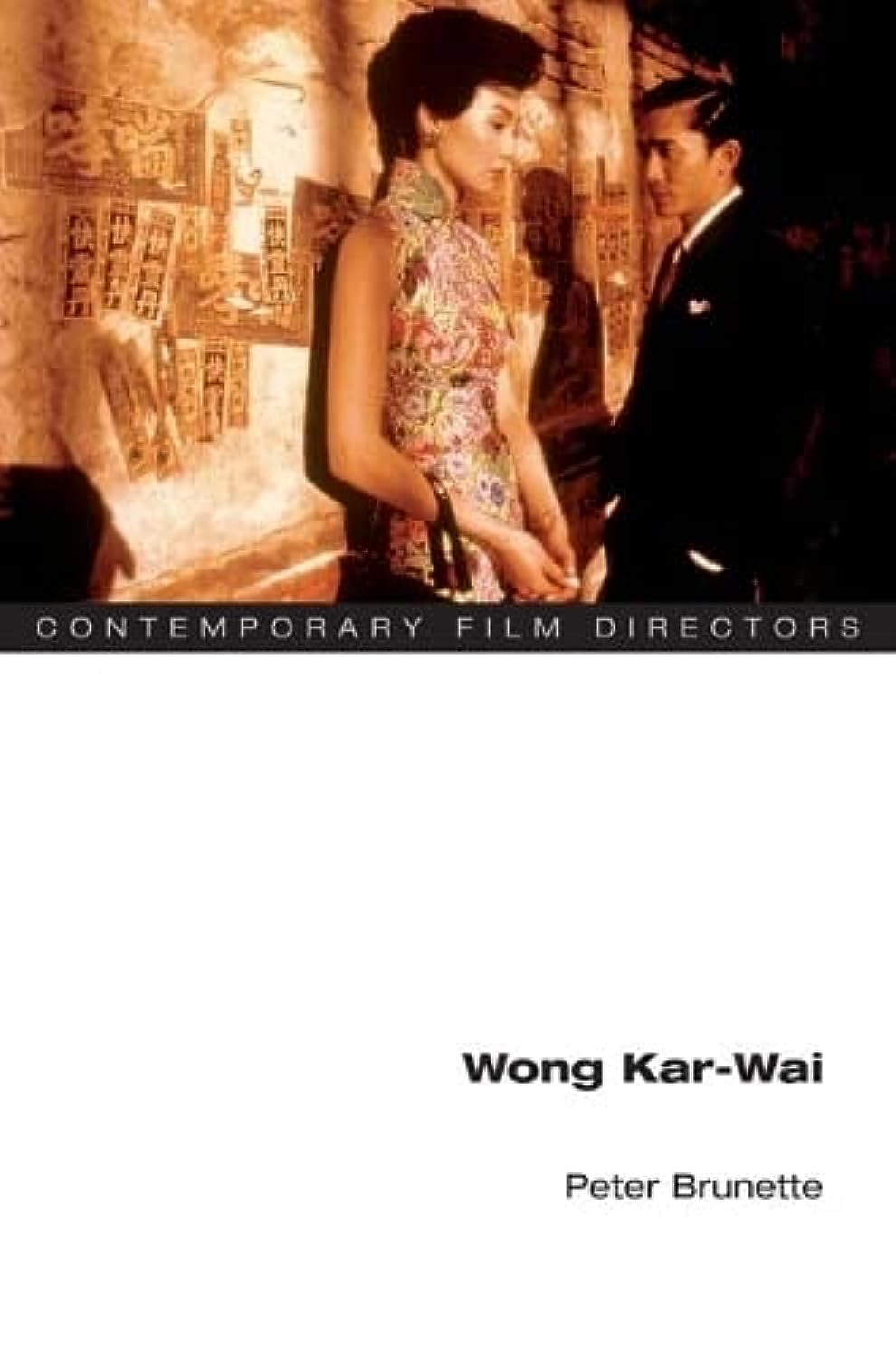



Called the leading heir to the great directors of post-WWII Europe and lavished with awards, Wong Kar-wai has redefined perceptions of Hong Kong's film industry. Wong's visual brilliance and emphasis on atmosphere over action have set him apart from peers while earning him an admiring international audience. In the Mood for Love regularly appears on lists of the twenty-first century's greatest films while critics and filmgoers recognize works like Chungking Express and Happy Together as modern classics. Peter Brunette describes the ways in which Wong's supremely haunting visual films create a new form of cinema by telling a story with stunning, suggestive visual images and audio tracks rather than character, dialogue, and plot. As he shows, Wong's early background in genre film offers fascinating insights on his more studied later works. He also delves into Wong's perennial themes of time, love, and loss and examines the political implications of his films, especially concerning the handover of former British colony Hong Kong to the People's Republic of China. “An insightful and encompassing look at an important director.”-- Film International "Brunette traces the love, longing, and regret on view in all of Wong's films, and he rightly emphasizes their 'graphic expressivity'—that is, the distinctive, visually kinetic approach that continues to be the director's hallmark as he matures."-- Booklist "Highly recommended."-- Choice "Film scholars and movie buffs alike will surely welcome [Brunette's] stimulating discussion."--Ruby Cheung Peter Brunette was the Reynolds Professor of Film Studies at Wake Forest University. He wrote books on Roberto Rossellini and Michelangelo Antonioni and was the coauthor of Screen/Play: Derrida and Film Theory. He was chief critic for indieWIRE.com and reviewed regularly for the British trade journal, Screen International. Wong Kar-Wai By Peter Brunette University of Illinois Press Copyright © 2005 Peter Brunette All right reserved. ISBN: 9780252072376 Chapter One Tears, Time, and Love: The Films of Wong Kar-wai As Tears Go By In 1988, when Wong Kar-wai directed his first film, As Tears Go By , he had already been working in the Hong Kong film industry for a number of years, principally as a scriptwriter. The project was initially given to Wong as a star vehicle for Andy Lau, a popular singer at the time (Carbon 36), initiating a pattern that has continued throughout the director's career. In an interview with the French journal Positif , whose critics were early supporters of Wong's films, the director explained that As Tears Go By was originally intended to be the second film in a trilogy: "The first part hasn't (yet) been filmed. The third is Final Victory , directed by Patrick Tam [and written by Wong], when the gangster is in his thirties and realizes that he hasn't been successful. In As Tears Go By , the second part, he's in his twenties. In the first part, which would have been called 'Hero for a Day,' he would be an adolescent" (Ciment, "Entretien" 40). Given the fact that the gangster hero dies at the end of As Tears Go By , however, the narrative logic of Wong's proposed trilogy is not entirely clear. In this putative middle film, Ah Wah (Andy Lau) is a young gangster who is torn between emotional commitments to his irresponsible friend, Fly (Jacky Cheung), and his cousin, Ah Ngor (Maggie Cheung), with whom he falls in love when she comes for a visit. After numerous confrontations with assorted bad guys that explosively punctuate the sparse narrative, Wah leaves the thug life to pursue the healthier and more fulfilling relationship that Ngor offers him. Inevitably, Fly pulls him back to Mongkok, an unsavory part of Kowloon, into the dangerously macho world of honor and betrayal that he is trying to escape. Fly is intent upon making a name for himself within triad circles by assassinating an informer held by the police, while Wah is just as intent on protecting his "little brother." At the end of the film, both tragically meet their deaths. Wong told another French critic that he had remarkable freedom in the making of As Tears Go By: "At the time, because of the success of John Woo's A Better Tomorrow (1986), gangster films were doing very well and, as a new director, I wanted to do one too, but different from what I had seen in Hong Kong. I wanted to do a film about young gangsters. And since I knew the producer very well, he gave me lots of freedom" (Reynaud, "Entretien" 37). This focus on young gangsters has led many critics to exaggerate the connection between Wong's first film and the American director Martin Scorsese's feature debut, Mean Streets (1973). Wong discussed this apparent linkage with Michel Ciment: "I think the Italians have lots of things in common with the Chinese: their values, their sense of friendship, their Mafia, their pasta, their mother. When I saw Mean Streets for the firs