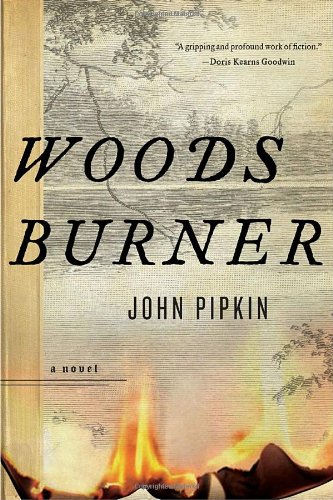



Woodsburner springs from a little-known event in the life of one of America’s most iconic figures, Henry David Thoreau. On April 30, 1844, a year before he built his cabin on Walden Pond, Thoreau accidentally started a forest fire that destroyed three hundred acres of the Concord woods—an event that altered the landscape of American thought in a single day. Against the background of Thoreau’s fire, Pipkin’s ambitious debut penetrates the mind of the young philosopher while also painting a panorama of the young nation at a formative moment. Pipkin’s Thoreau is a lost soul, plagued by indecision, resigned to a career designing pencils for his father’s factory while dreaming of better things. On the day of the fire, his path will intersect with three very different local citizens, each of whom also harbors a secret dream. Oddmund Hus, a lovable Norwegian farmhand, pines for the wife of his brutal employer. Elliott Calvert, a prosperous bookseller, is also a hilariously inept aspiring playwright. And Caleb Dowdy preaches fire and brimstone to his congregation through an opium haze. Each of their lives, like Thoreau’s, is changed forever by the fire. Like Geraldine Brooks’s March and Colm Tóibín’s The Master , Woodsburner illuminates America’s literary and cultural past with insight, wit, and deep affection for its unforgettable characters, as it brings to vivid life the complex man whose writings have inspired generations Best of the Month, May 2009: The early American tree-hugger and pioneering thinker Henry David Thoreau did a bad, bad thing back on April 30, 1844. A year before he settled into the “simple life” at Walden Pond, he struck a match to start a cooking fire in the dry woods around Concord, Massachusetts and accidentally ignited a forest fire that consumed 300 acres. The events of that chaotic day appear to have altered the course of Thoreau’s life and American history. More recently, this historical footnote sparked the creation of Woodsburner , a terrific debut novel from John Pipkin. Woodsburner offers a nuanced portrait of a young and less recognizable Thoreau, whose philosophy begins to materialize as the flames lay waste. The talented Pipkin simultaneously presents a vivid picture of mid-19th century New England on the cusp of unstoppable change through a cast of characters: a sadistic and misguided preacher, a desperate bookseller, and an isolated immigrant laborer harboring painful secrets. Their lives are forever changed by the fire which serves as a powerful metaphor for the destructive passions that consume us, as well as the eternal struggles between human society and the natural world. --Lauren Nemroff Amazon Exclusive: A Q&A with John Pipkin Question: How did the idea for Woodsburner come to you? John Pipkin: Although I have always admired Thoreau’s insights, many of which I think are still just as relevant today as they were 150 years ago, I really had no intention of ever writing a novel about Thoreau. In fact, I was working on an outline for an entirely different book in the fall of 2003 when I came across a brief line in the Harper’s Index: Estimated acres of forest Henry David Thoreau burned down in 1844 trying to cook fish he had caught for dinner: 300. The irony was striking: to think that one of America’s iconic environmentalists might have been driven—at least in part—by his remorse over having brought about the destruction of the very thing he so loved. Thoreau’s biographies mention the incident, but no one has explored the influence that this fire may have had on Thoreau’s naturalist philosophy. The forest fire takes place at a time in Thoreau’s life when his professional ambitions seem to have come to a standstill. By the age of 26, he had been unable to support himself by teaching, writing, and working as a handyman of sorts, and he had not yet built his famous cabin at Walden Pond. At the start of 1844, Thoreau was relatively unknown, but after the fire he finally begins the work for which he would be remembered. So I began to wonder if it were possible that an accidental forest fire had somehow helped change the landscape of American literary history. Question: Without giving too much away from the novel, can you tell us a little about how Thoreau accidentally started such a huge forest fire? John Pipkin: Well, it actually started with a simple act of carelessness, as I guess most forest fires do. On April 30, 1844, Thoreau went on a boating trip with a friend, Edward Sherman Hoar. After catching some fish, they decided to row ashore at Fair Haven Bay (a few miles south of the town of Concord) and build a fire to cook their fish into a chowder. There had been no rain for weeks, so the woods were exceptionally dry for springtime in New England, and, to make matters worse, the day was far too windy to build a fire safely. Thoreau proceeded to do so anyway, and as soon as he lit the kindling the wind blew the flames into the dry gra