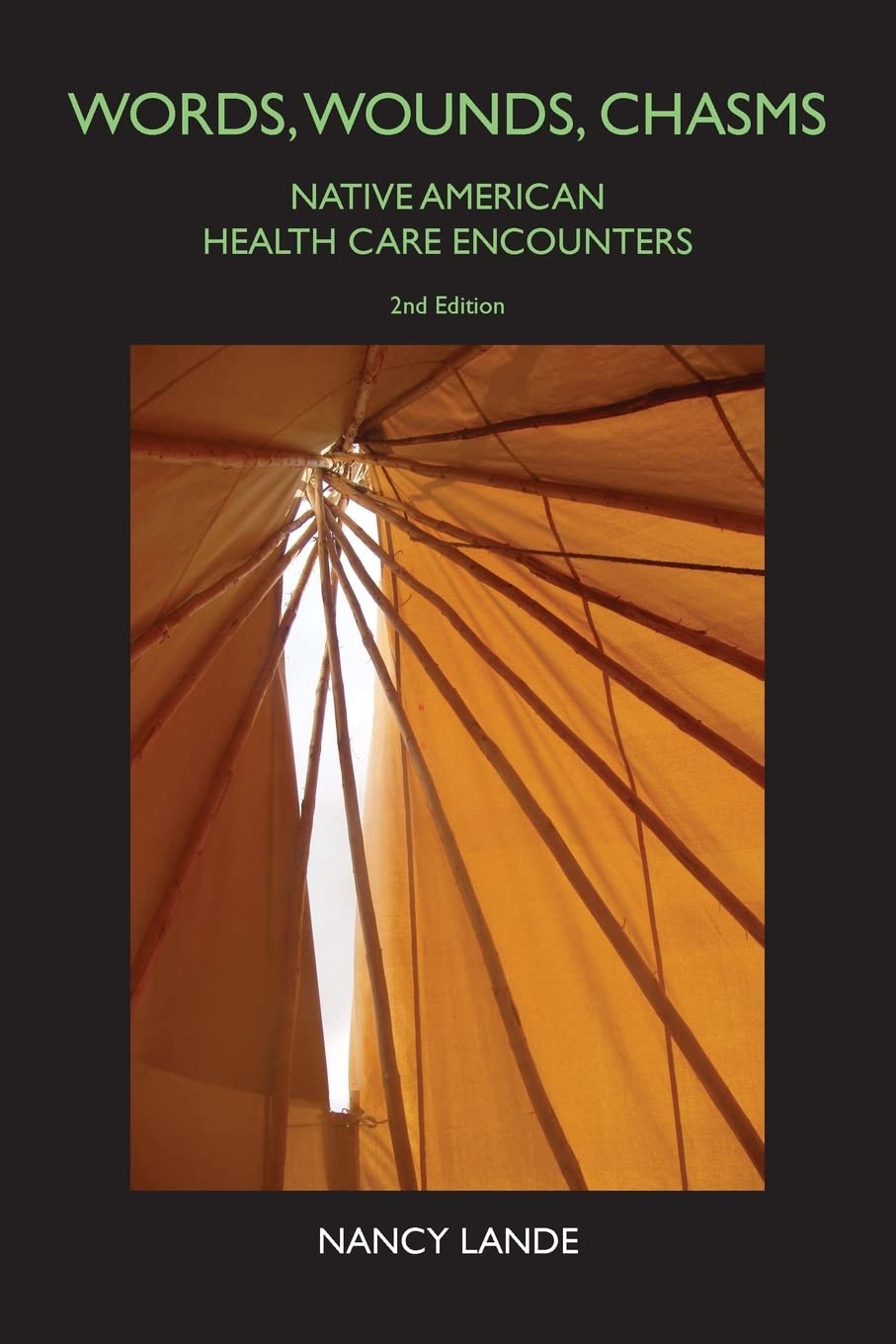



Nancy Lande highlights how powers of Western colonial privilege, social status, and use of Standard English often control communications in what can be life and death situations for Native Americans at health care facilities on Montana reservations. By exploring verbal and nonverbal sociolinguistic disparities and cultural differences through personal narratives, the objectifying discourse of Western biomedicine often devalues Native American patients. It is critical to note that even the best efforts of doctor-patient communications are most often ineffective in marginalized settings such as reservations. Health communications must be dramatically changed in order for cultural and linguistic divides to be more clearly defined and bridged, thus allowing for respectful and effective care. WORDS, WOUNDS, CHASMS sounds an alarm that current health communications often collide between doctors and Native American patients.This work is applicable to the general crisis that medicine is facing in its trials to communicate with patients of all cultures. “This groundbreaking book takes on an issue of great significance not only to those interested in intercultural communication in Native American relations with non-Indians, but also, and maybe more importantly, it tackles a problem that directly affects the health and well-being of Native Americans in their relationships with medical caregivers. It has practical as well as academic value, and offers insight and strategies for providers as well as thoughtful analysis for scholars engaged in research on linguistics and Native American Studies.”— Franke Wilmer, Ph.D., Professor of Political Science, Montana State University; former member Montana House of Representatives; Chair of the Montana Human Rights Commission. “In this timely, thoroughly researched and beautifully written book, Nancy Lande exposes the critical communication gaps that too often exist between Western-trained medical professionals and American Indians. Her powerful findings inspire a centering of reflexive communication and cultural fluency in all reservation-based health care practices. This book is highly recommended for scholars and practitioners alike.” — Leah Schmalzbauer, Ph.D., Associate Professor of Sociology, Anthropology, and American Studies, Amherst College. “The demographic research and narrated stories elicited by Nancy Lande focus on communicative frustrations that too many Native Americans and their health care providers experience in areas of cultural, social, economic, linguistic, health, and belief practices. Faulty verbal and nonverbal communications clash with the ability to effectively gain patient information, comprehension, and treatment. The issues explored in this book could not be more timely, since minority and Indigenous communities are actively standing against such structural and historic inequities” — Ruth Donegal Burleigh, (1952-2016, Cree) RN/BSN; M.A.; The Friends of the Sweet Grass Hills. “WORDS, WOUNDS, CHASMS is a major contribution to the scholarship about health care among Indigenous Peoples, not just in Montana, but globally. Well researched and well written, this text by Nancy Lande examines the nature of Native health care needs and contemporary health care practices. She contends, quite correctly, that effective communication between health care providers and patients is complex and becomes more so when cultural and socio-economic strata are included. Lande properly grounds her discussions on the importance of Indigenous Methodologies and the need for the ethical protocol for research with Indigenous communities. This work will be helpful to a wide audience in the health care fields but particularly valuable to those engaged in health disparity scholarship among Native peoples.” — Walter C. Fleming, (Kickapoo) Ph.D., Department Head and Professor of Native American Studies, Montana State University; past President of the National Indian Counselors’ Association; past Chair of Humanities Montana; and past Vice President of the Montana Chapter of the American Civil Liberties Association. “I am a physician who has been teaching leadership to other physicians (interns, residents, and especially chief residents) for over four decades. During that time, I have trained over 20,000 aspiring young physicians. The essential message has remained true throughout various courses and seminars. To maximize the effectiveness of interpersonal communication, everyone (deliverer as well as recipient) must aspire to better understand the source of the recipient’s reception of health communications. Creating an effective doctor-patient relationship alone is fraught with peril, but the addition of major cross cultural differences makes generating such effective relationships almost impossible. Nancy Lande’s work reveals some of the sources of these difficulties and, as such, is a significant contribution to that conversation.” — Robert A. Doughty, M.D., Ph.D.; Multi