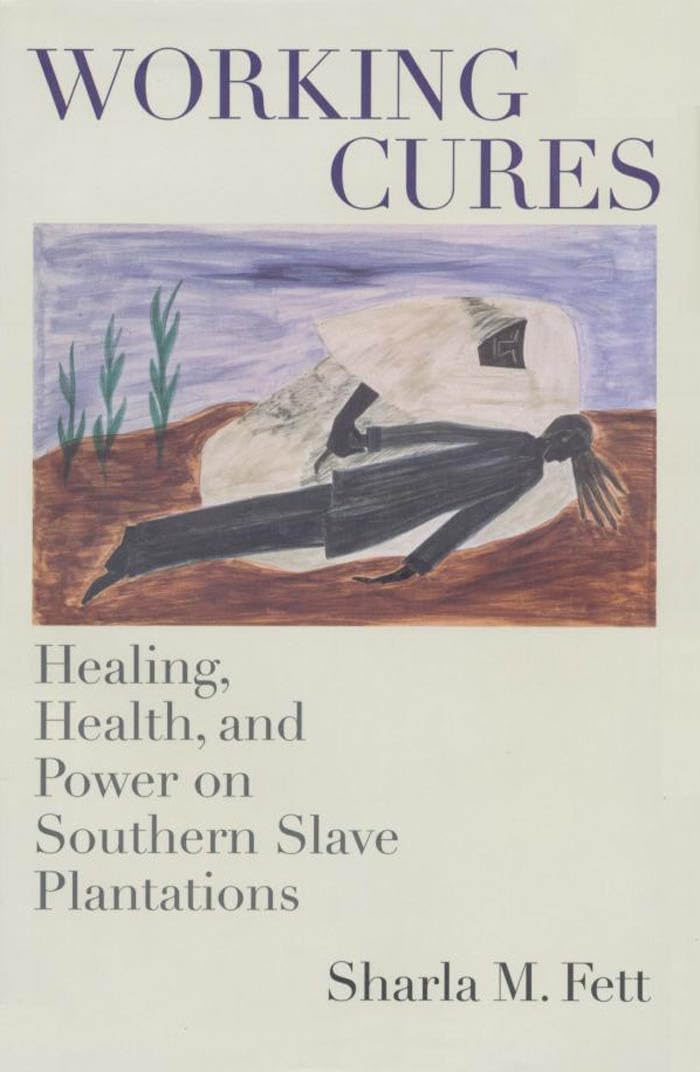
Working Cures: Healing, Health, and Power on Southern Slave Plantations (Gender and American Culture)
$38.37
by Sharla M. Fett



Exploring the charged topic of black health under slavery, Sharla Fett reveals how herbalism, conjuring, midwifery, and other African American healing practices became arts of resistance in the antebellum South. Fett shows how enslaved men and women drew on African precedents to develop a view of health and healing that was distinctly at odds with slaveholders' property concerns. While white slaveowners narrowly defined slave health in terms of “soundness” for labor, slaves embraced a relational view of health that was intimately tied to religion and community. African American healing practices thus not only restored the body but also provided a formidable weapon against white objectification of black health. Enslaved women played a particularly important role in plantation health culture: they made medicines, cared for the sick, and served as midwives in both black and white households. Their labor as health workers not only proved essential to plantation production but also gave them a basis of authority within enslaved communities. Not surprisingly, conflicts frequently arose between slave doctoring women and the whites who attempted to supervise their work, as did conflicts related to feigned illness, poisoning threats, and African-based religious practices. By examining the deeply contentious dynamics of plantation healing, Fett sheds new light on the broader power relations of antebellum American slavery. In this work, which is based on her 1995 Rutgers University dissertation, Fett assesses slave health and medical care in the U.S. South. She portrays slave society as a culture that developed its own healing methods while subject to abuse and racist theories from white medical practitioners. Slave healthcare was an amalgam of various African tribal traditions transmuted by their dispersal throughout the South. Important to these systems were such factors as kinship relations in the community and the role of slave women in healing practices. White medical care of slaves concentrated on their fitness for labor in the household or fields. Written in a lively and engaging style, this book is a unique overview of the complex interaction of white and slave medical care in the antebellum South. Fett, who is currently a visiting scholar at the University of California, Los Angeles, also provides an important background to African American health since the end of slavery. Recommended for academic and large public libraries. A.J. Wright, Univ. of Alabama Lib., Birmingham Copyright 2002 Reed Business Information, Inc. “ Working Cures reveals how African Americans developed a distinctive health culture that drew on a panoply of therapies, remedies, and botanical knowledge from African, European, and Native American sources. Their philosophies of health and healing, endowed with divine faith, bolstered their abilities to weather and challenge the social order. This is an excellent study sure to invigorate interest in the history of medicine in the antebellum South.”—Tera W. Hunter, Carnegie Mellon University “ Working Cures digs into an area of slave health untouched by previous historians. By skillful use of key fragments of primary source evidence and contemporary scholarship in fields like cultural and medical anthropology, sociology, and psychology, Fett draws a clearer picture of what health, disease, and doctoring meant to antebellum African Americans. She captures and explains the difference between the ways slaveholders and enslaved African Americans viewed health and healing.”—Todd L. Savitt, East Carolina University “ Working Cures digs into an area of slave health untouched by previous historians. By skillful use of key fragments of primary source evidence and contemporary scholarship in fields like cultural and medical anthropology, sociology, and psychology, Fett draws a clearer picture of what health, disease, and doctoring meant to antebellum African Americans. She captures and explains the difference between the ways slaveholders and enslaved African Americans viewed health and healing.”―Todd L. Savitt, East Carolina University Acts of healing, arts of resistance Sharla M. Fett is professor of history at Occidental College. Used Book in Good Condition