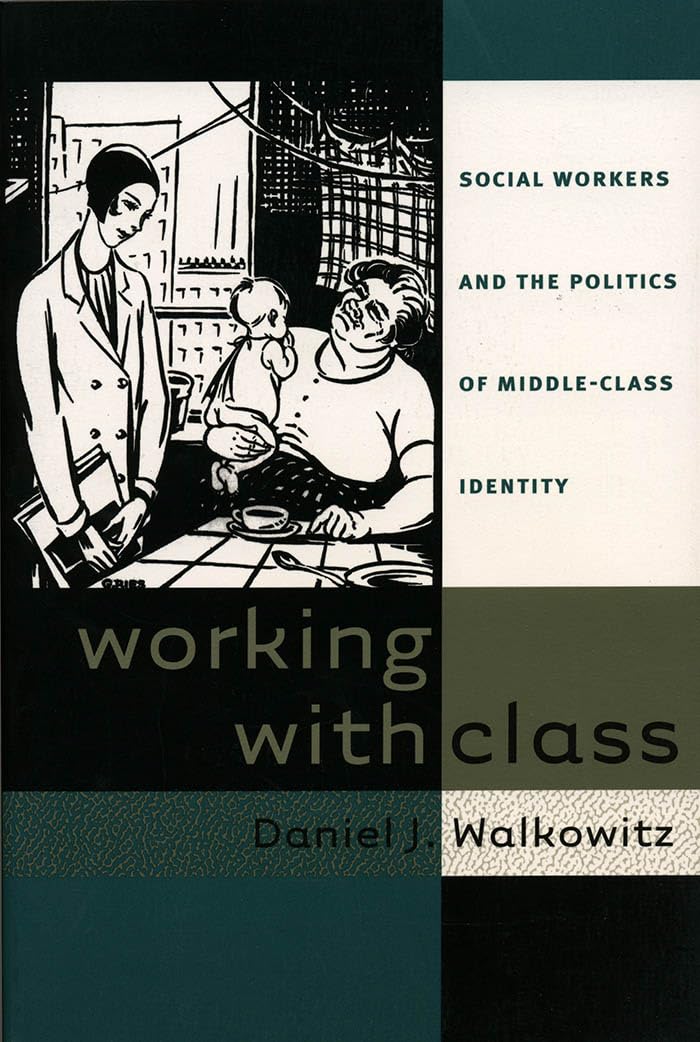
Working with Class: Social Workers and the Politics of Middle-Class Identity
$45.11
by Daniel J. Walkowitz



Polls tell us that most Americans — whether they earn $20,000 or $200,000 a year — think of themselves as middle class. As this phenomenon suggests, “middle class” is a category whose definition is not necessarily self-evident. In this book, historian Daniel Walkowitz approaches the question of what it means to be middle class from an innovative angle. Focusing on the history of social workers — who daily patrol the boundaries of class — he examines the changed and contested meaning of the term over the last one hundred years. Walkowitz uses the study of social workers to explore the interplay of race, ethnicity, and gender with class. He examines the trade union movement within the mostly female field of social work and looks at how a paradigmatic conflict between blacks and Jews in New York City during the 1960s shaped late-twentieth-century social policy concerning work, opportunity, and entitlements. In all, this is a story about the ways race and gender divisions in American society have underlain the confusion about the identity and role of the middle class. “[This] book should become one of the touchstone monographs on American social work.” — American Historical Review “This is an excellent history of the rise of radicalism . . . [and] an important contribution to the historical literature on the fate of radicalism in American society.” — Richard A. Cloward, New Labor Forum “This remarkable volume assays more vital subjects and touches upon more contentious issues than any one monograph or author could treat comprehensively.” — Journal of American History “Walkowitz is both a gifted and a sophisticated historian, and the bulk of the book contains case studies that illustrate the changing ways in which social workers organized to protect their professional and middle-class identities. In creating these case studies, Walkowitz writes with a special sensitivity to the ways in which race and gender influenced events.” — Labor History “An excellent history of the rise of radicalism, including red unions, among the staff in the Jewish federation of social agencies and among Jewish staff in New York City’s Department of Welfare during the 1930s, and of the repression that followed in the postwar years. It is an important contribution to the historical literature on the fate of radicalism in American society, if only in one place among one group.” — New Labor Forum “A trenchant critique of the trajectory of social work.”#Stanley Aronowitz ― The Nation### “ Working with Class is a highly textured, impressively researched, and sophisticated account of the transformations in social work and the identity of social workers over this century. But its real subject is the perpetual making, unmaking, and remaking of middle-class identity more broadly, one of the major conundrums of late-twentieth-century America and an analytical challenge that Walkowitz meets with great insight and grace.” — Lizabeth Cohen, Harvard University “Walkowitz addresses a problem of great complexity ― the definition and function of class in American life ― with appropriate attention to gender, race, ethnicity, and historical era. His strategy of focusing on social work as a case study will advance understanding of the nature of professionalism and the impact of public policy on social structure. His analysis will inform both basic scholarly research and issues of concern to lay citizens.” ― Clarke A. Chambers, University of Minnesota Walkowitz addresses a problem of great complexity--the definition and function of class in American life--with appropriate attention to gender, race, ethnicity, and historical era. His strategy of focusing on social work as a case study will advance understanding of the nature of professionalism and the impact of public policy on social structure. His analysis will inform both basic scholarly research and issues of concern to lay citizens.--Clarke A. Chambers, University of Minnesota How ethnicity and gender have complicated the meaning of “middle class” This study of social work and social workers illuminates the interplay of race, ethnicity, and gender in the formation of middle-class identity. This study of social work and social workers illuminates the interplay of race, ethnicity, and gender in the formation of middle-class identity. A labor historian and filmmaker, Daniel J. Walkowitz is director of the Metropolitan Studies Program and professor of history at New York University. Used Book in Good Condition