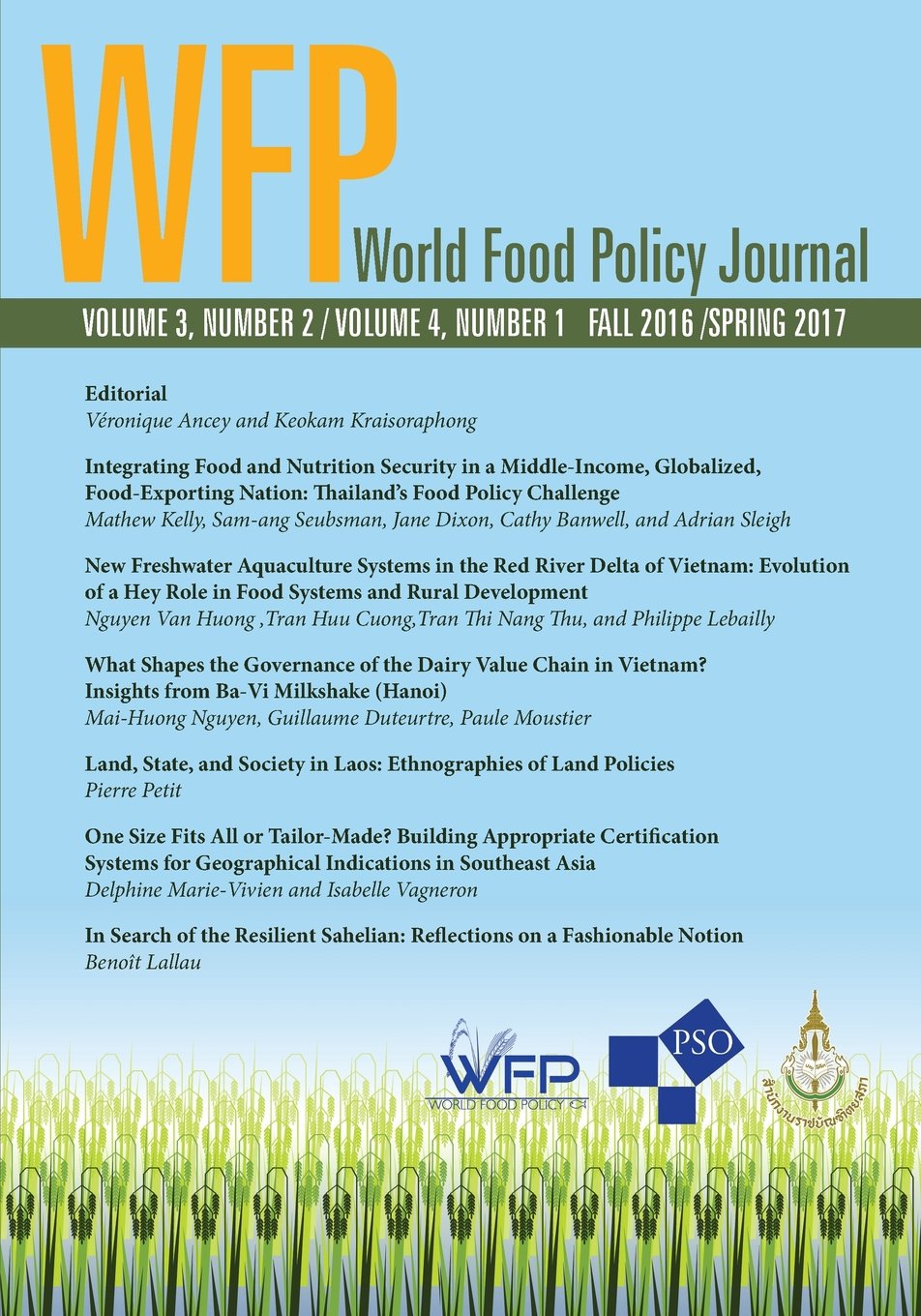
World Food Policy Journal: Vol. 3, No. 2 / Vol. 4, No. 1 • Fall 2016 / Spring 2017
$11.51
by Véronique Ancey



This World Food Policy issue brings to readers six research-based articles, which discuss food policy challenges in integrating food and nutrition security to food policy-related matters on aquaculture, dairy value chain, as well as land policies, geographical indications system, and the notion of resilience. Three articles provide perspectives on the tremendous changes both in food policy and in food systems: one article on the Thai enmeshment in the global food trade and its impacts on food and nutrition security for farmers and urban consumers, and two articles on Vietnam’s food system—that in a province of the Red River Delta affected by rapidly developing freshwater aquaculture, and the other on Ba-Vi district milkshed’s transition from state-owned concentrated production to smallholder farms. Two articles discuss food policy-related matters: one on the challenges in establishing an efficient yet appropriate system of geographical indications in four Southeast Asian countries: Thailand, Vietnam, Cambodia, and Laos—the other on land policy, with a case study on Laos where the state role as mediator has transformed the social fabric and reshaped people’s agency. The final article of this issue looks towards West Africa to explore the notion of resilience and discuss how policies may operationalize it under the Sahelian context.