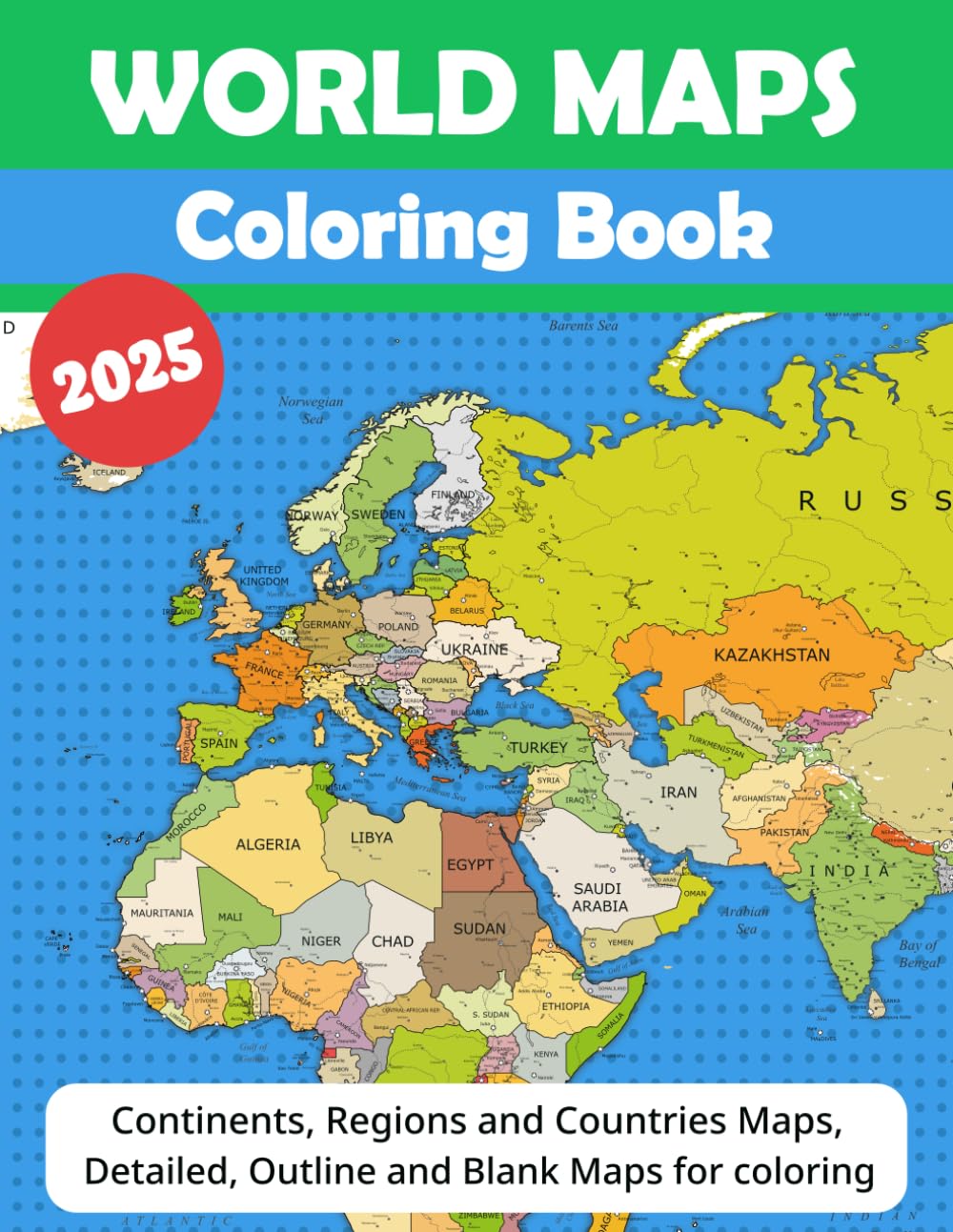



The World Maps Coloring Book is a valuable educational tool for anyone interested in learning world regional geography through coloring. Suitable for homeschooling and general learning, the book features detailed maps alongside blank and outline maps of various world regions. It encourages exploration by allowing users to color, trace map outlines, study continents, and highlight geographic features. Suitable for both children and adults, this book offers an engaging way to reinforce geographic knowledge. The book features over 52 geographical regions, each represented by three different versions of a map: a detailed version, a version showing only political borders, and a blank version. The detailed maps in the book provide a comprehensive view of each region. These maps include clearly labeled countries, major cities, capital cities, and map scale, as well as significant physical features such as rivers, lakes, and oceans. Additionally, each map is accompanied by useful information about the region, helping readers to understand the cultural, political, and geographical context. The second type of map focuses solely on political borders. These maps present the outlines of countries within a region, without internal details such as cities or physical features. They also include flags of selected countries from the region. The third version is a blank map, which serves as a practical tool for exercises. These maps contain only the outer shape of the region and the borders between countries, without any labels or additional information. Learners can use them to practice identifying and labeling countries, capitals, and geographical features. They also include flags of selected countries from the region. In addition to regional maps, the book includes pages with miniature maps dedicated to each country separately. The book also features globe maps—circular representations of different regions of Earth as seen from various angles. These maps offer a unique, three-dimensional perspective that helps learners visualize the planet’s curvature and the spatial relationships between continents and oceans.