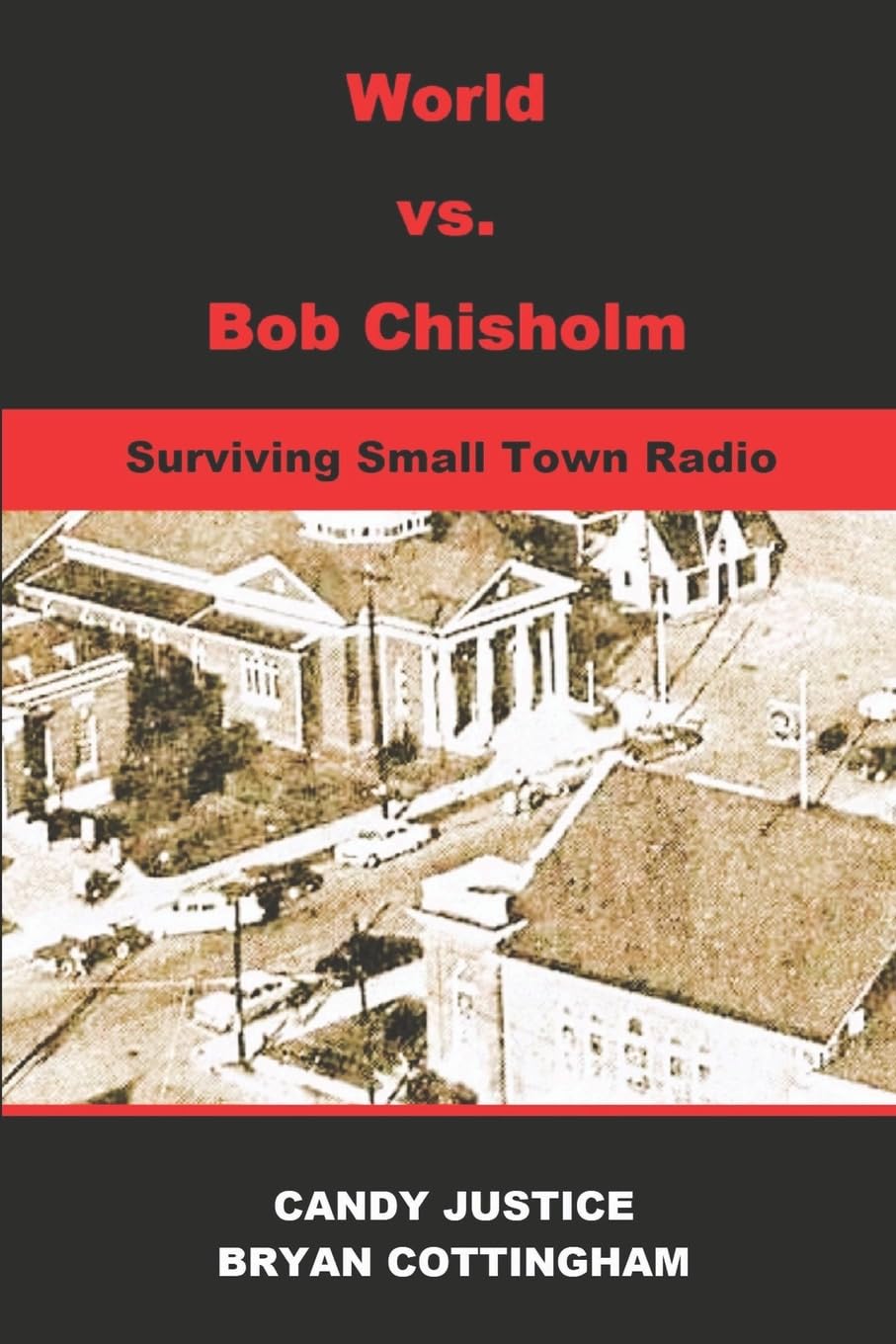



In the 1950s and 1960s, small-town AM radio was the life force of many Southern communities, energized by the birth of rock 'n' roll and the arrival of the civil rights movement. Therein lies a wonderful untold- until now -story about unheralded heroes who sacrificed everything to be a part of that life-changing experience. When 28-year-old Bob Chisholm relocated his wife, Carol, and daughter, Candy, to Winona, Mississippi (pop. 4282) in 1958, where he had a job as the manager/news director/announcer of that town's first radio station, WONA, he had no idea what was in store for him. Small town life in the 1950s and 1960s brings to mind people leaving their houses unlocked while they were away on vacation and everybody saying "yes ma'am" and "yes, sir" to their elders. Nearly everybody had a nickname and it was depicted as idyllic, especially if you were not Black or poor. Because there was a general friendliness between the races in small towns, it was easy for white people to convince themselves that racial discrimination did not exist. As Bob Chisholm would quickly learn, the 1950s and 1960s in Mississippi had a dark side. It was as if the state was a cross between "The Wild Wild West" and "The Twilight Zone," two popular TV shows of that era. Winona was a microcosm of small-town Mississippi. White women could vote, but it was not advertised by the state that they could and that deception continued until 1984 when Mississippi ratified the 19 th Amendment that had guaranteed women the right to vote since 1920. Of course, Black, Asian, Native American and Hispanic women were blocked from voting as were Black men until passage of the Civil Rights Act of 1965. Women of any color were not allowed to apply for credit, obtain credit cards, or serve on juries. In other words, Mississippi was a deeply authoritarian state that often used violence to perpetuate the status quo. You would think that Bob, being a white man, would have an easy go of it. But because he went on the air each morning and broadcast the news that he had collected about conflict of interest deals involving city and county officials, illegal actions committed by town and county law enforcement officials, and the latest civil rights news, he was severely beaten and his life was threatened on a regular basis. It wasn't that he editorialized about the news, he simply reported the facts for which he had reliable sources. Winona was one of several "ground zero" communities in Mississippi for the Civil Rights movement. It was in Winona that Civil Rights icon Fannie Lou Hamer was brutally beaten on the orders of local law enforcement authorities. And it was through Winona that Martin Luther King marched with music icon Joan Baez on his arm after the march's organizer James Meredith was shot and wounded on the highway shortly after leaving Memphis. Capturing all this history are co-authors Candy Chisholm Justice , Bob's daughter, and Bryan Cottingham , who worked as an announcer at WONA. They provide insider details of the good, the bad and the ugly of small-town life in the 1950s and 1960s with stories that strangely enough make sense of today's chaotic times when many Americans seem to want to return to the 1950s and live through that era of repression and violence against Blacks all over again. "World v. Bob Chisholm: Surviving Small Town Radio, is an intimate account of a courageous small town radio general manager who put his reputation and safety on the line to fight for the dignity and respect of each citizen, black and white/male and female, in Winona, Mississippi, in the late 1950s and into the 1970s. The story is told from the perspective of two people who knew Chisholm the best - his daughter Candy Justice and his protégé Bryan Cottingham. Chisholm's story is powerful, inspirational and emotional. It fills a major void in media history by demonstrating the power that one person and one radio station could have in fighting racism, discrimination and injustice." -Thomas J. Hrach, Professor of Journalism at The University of Memphis. "Sweet, funny, and poignant, this delightful memoir guides us on a warm-hearted trip back to small-town Mississippi and to a nearly forgotten era in the early days of radio in America. Cottingham and Justice show us a model of what real local news and community service once were-and sometimes still are. How inspiring to be reminded of journalism's most essential mission ."-Joe Hayden, Professor of Journalism, The University of Memphis. "Bryan Cottingham and I were born on the same day, 200 miles apart. At age 15 we both began working at small local stations. You will find this book informative. It reminds us of difficult times, but also of happy times when playing music on the air. A great read from two true professionals!" - Dave Brown, Chief Meteorologist Emeritus, WMC-TV Memphis TN. "Candy Justice and Bryan Cottingham have produced a gem. World vs. Bob Chisholm is a well-written na