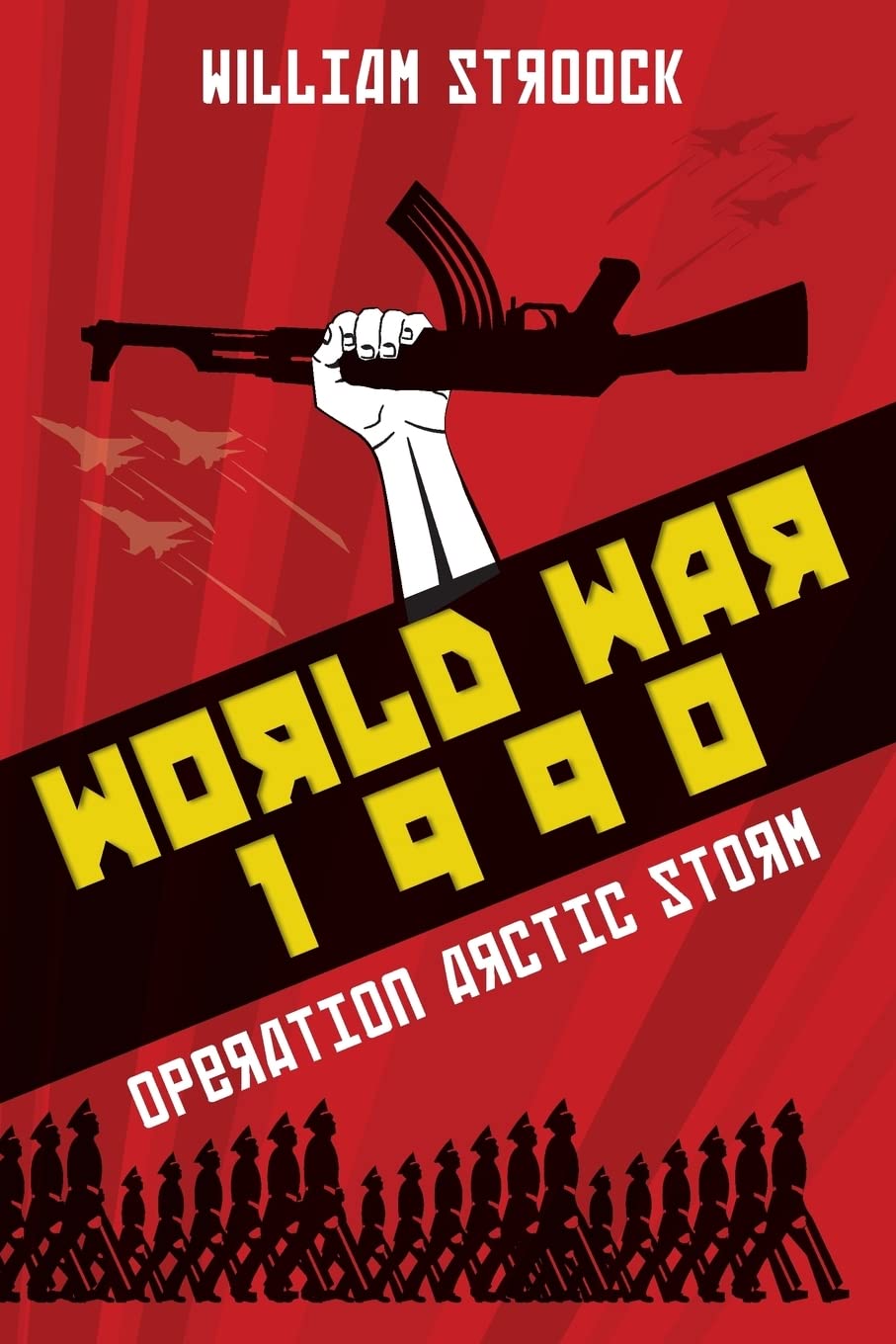



In a different 1990… The Soviet/Warsaw Pact offensive against NATO almost succeeded save for a last ditch defense by NATO forces in the epic Battle of the Weser River. But with the communist advance halted tough decisions lie ahead for NATO. Prime Minister Thatcher and Chancellor Kohl want to counterattack, while the Bush Administration worries about the effects of further war. As NATO deliberates, the United States and Royal Navies gather in the North Sea for a massive offensive against Soviet occupied Norway. In the Soviet Union the Politburo is split between the hawks and doves, and contemplates the unthinkable nuclear option. Its two minutes to midnight in Operation Arctic Storm. This novel is about the war that never happened, the Third World War, and it's the novel I have always wanted to write. Born in 1973, I was a child of the Cold War. The threat of nuclear war was always below the surface of daily life, a vague possibility a child might have wondered about when he went to bed, just as Roman children might have wondered about Hannibal or British children might have wondered about Napoleon. There were a few important novels about World War III, and many readers no doubt are familiar with them. The first is Tom Clancy's Red Storm Rising . Over 700 pages long, this dyslexic 14 year old read it in one dreary, February winter break. I was hooked. In the 1980s one could also read General Sir John Hackett's Third World War . While Clancy's was a spellbinding novel, a techno-thriller the genre came to be called, Hackett wrote his tale of World War III from the perspective of historians a few years after the conflict. Of course, by the time I was discovering the possibility of the Third World War, the actual Cold War was thawing out, and then Saddam Hussein stupidly invaded Kuwait. I was 17 years old, and because I played tabletop war games and had read a few Tom Clancy novels, I knew more about what was happening than journalists with advanced degrees and decades of experience, but no understanding of military affairs whatsoever. So in the summer of 1990, the United States military armed with the latest high tech weaponry, new doctrine, and a generation of leaders eager to use both in an epic battle of maneuver, was sent to the Middle East. In four days of war, the armed forces of the United States and her allies made mincemeat of the larger, battle tested Iraqi Army. Here were the high tech weapons built for Armageddon on the European battlefield; smart bombs, stealth fighters, M-1 tanks, cruise missiles used to deadly effect by remorseless killing technocrats like Dick Cheney and Colin Powell, and their battlefield commander 'Stormin' Norman' Schwarzkopf. The Iraqis never stood a chance. From there the best ever trained, motivated, equipped and led American military faded into history. A quarter century after the end of the Cold War the massive 28 Division United States Army and 600 ship U.S. Navy are gone, no longer necessary, really. Writing this book was like coming home again. In their World War III novels, General Hackett and Tom Clancy made informed guesses which were generally right. Hackett's book, written in 1978 was a warning to NATO and the west, then reeling from communist advances in the 1960s and 1970s. Frankly, NATO would have lost a war fought in the 1970s. By the time Tom Clancy published Red Storm Rising in 1986 that calculus had changed. The Untied States was deploying the latest weapons, of which the nearly invincible M-1 tank was the most important, and training under the doctrine of maneuver warfare known as AirLand Battle 2000. Clancy understood the technological edge NATO had acquired. Also, he had intensely studied the Soviet Armed Forces and was not impressed. In Red Storm Rising Clancy portrays a Soviet Army that was cumbersome, top-heavy and slow to adapt. Its only advantage lay in numbers. Clancy, I think, was right about the Soviet Army. Researching this book was both fun and interesting. In doing so I took two tracks. First, I read Cold War era books about the world militaries at the time. For the United States military I used the various non-fiction works of Tom Clancy, Submarine , Armored Cav , Carrier , and especially Into The Storm, which also gave me background on many of the personalities involved. Speaking of personality, Bob Woodward's The Commanders was a sensation at the time of its release in 1991 and indispensable to me. I am well aware of the weakness of Woodward's work and agree with most of his critics. It is all too easy for one to discern who Woodward's sources are as he rewards them in his books. However, many of the players in The Commanders came to the public eye again in the 2000s, and I think Woodward's sketches of these men stand the test of time. To anyone who was paying attention, George Bush the Elder came off as a wishy-washy wimp, an unfair characterization of a man who was shot down in the Pacific. Still, 1992 was my