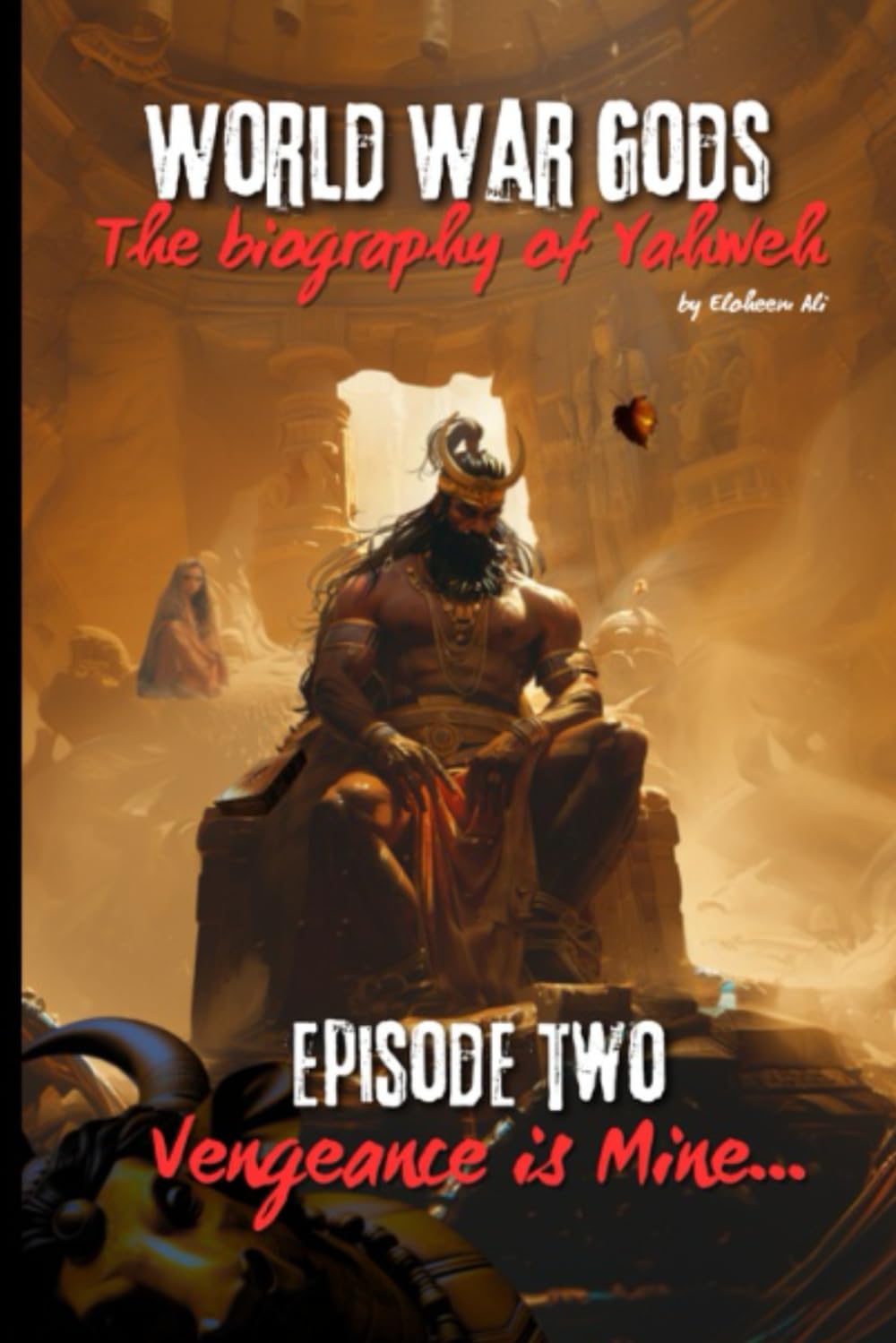
World War Gods: The Biography of Yahweh Episode 2: Vengeance is Mine (World War Gods Series)
$40.00
by Eloheem Ali



World War Gods: The Biography of Yahweh — Episode Two: Vengeance Is Mine is an ambitious work that deliberately occupies the boundary between academic inquiry and narrative fiction. Framed as both a dramatic epic and an abstract-historical investigation, the book advances a central thesis introduced in its opening “You Should Know” section: that gods, spirits, and abstract entities can be studied as real causal agents whose influence precedes and shapes physical history. Drawing from what the author terms the Philosophy of Order , the book establishes two foundational claims: first, that every phenomenon possesses a spirit understood as an essence or pattern of attributes; and second, that every spirit develops within a “matrix,” a formative structure analogous to a womb. These principles are not presented as theology in the conventional sense, but as a metaphysical framework that treats deities such as Yahweh, Hadad, Asherah, and others as abstract entities whose actions generate historical and cultural outcomes. This approach aligns more closely with Platonic realism and animist metaphysics than with modern doctrinal religion, inviting readers to reconsider how myths, mathematics, and history may reflect underlying abstract structures rather than mere symbolism Paperback World War Gods Ep 2 F… . The book is intentionally structured as edutainment. Its first section employs an extended narrative—rich in character, dialogue, and dramatic tension—to depict divine conflicts, political alliances, and moral crises among the gods. This narrative is not meant as escapist fantasy alone; it functions as a pedagogical device that translates abstract-historical claims into emotionally intelligible form. Readers encounter metaphysical arguments not through exposition alone, but through scenes of betrayal, sacrifice, vengeance, and governance, allowing complex ideas about power, justice, and causality to be absorbed intuitively as the story unfolds. What follows the narrative is a shift in mode rather than a departure in purpose. The text transitions into explicit abstract-history analysis, separating dramatization from factual and philosophical claims. This section clarifies which elements are narrative representations and which are evidence-based interpretations of ancient Near Eastern religious development. A concluding Q&A section then addresses anticipated objections—historical, philosophical, and theological—guiding readers through the implications of treating gods as real abstract agents without reducing them to metaphor or dismissing religious traditions as mere superstition. Importantly, the book positions itself as neither an attack on faith nor an endorsement of any single religious doctrine. Instead, it argues for a reframing: to take ancient gods seriously as forces that shaped—and may still shape—human history, culture, and psychology. By combining rigorous metaphysical claims with an accessible and dramatic narrative, World War Gods: Episode Two aims to educate while it entertains, challenging readers to think critically, imaginatively, and historically about divinity, order, and the origins of belief.