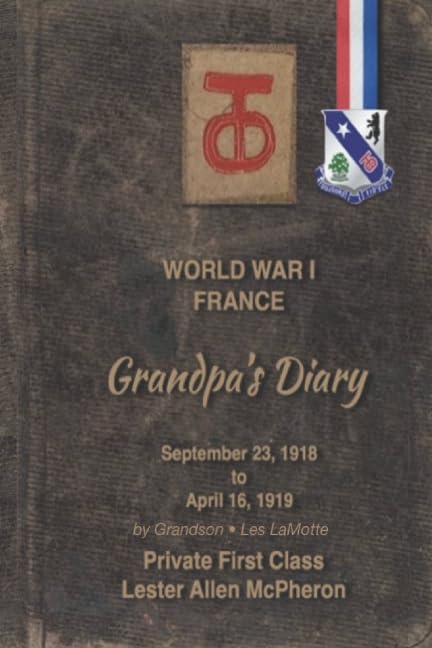
World War One Diary: 1918-1919 - Private First Class - Lester Allen McPheron
$8.38
by Mr. Lester Albert LaMotte



"World War One Diary 1918-1919: Private First Class - Lester Allen McPherson" is a deeply personal and captivating account of a soldier's experiences during World War I. The book presents the actual diary entries of Lester Allen McPherson, accompanied by insightful commentary by Les LaMotte, McPherson's adoptive grandson. This unique perspective offers readers a glimpse into the realities of war, as well as the profound impact it had on the author's life. The diary unfolds as a chronicle of McPherson's wartime journey, recounting his thoughts, emotions, and day-to-day experiences on the battlefield. From the trenches of France to the final days of the war, McPherson's entries vividly capture the horrors, camaraderie, and personal sacrifices endured by those who fought in the Great War. His account is both poignant and raw, allowing readers to connect with the human side of history. Les LaMotte's commentary adds an extra layer of depth to the narrative. As McPherson's adoptive grandson, LaMotte provides valuable insight into his grandfather's character, motivations, and the impact of the war on his life. The interplay between the diary entries and LaMotte's reflections creates a rich tapestry of storytelling that immerses readers in the author's world. Beyond the war narrative, the book also explores the remarkable bond between McPherson and LaMotte. Growing up next door to his grandfather when he moved next to him in White Bear Lake Minnesota, LaMotte became an integral part of McPherson's life, especially after the latter lost his sight at the age of 65. Here, the book delves into their relationship, highlighting how McPherson's mentorship in kite-making, combined with LaMotte's Eagle Scout and graphic design skills, shaped LaMotte's future and entrepreneurial success. While "World War One Diary 1918-1919: Private First Class - Lester Allen McPherson" primarily focuses on McPherson's war experiences, it also serves as a testament to the resilience of the human spirit and the transformative power of relationships. The book seamlessly weaves together history, personal memoir, and life lessons, making it a compelling read for anyone interested in World War I, family dynamics, and personal growth. Overall, "World War One Diary 1918-1919: Private First Class - Lester Allen McPherson" is a poignant and engaging narrative that transports readers to the frontlines of the Great War while simultaneously exploring the profound impact it had on one soldier's life. Les LaMotte's commentary and the inclusion of personal experiences make this book a valuable addition to both historical and personal memoir collections. This book I began assembling many years ago when my mother showed it to me. It was the WWI Diary that he wrote in France in 1918-1919. I recorded it word for word and added connection to unbroken parts, but is is my adoptive grandfather's words. I appears that he was quite a bright young man at 18 years old and could take in all that was going on around him without getting killed himself although he describes the bitter loss of many of his friends in very detailed and in some gruesome detail. I didn't want to add anything or take anything away as it is his personal view of what went on and I tried to allow it to describe all of that in great detail. The preamble to the book I wrote in its entirety of my personal experience with my grandpa beginning at the age of about 65. He and Grandma came to White Bear Lake where we lived and took up residents in what we called the "Little House". My father it is said built it one 2x4 at a time. When he built a bigger one for our growing family close by he invited mom's parents to move next door to us. It was a great and educational thing to have them there so close. I ran errands for them and did small jobs and got paid. Grandpa and I also had and attended a one acre garden that pretty much feed our family. Everything from a grape arbor almost 100 feet long, a half acre of corn. Watermelon at the edge of the swamp and every vegetable know to man. We even had about 10-12 apple trees. We were in those times very self-sufficient certainly much more that today. My mother had mint, chives, and current bushes. We also had our own well and sewer. So, you might say we lived almost off grid accept that solar wasn't as plentiful in those days and I am sure the cost was not even imaginable. I built a hot house so we could do tomato sets and other vegetables. We lived like a small tribe and life was very good despite the fact that my father came back from Shanghai China where he spent a year or so in the Navy preparing PT boats diesel engines. Unfortunately as he returned he some how developed as case of schizophrenia. That led to many rough years of living with him in a very upsetting crazy way of life and then without him while he spent time in the VA hospital in Minneapolis or St. Cloud Minnesota for up to a year at a time. I left us very poor without a father's incom