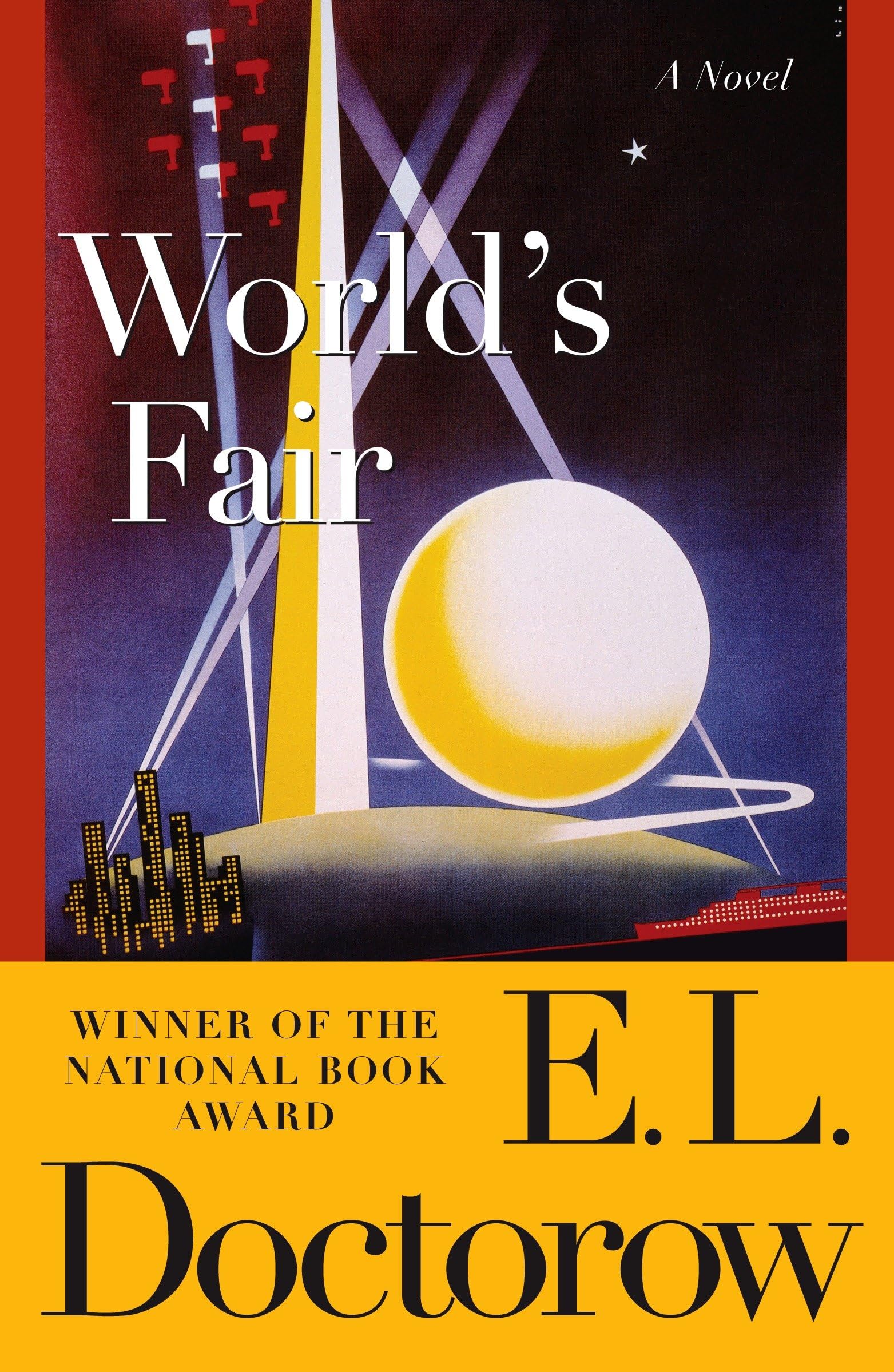



Winner of the National Book Award • “Marvelous . . . You get lost in World’s Fair as if it were an exotic adventure. You devour it with the avidity usually provoked by a suspense thriller.”— The New York Times Hailed by critics from coast to coast and by readers of all ages, this resonant novel is one of E.L. Doctorow’s greatest works of fiction. It is 1939, and even as the rumbles of progress are being felt worldwide, New York City clings to remnants of the past, with horse-drawn wagons, street peddlers, and hurdy-gurdy men still toiling in its streets. For nine-year-old Edgar Altschuler, life is stoopball and radio serials, idolizing Joe DiMaggio, and enduring the conflicts between his realist mother and his dreamer of a father. The forthcoming Word’s Fair beckons, an amazing vision of American automation, inventiveness, and prosperity—and Edgar Altschuler responds. A marvelous work from a master storyteller, World’s Fair is a book about a boy who must surrender his innocence to come of age, and a generation that must survive great hardship to reach its future. Praise for World’s Fair “Something close to magic.” — Los Angeles Times “ World’s Fair is better than a time capsule; it’s an actual slice of a long-ago world, and we emerge from it as dazed as those visitors standing on the corner of the future.” —Anne Tyler “Doctorow has managed to regain the awed perspective of a child in this novel of rare warmth and intimacy. . . . Stony indeed in the heart that cannot be moved by this book.” — People “Fascinating . . . exquisitely rendered details of a lost way of life.” — Newsweek “Wonderful reading.” — USA Today “Marvelous . . . You get lost in World’s Fair as if it were an exotic adventure. You devour it with the avidity usually provoked by a suspense thriller.” — The New York Times “Something close to magic.” — Los Angeles Times “ World’s Fair is better than a time capsule; it’s an actual slice of a long-ago world, and we emerge from it as dazed as those visitors standing on the corner of the future.” —Anne Tyler “Doctorow has managed to regain the awed perspective of a child in this novel of rare warmth and intimacy. . . . Stony indeed in the heart that cannot be moved by this book.” — People “Fascinating . . . exquisitely rendered details of a lost way of life.” — Newsweek “Wonderful reading.” — USA Today E. L. Doctorow ’s works of fiction include Welcome to Hard Times, The Book of Daniel, Ragtime, Loon Lake, World’s Fair, Billy Bathgate, The Waterworks, City of God, The March, Homer & Langley, and Andrew’s Brain. Among his honors are the National Book Award, three National Book Critics Circle awards, two PEN/Faulkner awards, and the presidentially conferred National Humanities Medal. In 2009 he was shortlisted for the Man Booker International Prize, honoring a writer’s lifetime achievement in fiction, and in 2012 he won the PEN/ Saul Bellow Award for Achievement in American Fiction, given to an author whose “scale of achievement over a sustained career places him in the highest rank of American literature.” In 2013 the American Academy of Arts and Letters awarded him the Gold Medal for Fiction. In 2014 he was honored with the Library of Congress Prize for American Fiction. ONE Startled awake by the ammoniated mists, I am roused in one instant from glutinous sleep to grieving awareness; I have done it again. My soaked thighs sting. I cry, I call Mama, knowing I must endure her harsh reaction, get through that, to be rescued. My crib is on the east wall of their room. Their bed is on the south wall. “Mama!” From her bed she hushes me. “Mama!” She groans, rises, advances on me in her white nightgown. Her strong hands go to work. She strips me, strips the sheets, dumps my pajamas and the sheets, and the rubber sheet under them, in a pile on the floor. Her pendulous breasts shift about in the nightgown. I hear her whispered admonitions. In seconds I am washed, powdered, clean-clothed, and brought to secret smiles in the dark. I ride, the young prince, in her arms to their bed, and am welcomed between them, in the blessed dry warmth between them. My father gives me a companionable pat and falls back to sleep with his hand on my shoulder. Soon they are both asleep. I smell their godlike odors, male, female. A moment later, as the faintest intimation of daylight appears as an outline of the window shade, I am wide awake, blissful, guarding my sleeping parents, the terrible night past me, the dear day about to dawn. These are my earliest memories. I liked when morning came to climb down from their bed and watch my parents. My father slept on his right arm, his legs straight, his hand coming over the pillow and bending at the wrist against the headboard. My mother lay curled with the curve of her broad back touching his. Together under the covers they made a pleasing shape. The headboard knocked against the wall as they stirred. It was baroque in style, olive green