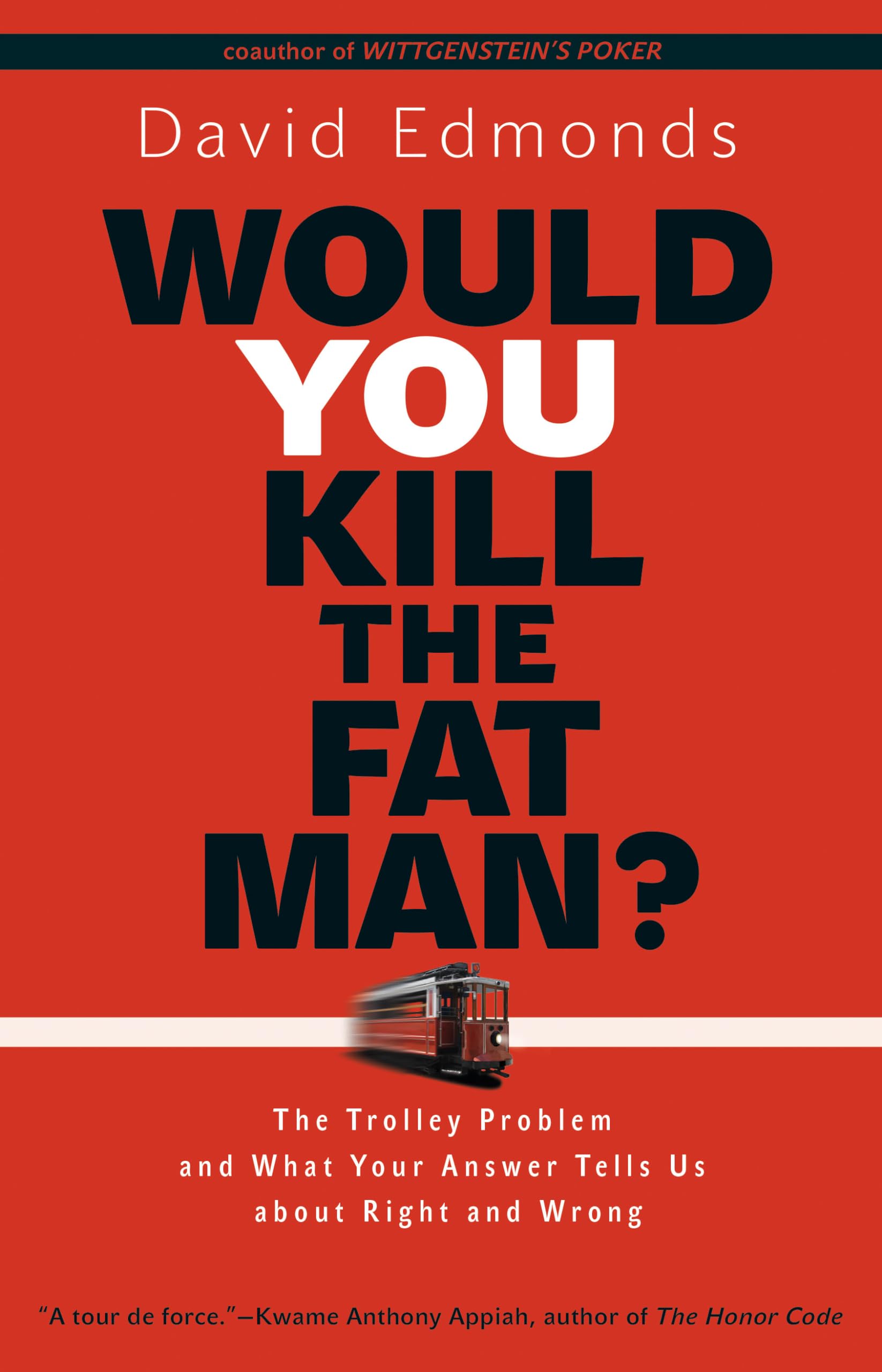
Would You Kill the Fat Man?: The Trolley Problem and What Your Answer Tells Us about Right and Wrong
$17.58
by David Edmonds



From the bestselling coauthor of Wittgenstein's Poker , a fascinating tour through the history of moral philosophy A runaway train is racing toward five men who are tied to the track. Unless the train is stopped, it will inevitably kill all five men. You are standing on a footbridge looking down on the unfolding disaster. However, a fat man, a stranger, is standing next to you: if you push him off the bridge, he will topple onto the line and, although he will die, his chunky body will stop the train, saving five lives. Would you kill the fat man? The question may seem bizarre. But it's one variation of a puzzle that has baffled moral philosophers for almost half a century and that more recently has come to preoccupy neuroscientists, psychologists, and other thinkers as well. In this book, David Edmonds, coauthor of the bestselling Wittgenstein's Poker , tells the riveting story of why and how philosophers have struggled with this ethical dilemma, sometimes called the trolley problem. In the process, he provides an entertaining and informative tour through the history of moral philosophy. Most people feel it's wrong to kill the fat man. But why? After all, in taking one life you could save five. As Edmonds shows, answering the question is far more complex―and important―than it first appears. In fact, how we answer it tells us a great deal about right and wrong. "Honorable Mention for the 2015 PROSE Award in Philosophy, Association of American Publishers" "One of Choice's Outstanding Academic Titles for 2014" "A lucid account of a famous thought experiment in moral philosophy." ---Editors' Choice, New York Times Book Review "[J]aunty, lucid and concise. . . . In Would You Kill the Fat Man? David Edmonds . . . a seasoned philosopher, tells the story . . . with wit and panache." ---Sarah Bakewell, New York Times Book Review "[E]legant, lucid, and frequently funny. . . . Edmonds has written an entertaining, clear-headed, and fair-minded book." ---Cass R. Sunstein, New York Review of Books "[E]legantly written . . . Edmonds's book is especially valuable for the way in which it embeds his introduction to the trolley problem in a story of the social reality that produced it." ---Hallvard Lillehammer, Times Literary Supplement "David Edmonds's vastly more ambitious Would You Kill the Fat Man? has the cartoons--and just about everything else you could want in a thoughtful popular treatment of [the trolley problem]. A marvel of economy and learning worn lightly, Mr. Edmonds's book ranges pleasurably back to Aquinas and forward into the future of robots, who will of course need an ethics just as much as people do. Perhaps best of all, Mr. Edmonds recognizes that the origins of 'trolleyology' are at least as interesting as the many philosophical writings, academic exercises and parlor games that have sprung from the original trolley paper, published in 1967 by an English philosopher named Philippa Foot." ---Daniel Akst, Wall Street Journal "An accessible, humorous examination of how people approach complex ethical dilemmas. . . . Written for general readers, the book captures the complexities underpinning difficult decisions." ― Publishers Weekly "Informative, accessible, engaging and witty, his book is a marvelous introduction to debates about right and wrong in philosophy, psychology, and neuro-science. . . . In the hands of a lucid explicator like David Edmonds, trolleyology is, at once, serious business (relevant, among others things, to preferences for drone strikes) and lots of fun." ---Glenn Altschuler, Psychology Today "This is a rare treat--a serious, thought-provoking book on ethics that is also witty, funny, and entertaining. Not to be missed. . . . David Edmonds has taken the well-known trolley car problem and breathed new life into it, examining it from different perspectives and using it to shed light on the ethical theories of Immanuel Kant, Jeremy Bentham, John Rawls, Aristotle, and others. If you think philosophy has to be ponderous and difficult, you haven't read this book. . . . What's intoxicating about this book is that every time you think you know what you think, Edmonds tosses out a new element. . . . There's lots more to enjoy and learn from this book, a real gem and one of my new favorites." ---Mark Willen, TalkingEthics.com "[H]umans seem hard-wired to draw a distinction between a foreseeable side effect that sadly results from doing good (switching the tracks) and purposefully harming another, no matter how noble the cause (pushing the fat man off the bridge). Edmonds's exploration of why this is so is at the heart of his thoroughly delightful book." ---Brian Bethune, Macleans "[A] fascinating and important field. The light it throws on the moral institutions of human beings is its own reward, and this book will make its readers think." ---Richard King, Australian "This provocatively titled tract opens with a burst of drama that proves philosophy can b