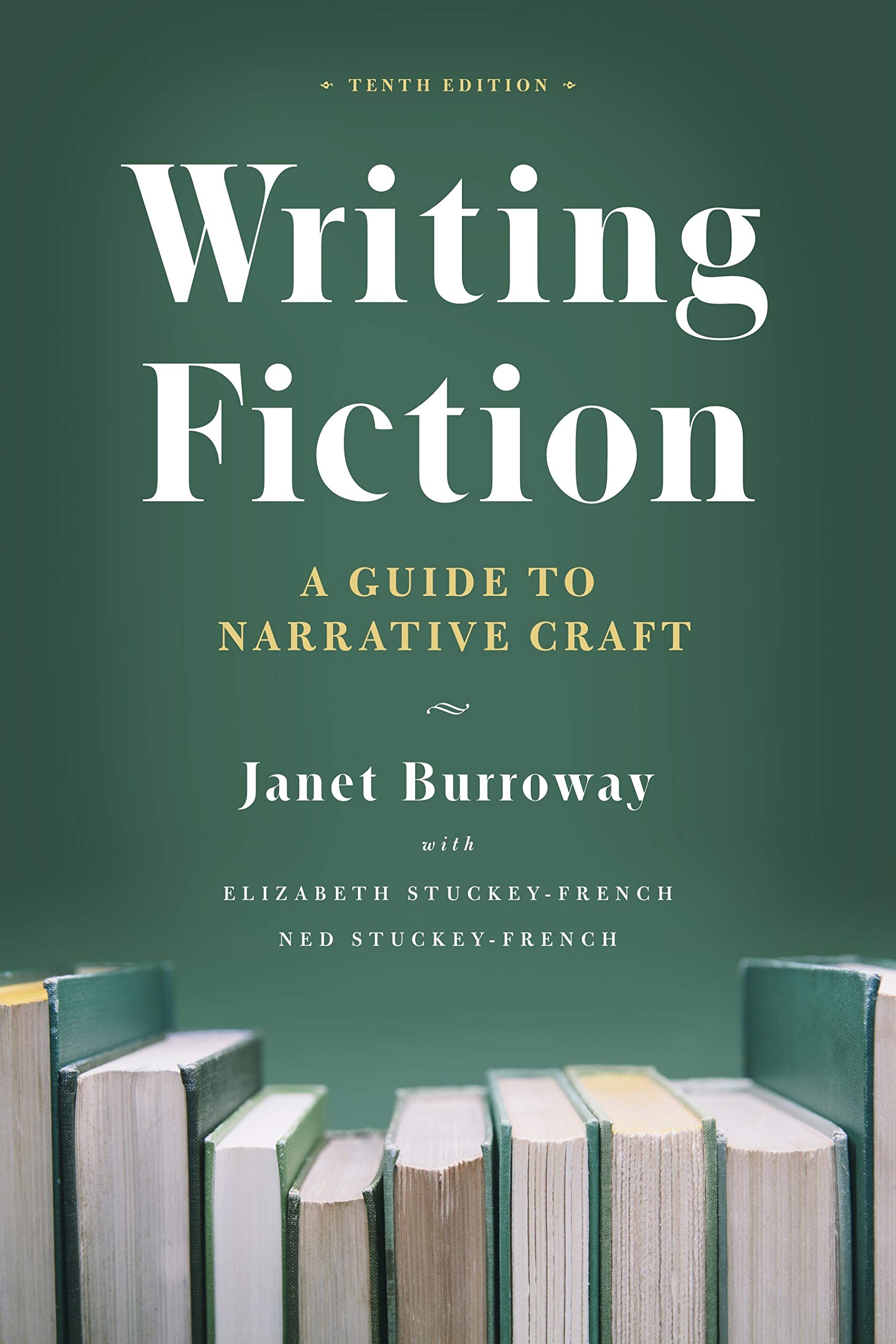
Writing Fiction, Tenth Edition: A Guide to Narrative Craft (Chicago Guides to Writing, Editing, and Publishing)
$13.27
by Janet Burroway



More than 250,000 copies sold! A creative writer’s shelf should hold at least three essential books: a dictionary, a style guide, and Writing Fiction. Janet Burroway’s best-selling classic is the most widely used creative writing text in America, and for more than three decades it has helped hundreds of thousands of students learn the craft. Now in its tenth edition, Writing Fiction is more accessible than ever for writers of all levels—inside or outside the classroom. This new edition continues to provide advice that is practical, comprehensive, and flexible. Burroway’s tone is personal and nonprescriptive, welcoming learning writers into the community of practiced storytellers. Moving from freewriting to final revision, the book addresses “showing not telling,” characterization, dialogue, atmosphere, plot, imagery, and point of view. It includes new topics and writing prompts, and each chapter now ends with a list of recommended readings that exemplify the craft elements discussed, allowing for further study. And the examples and quotations throughout the book feature a wide and diverse range of today’s best and best-known creators of both novels and short stories. This book is a master class in creative writing that also calls on us to renew our love of storytelling and celebrate the skill of writing well. There is a very good chance that one of your favorite authors learned the craft with Writing Fiction . And who knows what future favorite will get her start reading this edition? “The tenth edition of Janet Burroway’s classic 1982 book guides fiction writers of all levels through the entire creative process, with updated exemplary passages and advice from contemporary authors, and sections on current issues such as distraction, appropriation, different genres, and young adult fiction. Chapters focus on characterization, setting, plot and structure, point of view, and revision, and each closes with a list of suggested readings and writing prompts that allow for further study.” -- Best Books for Writers ― Poets & Writers “Scrupulously written by a first-rate novelist who . . . gives tips, offers sensitive commentary, and exceptions to what may pass for ‘rules’ in writing.” -- Praise for a previous edition ― Frederick Busch, Los Angeles Times “Marvelously clear-headed.” -- Praise for a previous edition ― Joan Fry, Poets and Writers Elizabeth Stuckey-French is professor of English at Florida State University. Ned Stuckey-French (1950–2019) was associate professor of English at Florida State University and director of the FSU Certificate Program in Publishing and Editing. Writing Fiction A Guide to Narrative Craft By Janet Burroway, Elizabeth Stuckey-French, Ned Stuckey-French The University of Chicago Press Copyright © 2019 Janet Burroway, Elizabeth Stuckey-French, and Ned Stuckey-French All rights reserved. ISBN: 978-0-226-61669-8 Contents Preface, 1 WHATEVER WORKS: The Writing Process, 2 SEEING IS BELIEVING: Showing and Telling, 3 BUILDING CHARACTER: Characterization, Part I, 4 THE FLESH MADE WORD: Characterization, Part II, 5 LONG AGO AND FAR AWAY: Fictional Setting, 6 THE TOWER AND THE NET: Plot and Structure, 7 CALL ME ISHMAEL: Point of View, 8 IS AND IS NOT: Comparison, 9 PLAY IT AGAIN, SAM: Revision and Theme, Acknowledgments, Index, CHAPTER 1 Whatever Works THE WRITING PROCESS Get Started Keeping a Journal Freewriting and Freedrafting Keep Going Prompts The Computer The Critic: A Caution Choosing a Subject Reading as a Writer A Word about Theme You want to write. Why is it so hard? There are a few lucky souls for whom the whole process of writing is easy, for whom the smell of fresh paper is better than air, whose minds chuckle over their own agility, who forget to eat, and who consider the world at large an intrusion on their good time at the keyboard. But you and I are not among them. We are in love with words except when we have to face them. We are caught in a guilty paradox in which we grumble over our lack of time, and when we have the time, we sharpen pencils, check email, or clip the hedges. Of course, there's also joy. We write for the satisfaction of having wrestled a sentence to the page, for the rush of discovering an image, for the excitement of seeing a character come alive. Even the most successful writers will sincerely say that these pleasures — not money, fame, or glamour — are the real rewards of writing. Fiction writer Alice Munro concedes: It may not look like pleasure, because the difficulties can make me morose and distracted, but that's what it is — the pleasure of telling the story I mean to tell as wholly as I can tell it, of finding out in fact what the story is, by working around the different ways of telling it. Nevertheless, writers may forget what such pleasure feels like when confronting a blank page, like the heroine of Anita Brookner's novel Look at Me: Sometimes it seems like a