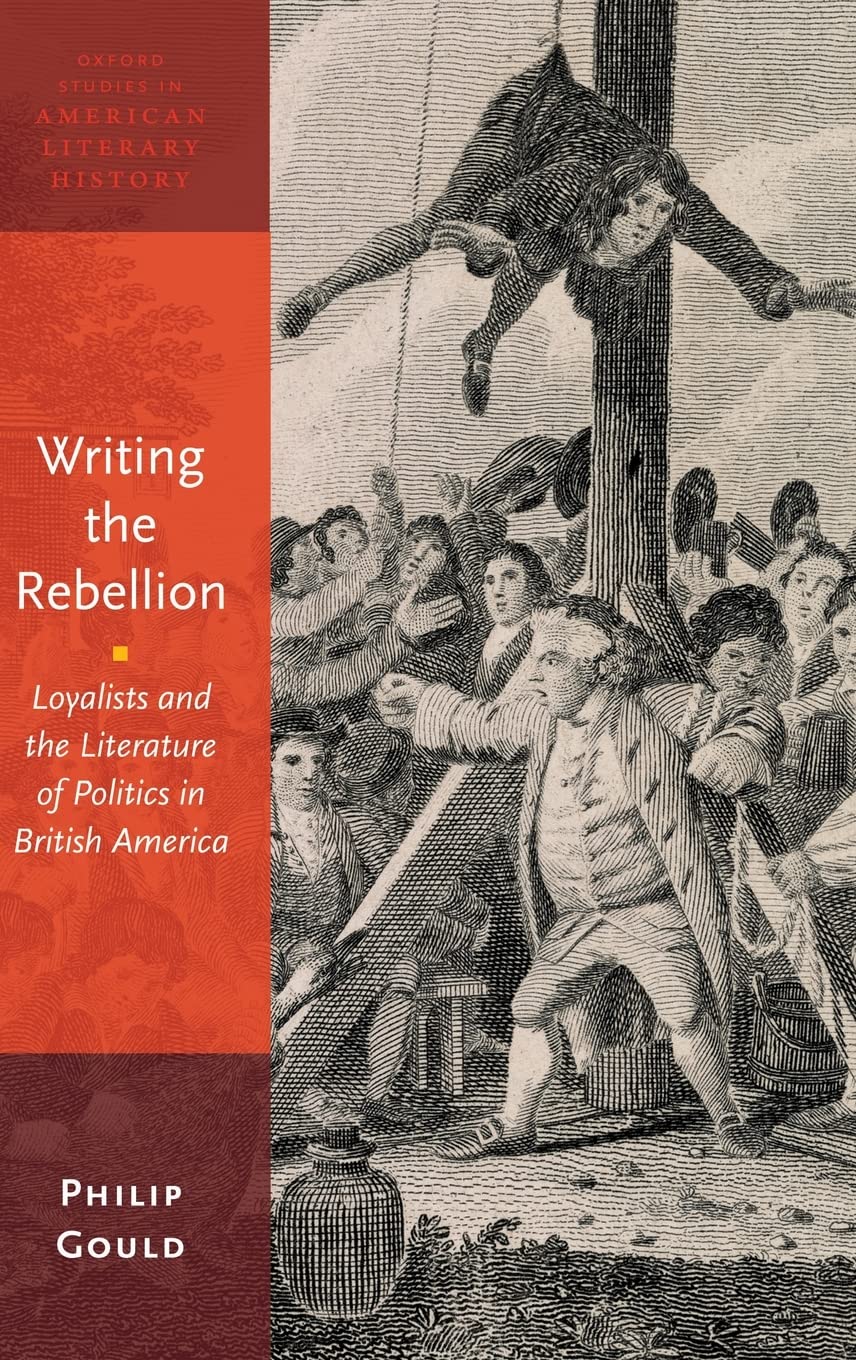
Writing the Rebellion: Loyalists and the Literature of Politics in British America (Oxford Studies in American Literary History)
$47.98
by Philip Gould



Traditional literary histories of Revolutionary-era America tend to privilege the works of Benjamin Franklin, Thomas Paine, and other ardent Patriots eager to see the thirteen colonies sever all ties with the British Crown. Yet the literature produced by Loyalists--the faction of colonists opposed to severing ties with Britain--made up an equally important part of the nation's burgeoning literary culture. With ample attention to both Loyalists and Patriots, Writing the Rebellion reveals the complicated ways colonial Americans sought to reconstruct their English identities at a moment of political crisis, when the British Empire was falling apart in North America. Employing the methods of transatlantic literary studies, postcolonial theory, and the history of the book, Philip Gould considers how British Americans coped with what amounted to a cultural identity crisis. Each chapter addresses an important subject of literary history and literary form--sublime writing, wit, balladry, satire and burlesque, questions of authorship, and regional identification--to show how the literature of politics operated simultaneously as the site where aesthetic and cultural matters were also contested and reconfigured. By re-mapping the literature of revolutionary politics in this way, and accounting for the Loyalist presence in political debate, Writing the Rebellion offers a new literary and cultural history, not of the American Revolution but of an "American Rebellion." " Writing the Rebellion leaves us with a vision of eighteenth-century print culture in British America as more labile and more literary than we'd realized, and with an expanded sense of why that matters." -- Early American Literature "...Philip Gould's scholarly and beautifully written monograph offers a new way to conceptualize their agency.... [A] deeply scholarly and critically acute study of loyalist writing...." -- American Historical Review " Writing the Rebellion presents a methodologically rich approach to Loyalist writings that have fallen through the cracks of national literary histories. Much more than a recovery effort, Gould's important book reveals the dynamic relation between literary forms and Revolutionary conflict and shows how Loyalist aesthetics continue to resonate in liberal political theory." --Sandra Gustafson, author of Imagining Deliberative Democracy in the Early American Republic " Writing the Rebellion is not only a groundbreaking study of colonial American literary debates, but it also sets a new scholarly standard on Loyalist writing. Gould has produced the first major study of Loyalist writing to take the Loyalist position on its own terms as well as from opposing viewpoints. It's a lucid, richly documented study that will change how we read the literature of the American Revolution." --Leonard Tennenhouse, author of The Importance of Feeling English: American Literature and the British Diaspora, 1750-1850 " Writing the Rebellion refocuses attention on the losers of the American Revolution--and on the experience of loss itself. Gould's Loyalists dissented from critical categories we now invoke to evaluate American political literature. Severing virtue from politics, suspicious of the seductions of language, Loyalists did not believe there was an American 'public' in revolutionary America. By carefully recovering their intellectual world, Gould gives us a timely reminder of the history of a divided country." --Eric Slauter, author of The State as a Work of Art: The Cultural Origins of the Constitution "Gould discusses the relationship between Britain and its North Atlantic colonies during the decades leading up to and including those colonists' Revolution..." -- American Literature A cultural history of loyalist writing in early America Philip Gould is Nicholas Brown Professor of Oratory and Belles Lettres at Brown University. He is the author of Covenant and Republic: Historical Romance and the Politics of Puritanism and Barbaric Traffic: Commerce and Antislavery in the 18th-Century Atlantic World .