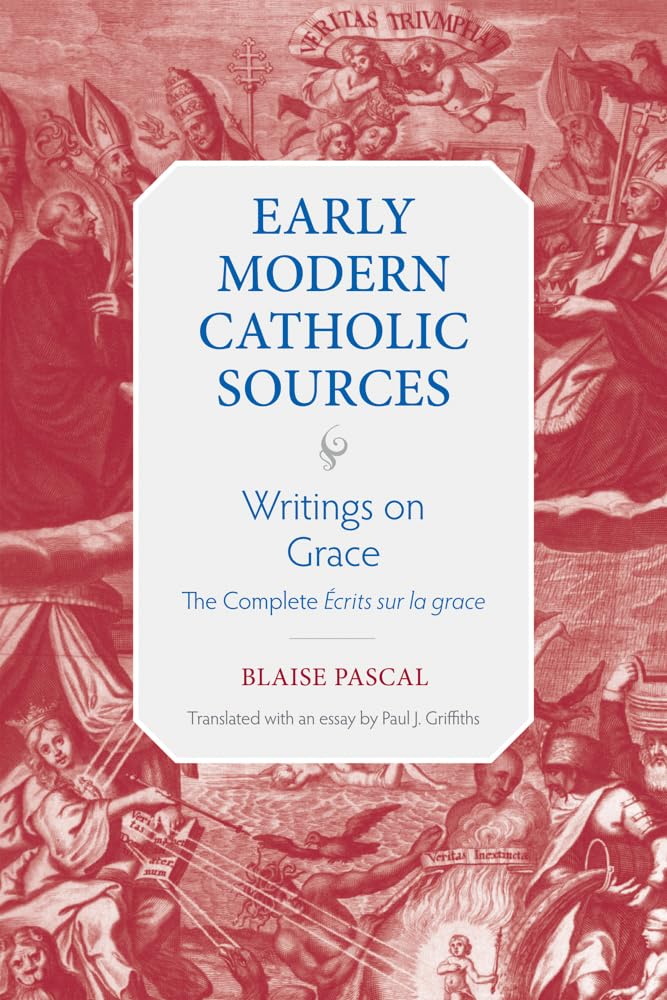
Writings on Grace: The Complete Ecrits sur la grace (Early Modern Catholic Sources)
$75.00
by Blaise Pascal



A few years before he died in 1662, Blaise Pascal wrote fifteen interconnected essays on grace, which have collectively come to be known as the Écrits sur la grâce . These were not published before his death, and were not polished and revised by him with an eye to publication, which means that they show his mind at work experimentally, trying out lines of argument and engagements with magisterial and patristic texts without resolving them into anything like a final system. The Écrits are replete with experimental formulations and bursts of literary and intellectual energy; taken together, they provide an intense and extreme presentation of Pascal's version of Augustinianism with respect to grace, election, and predestination, the meaning of the Council of Trent, and much else. These essays provide one of the keys to the entirety of Pascal's thought, and they provide a view of grace's workings ― perhaps better, a grammar of grace ― which still warrants serious attention by Catholic theologians. Less than one-fifth of the Écrits has yet been published in English. This book provides a complete translation, made from the French text provided in Michel Le Guern's edition (1998, 2000) of Pascal's Oeuvres complètes , and annotated to provide full information about Pascal's sources and how he used them. The translation is followed by a substantial interpretive essay in which Pascal's positions and approaches are restated and argued with. "The Writings on Grace is Pascal’s eloquent and carefully reasoned plea for the Church’s abiding loyalty to her Augustinian heritage―to the utter need, and unfailing effectiveness, of God’s grace for our salvation. Paul Griffiths’ elegant translation, and his characteristically thought-provoking essay on the text, bring to life the abiding significance of what Pascal has to say about grace, and of the momentous theological controversy in which he took part. Together with his book Why Read Pascal? this volume from Griffiths gives us the most penetrating theological engagement with Pascal currently on offer."―Bruce D. Marshall, Southern Methodist University "If Griffiths had only fluidly translated Pascal’s essays here, the book would be a quite remarkable gift: the most wide-ranging (if not comprehensive) and profound (and definitely acute) ‘grammar of grace’ that Pascal ever offered, making him the most interesting, and most searching, writer on grace between John Calvin and Jonathan Edwards. But Griffiths does more: for in a concluding essay, he then engages deeply, critically, and yet charitably with Pascal’s thinking, thinking Griffiths himself believes deeply misguided. Profound but invitingly accessible, this book could be straightforwardly taught to undergraduates and also read with endless benefit by mature philosophers and theologians as well. This work will make the Écrits’s impact on Anglophone theology and philosophy palpable and substantial."―Charles T. Mathewes, University of Virginia "The Writings on Grace present Pascal's most thorough and systematic treatment of how to reconcile God's grace and human freedom, as well as deepening and amplifying the account of original sin and the fall offered in the Pensêes . Until now, there has never been an unabridged English translation of the Writings on Grace , and so this text has remained inaccessible to many readers. Paul Griffiths' translation and commentary is therefore extremely welcome and valuable, not just for Pascal scholars, but for anyone who wants to think carefully about some of the most challenging questions in Christian theology."―William Wood, Oriel College, University of Oxford "We must be sincerely grateful to Paul Griffiths for his skilled translations of Pascal, his generous introduction, and his afterward, which illuminates the hows and why of Pascal's thinking about grace. Few scholars today have the patience and wisdom to shed light on difficult historical topics. Griffiths has abundantly graced us with his learning. The afterward, which 'overthrows' Pascal's arguments for the limitation of grace to the few, gives the reader the opportunity to contrast early modern and contemporary opinions and salvation. Griffiths' analyses of what Pascal is about are a gift to the reader."―Francesca Murphy, University of Notre Dame Blaise Pascal (1623-1662) was a French mathematician, physicist, and religious philosopher, who laid the foundation for the modern theory of probabilities. Paul Griffiths is the author of Intellectual Appetite: A Theological Grammar ; The Practice of Catholic Theology: A Modest Proposal and Why Read Pascal