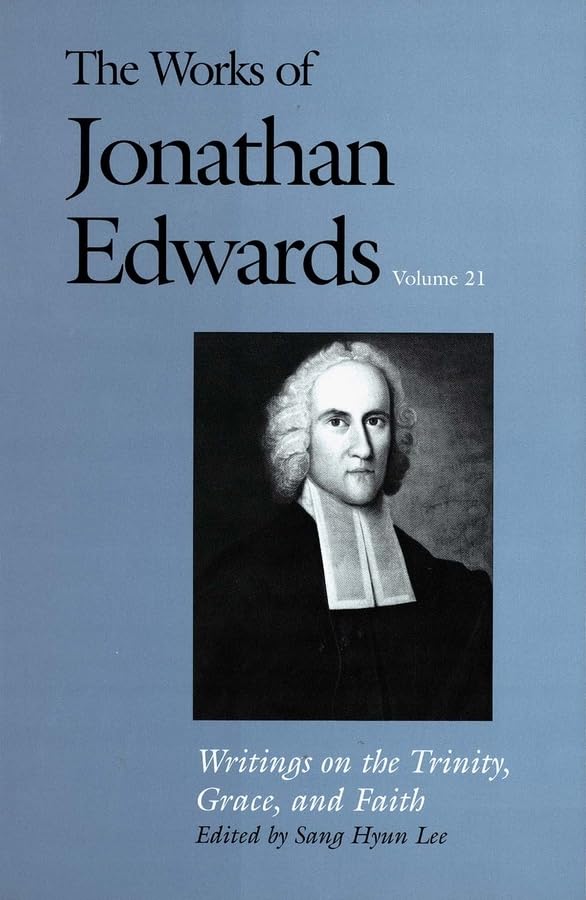
Writings on the Trinity, Grace, and Faith (The Works of Jonathan Edwards Series, Volume 21)
$138.00
by Jonathan Edwards



In this collection of writings drawn from Jonathan Edwards’s essays and topical notebooks, the great American theologian deals with key Christian doctrines including the Trinity, grace, and faith. The volume includes long-established pieces in the Edwards canon, newly reedited from the original manuscripts, as well as documents that have never before been published and that in some cases reveal new aspects of his theology. Sang Hyun Lee is Kyung-Chik Han Professor of Systematic Theology at Princeton Theological Seminary. THE WORKS OF JONATHAN EDWARDS VOLUME 21 Writings on the Trinity, Grace, and Faith By JONATHAN EDWARDS YALE UNIVERSITY PRESS Copyright © 2003 Yale University All right reserved. ISBN: 978-0-300-09505-0 Contents Editorial Committee................................................vList of Illustrations..............................................viiiNote to the Reader.................................................ixEditor's Introduction..............................................1Discourse on the Trinity...........................................109On the Equality of the Persons of the Trinity......................145Treatise on Grace..................................................149EffaciousBook I.............................................................198Book II............................................................223Book III...........................................................239"Controversies" NotebookEfficacious Grace..................................................291The Nature of True Virtue..........................................312Justification......................................................328Faith..............................................................414Signs of Godliness.................................................469Christ's Example...................................................511Directions for Judging of Persons' Experiences.....................520General Index......................................................525Index of Biblical Passages.........................................545 Chapter One DISCOURSE ON THE TRINITY According to Thomas A. Schafer, Edwards began the manuscript of what he called the "Discourse on the Trinity" (otherwise known as "Essay on the Trinity") in early 1730, when he wrote eight folio pages in a short time. He was able to write at such a pace because he could draw upon numerous "Miscellanies" entries on the topic written up to that time. He later went back over these eight pages, making some changes, soon after their original composition, struggling to improve the language and clarify the thought. Edwards' intention for the composition is unclear; he put it aside for some time, apparently several years. When in the mid- or late 1730s he took up the manuscript again, he added another folio signature (pp. 9-12), as well as an additional leaf or signature that is now missing. The additions are of two kinds and perhaps reflect Edwards' changing perception of the piece as a whole. At first he tried to improve the original portion of the essay by signaling additions, via cue marks, to particular passages. Probably in the early to mid-1740s, however, he simply started appending discrete entries without connecting them to earlier passages. This latter phase suggests that Edwards came to view the manuscript as a source book rather than as an autonomous statement, a speculation borne out by his willingness to cannibalize it for other works such as A Divine and Supernatural Light, Treatise on Grace, and Religious Affections . All the same, there are no use marks. The first part of the "Discourse" is taken up with describing the persons of the Trinity, particularly the Son and the Holy Spirit. God, Edwards begins, is infinitely happy in the enjoyment and contemplation of himself, which engenders a "perfect idea of himself." Thus the Deity is "repeated." God's idea of himself is "the express and perfect image of himself" and is a "spiritual idea," or the repetition of all of God's memories, exercises, and powers-that is, a replication of God, or God himself again. This is confirmed by scriptural descriptions of the Second Person, where the Son is the "image" and "face" of God, the "brightness, effulgence and shining forth of God's glory," the "wisdom," "logos," and "Amen" of God. Between the Father and Son exists a mutual love, joy, and delight, a "pure act," or the "Deity in act," which is the Holy Spirit. The Holy Spirit is the love of the Father and Son for each other, the love that "quickens and enlivens" creation and created spirits, and comforts God's people. Again, Scripture confirms this definition by describing the Holy Spirit as a dove, a symbol of love; scriptural types and similitudes of the Holy Spirit are oil, water, fire, breath, and wind, all of which connote a "flowing out." So the saints' communion with God consists in partaking of the Holy Spirit, or God'