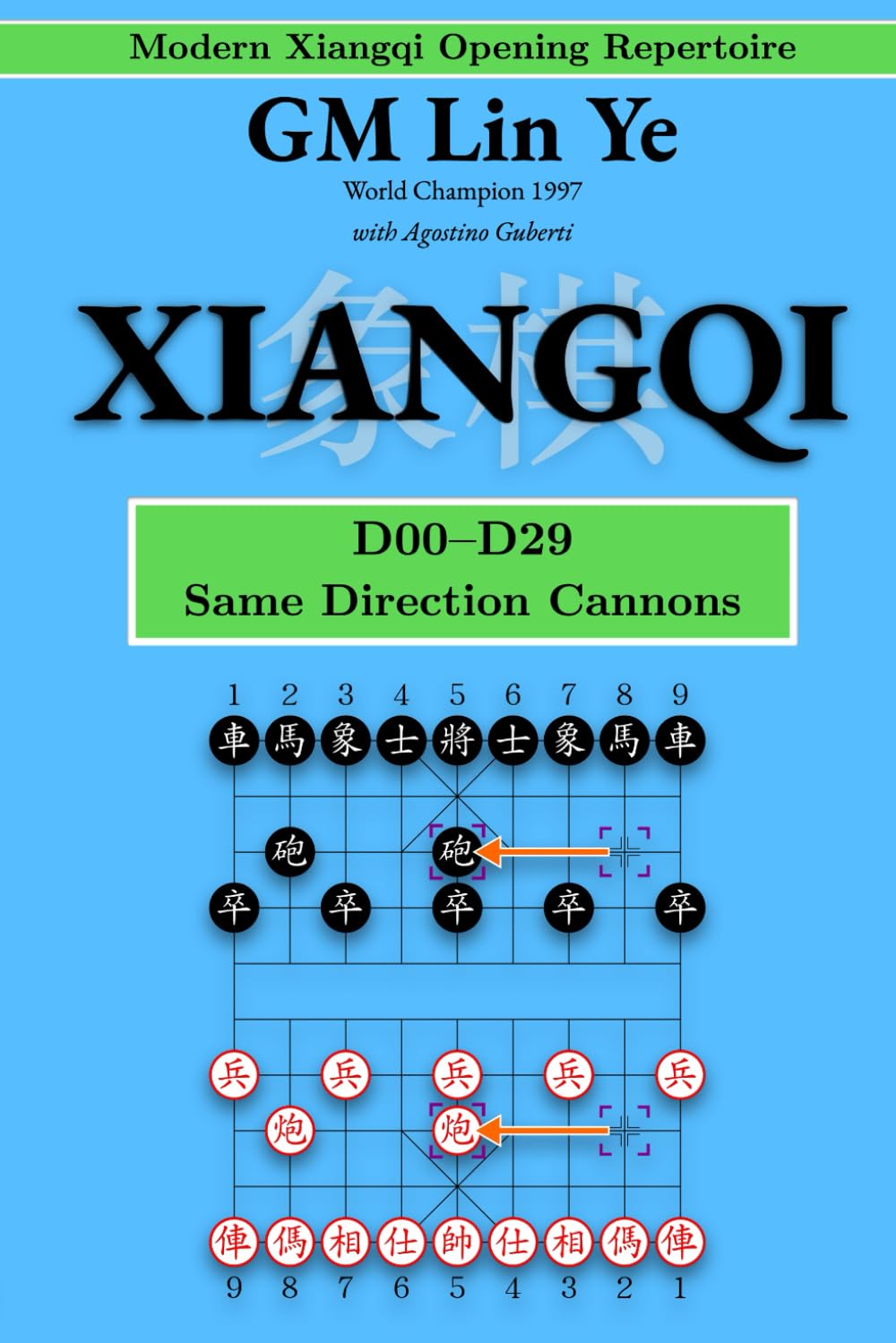



After attempting to partially fill the gap of books written by a professional player in a Western language on xiangqi with “ XIANGQI Introduction to Chinese Chess for beginners ” and “ IGM Lin Ye 60 Memorable Xiangqi Games - The Path to Winning the World Chinese Chess Championship ”, with this book, GM Lin Ye seeks to fill an even larger void: the scarcity, in Western chess literature, of works on xiangqi openings. “ D00-D29: Same Direction Cannons ” is the first in a series of books dedicated to helping readers build their own repertoire of modern openings. From a strictly strategic perspective, the Same Direction Cannons system leads to very aggressive games where attacking and counterattacking actions begin immediately. Therefore, it is loved by players with a strong combative inclination. This is, by the way, the first opening studied and played diligently by Lin Ye at the beginning of her professional xiangqi player career. The book is divided into two parts. The first part addresses the most commonly used lines by professional players when playing the “Same Direction Cannons” system . The presented variations have been selected by referencing the best texts on xiangqi openings and analyzing hundreds of thousands of games played by Chinese champions . For this occasion, the games of these champions have been saved in a database, sorted, and analyzed by the strongest xiangqi programs currently available. This first part not only lists and comments on the ”first dozen” moves of the selected variations but also shows possible continuations up to the advanced middlegame to give an idea of how each variation can be further developed in a game. Abundant are also indications of wrong moves, weak plans, and possible traps. All the presented variations and their possible continuations have been checked, corrected, and validated by the Cyclone (旋风) and Pikafish (皮卡鱼) programs, engines with an Elo rating around 3600 Elo points. This is one of the reasons why the term ”modern” is used in the title of the book. This does not mean that the chosen lines are absolutely the best. The goodness of a variation depends on many other factors, including, for example, a player’s playing style. When two or more moves or two or more variations lead to a similar outcome, Lin Ye’s choice went to those she judged more interesting or instructive. The same criterion was used when the two programs disagreed on the best move in a given position. It is worth remembering in this regard that the evaluation of a position made by an engine is often influenced by various technical factors such as the number and quality of CPUs used, the reflection time set for each move, the chosen neural networks, the number of set threads, the size of the hash tables used, etc. Therefore, in different conditions, it is possible that the engines used, even of the same version, give different responses. However, it is reasonable to think that the lines chosen by the champion for this book, thanks to her experience and the previously listed tools, are not only free of “errors” but are also good, if not excellent, for the vast majority of xiangqi readers and players. The second part of the book consists of a collection of games played by the strongest Chinese players. Each game is dedicated to a specific variation of the opening presented in this book. All selected games are very recent (and this is the second reason why the adjective ”modern” was chosen in the title of the book) and are played by top players such as the world champions Wang TianYi (王天一), Jiang Chuan (蒋川), Xu YinChuan (许银川), Lu Qin (吕钦), etc.