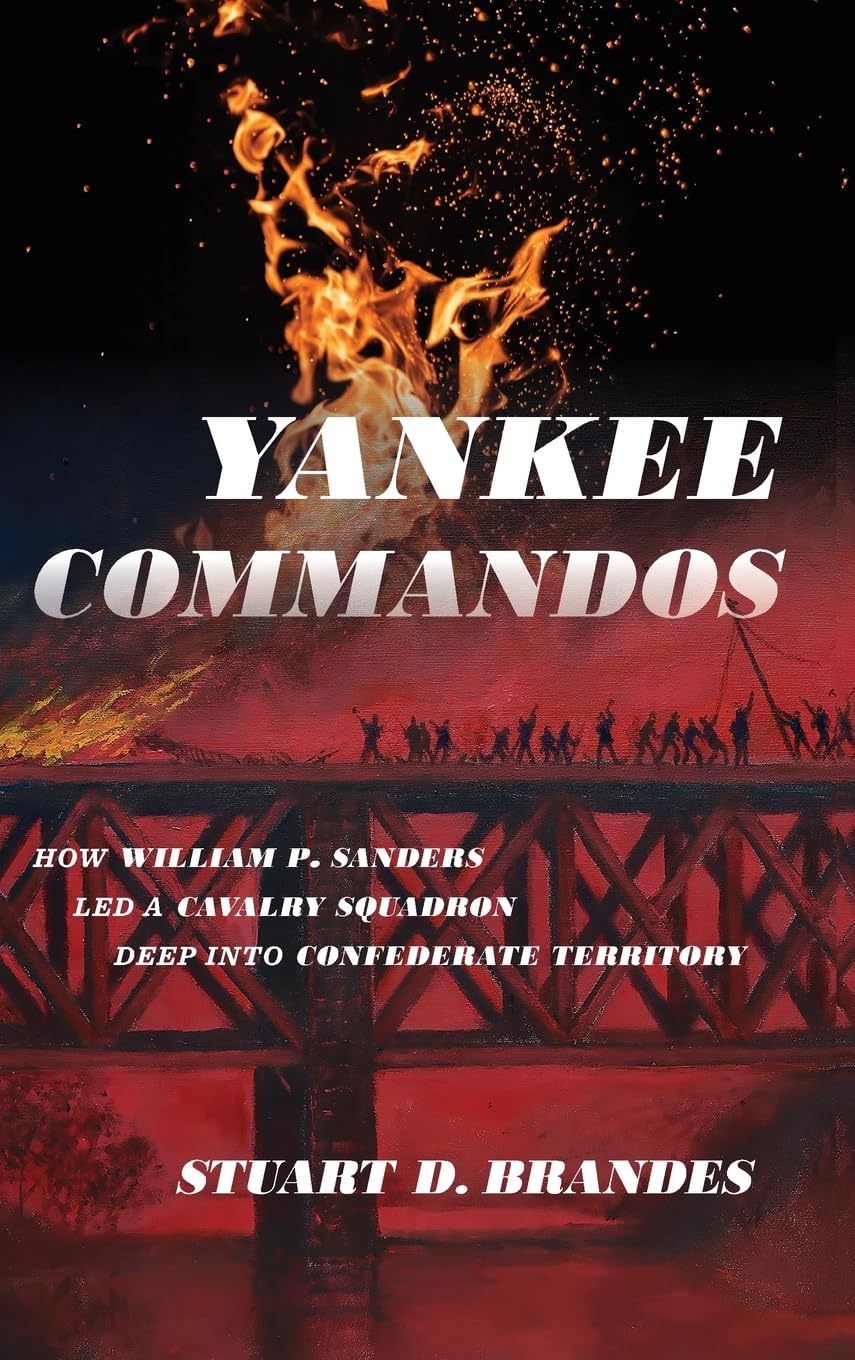
Yankee Commandos: How William P. Sanders Led a Cavalry Squadron Deep into Confederate Territory
$24.62
by Stuart Brandes



In June of 1863, Col. William P. Sanders led a cavalry raid of 1,300 men from the Union Army of the Ohio through Confederate-held East Tennessee. The raid severed the Confederate rail supply line from Virginia to the Western Theater and made national headlines. Until now, this incredible feat has been relegated to a footnote in the voluminous history of the American Civil War. In Yankee Commandos, Stuart Brandes presents readers with the most complete account of the Sanders raid to date by using newly discovered and under-explored materials, such as Sanders’s official reports and East Tennessee diaries and memoirs in which Sanders is chronicled. The book presents important details of a cavalry raid through East Tennessee that further turned the tide of war for the Union in the Western Theater. It also sheds light on the raid’s effect on the divided civilian population of East Tennessee, where, unlike the largely pro-secession populations of Middle and West Tennessee, the fraction of enlisted men to the Union cause rose to nearly a quarter. Colonel Sanders remains an enigma of the American Civil War. (He was a cousin of Confederate president Jefferson Davis, and his father and three brothers donned Confederate gray at the outbreak of the war.) By studying the legend of Sanders and his raid, Brandes fills an important gap in Civil War scholarship and in the story of Unionism in a mostly Confederate-sympathizing state. STUART D. BRANDES is a professor emeritus of history at the University of Wisconsin, Whitewater. He is the author of American Welfare Capitalism, 1880–1940 and Warhogs: A History of War Profits in America. At eleven o’clock in the morning of Wednesday, June 3, 1863, an urgent telegram arrived in Lexington, Kentucky, the field headquarters of the Union Army of the Ohio. The message came from Washington, DC, and carried the signature of Major General Henry W. Halleck, the general-in-chief of the Union Army. The addressee was Major General Ambrose E. Burnside, the commanding officer of the Department of the Ohio, who was in Lexington preparing to lead a force of about 16,000 men, south through Kentucky and into the Confederate Department of East Tennessee. Burnside expected to move out in only four days, but Halleck’s message obtruded. “You will immediately,” the general-in-chief bluntly ordered, “dispatch 8,000 men to General Grant, at Vicksburg [Mississippi].” This directive stripped the Army of the Ohio of about half the troops which Burnside counted upon for his East Tennessee foray. With only two divisions remaining, Burnside believed that he was too weak to both mount a general invasion and also to protect his supply line, which stretched nearly 200 miles from Cincinnati, Ohio, to the Kentucky-Tennessee border. Convinced that an invasion was now impracticable, Burnside suspended the operation. Halleck wanted to maintain pressure on the enemy while the men were absent, so Burnside devised a bold but trimmed-down alternative: a cavalry raid. Within a week the Army of the Ohio began preparing to dispatch a squadron of 1,300 horsemen on a sweep through enemy-occupied East Tennessee. Led by Colonel William P. Sanders, the raiders successfully severed the principal rail artery which connected Confederate troops in Virginia to rebel forces in the West. The safe return of almost the entire squadron made national headlines, but the memory of the feat faded over the years. There are reasons why the Sanders Raid lost its foothold in the chronicle of the war. Southern historians dominated the history of the Civil War written in the late-nineteenth and early-twentieth centuries, and since Sanders’s raid was both a Yankee victory and a rebel embarrassment, few were inclined to mention it. Moreover, several aspects of the event contradicted their notion that Southerners were united in support of disunion. In most of Tennessee, secession was very popular, but in the eastern counties, where the raid took place, a heavy majority of voters disapproved of separation. As a further expression of their loyalty, about 42,000 citizens (or roughly a quarter of the total number of Tennesseans who went to war) preferred to fight for Old Glory. Three-fourths of Tennessee’s Union troops hailed from its eastern counties. Southern writers ignored William P. Sanders as well, although he was a true son of the Old South. Sanders was born in the capital of a border state (Frankfort, Kentucky), but he grew to manhood in the heart of the Cotton Kingdom, Natchez, Mississippi. Sanders’s father, a prominent attorney and pro-slavery activist (he owned twenty slaves in 1850), was also a lifelong friend and political ally of Jefferson Davis. Yet, when war erupted, William Sanders swam against the tide. Unlike three of his brothers, who fought for Dixie, he chose to don Union blue. His decision both defied his father’s wishes and clashed with the concept of a Solid