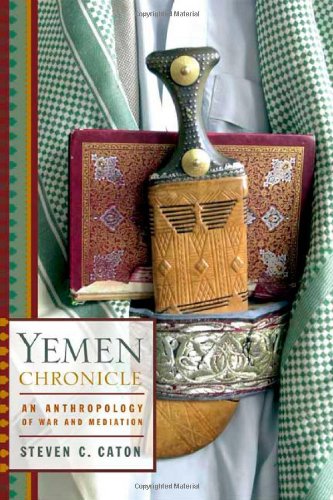



A report like no other from the heart of the Arab Middle East In 1979, Steven C. Caton went to a remote area of Yemen to do fieldwork on the famous oral poetry of its tribes. The recent hostage crisis in Iran made life perilous for a young American in the Middle East; worse, he was soon embroiled in a dangerous local conflict. Yemen Chronicle is Caton's touchingly candid acount of the extraordinary events that ensued. One day a neighboring sheikh came angrily to the sanctuary village where Caton lived, claiming that a man there had abducted his daughter and another girl. This was cause for war, and even though the culprit was captured and mediation efforts launched, tribal hostilities simmered for months. A man who was helping to resolve the dispute befriended Caton, showing him how the poems recited by the belligerents were connected to larger Arab conflicts and giving him refuge when the sanctuary was attacked. Then, unexpectedly, Caton himself was arrested and jailed for being an American spy. It was 2001 before Caton could return toYemen to untangle the story of why he had been imprisoned and what had happened to the missing girls. Placing his contradictory experiences in their full context, Yemen Chronicle is not only an invaluable assessment of classical ethnographic procedures but also a profound meditation on the political, cultural, and sexual components of modern Arab culture. A Harvard anthropologist whose wanderlust and complex cultural identity suggest (and were perhaps inspired by) T. E. Lawrence, Caton has already written extensively on the prominence of poetry in Yemeni society, where chanted verse is an integral part of politics and intertribal dispute resolution. Caton's latest work engages the same subject matter in vivid firsthand context. As a graduate student researching oral poetry in a remote Yemeni village in 1979, Caton adopts local dress and chews khat with the locals out of respect for their culture as well as ethnographic legitimacy. But a dispute with a neighboring sheik, angry over the apparent kidnapping of his two young daughters, demonstrates both the strength and the limits of tribal generosity, and Caton is plunged into an anthropological spy thriller of sorts, surrounded by cultural mysteries and inexplicably imprisoned under suspicion of espionage. Despite such intrigues, Caton is not Indiana Jones, and this book's truly exciting focus is an intellectual one: poetry's power to mediate and explicate complex and perhaps intractable disputes. Strongly recommended for robust Middle East collections. Brendan Driscoll Copyright © American Library Association. All rights reserved " Yemen Chronicle is a wonderfully paradoxical book: an elegy shot through with comedy, a tale of a recent Arabian past that rings with echoes of the Iliad . Caton modestly describes it as an 'ethno-memoir,' but it is more than that: it is a meditation on the very workings of memory, on the genesis of poetry and the nature of truth itself; it has resonances with a history of conflict that runs from the plain of Troy to present-day Baghdad. And therein is the greatest paradox: that a story as intensely personal as Caton's can be so universal." —Tim Mackintosh-Smith, author of Yemen: Travels in Dictionary Land " Yemen Chronicle is a talented anthropologist’s account of trying to unravel meanings in a society where the rules are not only different from our own, but also fluid. Along the way the reader will learn much about Yemeni culture, poetry, politics, and the difficulty of interpreting what one sees and hears. And, to top it off, there is a mystery that goes unsolved for twenty years—and even now remains elusive." —William B. Quandt, University of Virginia " Yemen Chronicle is a book of exquisite beauty and depth. Steven Caton weaves an ethnography of life in Yemen—in an accounting of particular events of abduction, imprisonment, and betrayal—that is as delicate as a spider’s web. His keen sensibility and his gift for tuning into the poetic dimension of spoken Arabic make the reader part of the sanctuary where he lived, a witness on the roads he traveled. Yet the book is also a theoretical intervention of profound importance on key questions about ethnography and its relation to memory; the relation between what is an event and what is ordinary; who or what the anthropologist is; and, ultimately, the question that haunts the book—what is home?" —Veena Das, Chair, Department of Anthropology, The Johns Hopkins University " Yemen Chronicle is an extraordinary work—beautifully crafted, deeply subtle, filled with an astonishing cultural sensibility. Caton's poignant portrait of lost friendships and the social suffering caused by cycles of tribal revenge killings is a triumph both of ethnography and of deeply personal narrative. The thrice-told tale of the abduction of two young Yemeni girls and the miserable fate of their abductor goes from page-turning mystery to seeming epic trag