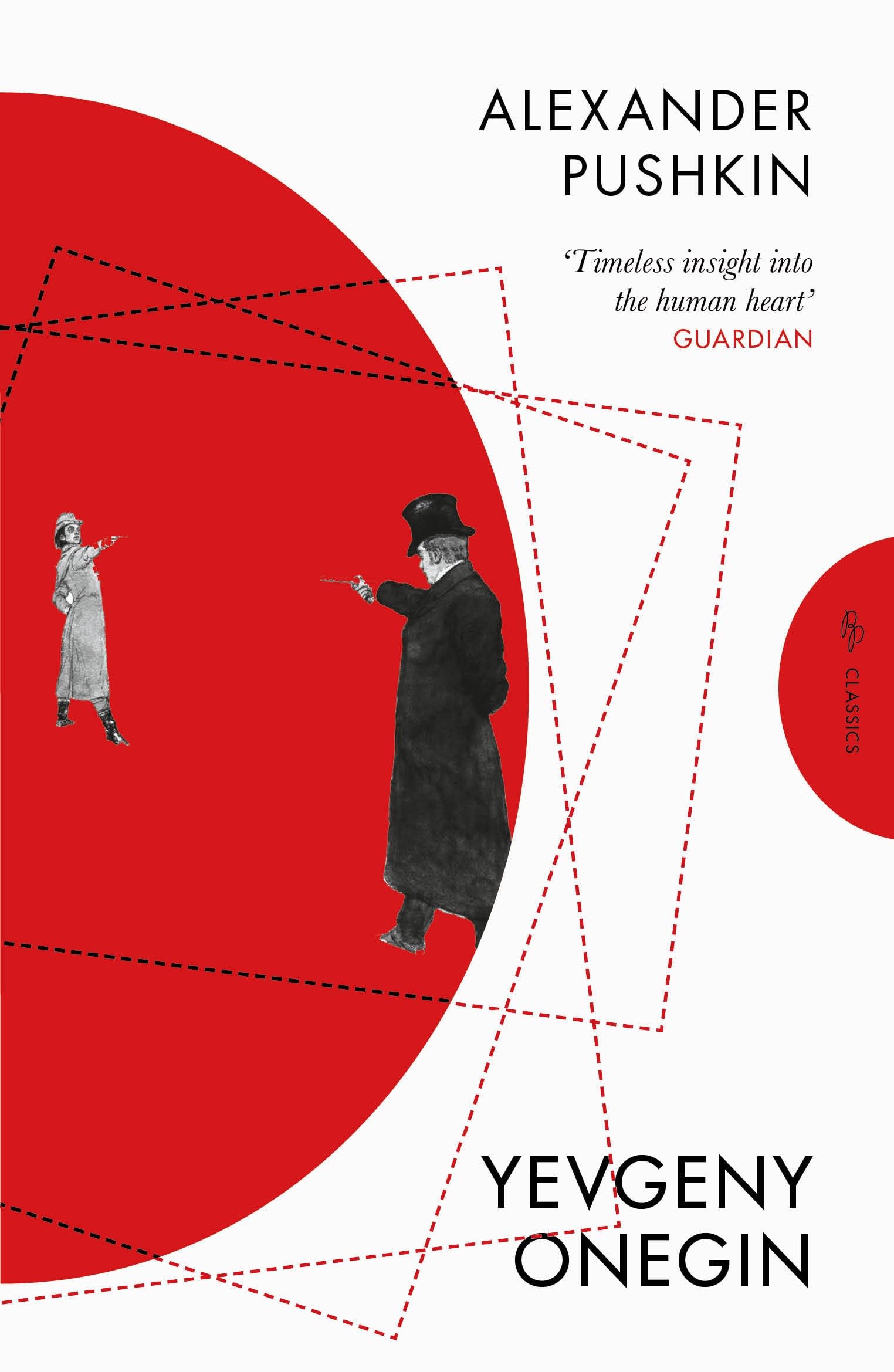



The aristocratic Yevgeny Onegin has come into his inheritance, leaving the glamour of St Petersburg's social life behind to take up residence at his uncle's country estate. Master of the nonchalant bow, and proof of the fact that we shine despite our lack of education, the aristocratic Onegin is the very model of a social butterfly - a fickle dandy, liked by all for his wit and easy ways. When the shy and passionate Tatyana falls in love with him, Onegin condescendingly rejects her, and instead carelessly diverts himself by flirting with her sister, Olga - with terrible consequences. Yevgeny Onegin is one of the - if not THE - greatest works of all Russian literature, and certainly the foundational text and Pushkin the foundational writer who influence all those who came after (Tolstoy, Dostoevsky, Chekhov, etc). So it's no surprise that this verse novella has drawn so many translators. It's a challenge, too, since verse is always harder to translate than prose. (Vikram Seth, rather than translating Onegin again, updated it to the 1980s in San Franciso in his The Golden Gate ). A.D.P. Briggs is arguably the greatest living scholar of Pushkin, certainly in the UK, and as such he's spent a lifetime thinking about how to translate Pushkin. Briggs is an experienced and accomplished translator, not only for Pushkin (Pushkin's The Queen of Spades ) but for Penguin Classics ( War and Peace, The Resurrection ) and others. Briggs has not only been thinking about Pushkin for decades, he's been working on this translation for nearly as long. It's a landmark event in the history of Onegin translations and this edition is accompanied by a thoughtful introduction and translator's note. Alexander Pushkin was born in 1799. He published his first poem when he was a teenager, and in 1820 his first long poem - Ruslan and Lyudmila - made him famous. His work, including the novel-in-verse Yevgeny Onegin, the poem 'The Bronze Horseman' and the short story 'The Queen of Spades', has secured his place as one of the greatest writers, in any language, ever to have lived. He died aged just 37, having been wounded in a duel - Pushkin's 29th - by his brother-in-law. Anthony Briggs is one of the world's leading authorities on the work of Pushkin. He is the author of Alexander Pushkin: A Critical Study and editor of Alexander Pushkin: A Celebration of Russia's Best-Loved Writer . He is an acclaimed translator from Russian, whose translations include Tolstoy's War and Peace and The Queen of Spades , a collection of Pushkin's writings published by Pushkin Press. 1 “Uncle, a man of purest probity, Has fallen ill, beyond a joke. Respected now, and scorned by nobody, He has achieved his masterstroke With this exemplary behaviour, But it would try the Holy Saviour To tend a sickbed night and day, And never stir a step away, Employing shameful histrionics To bring a half-dead man some cheer, Plump pillows and draw sadly near, Indulging him with pills and tonics, Heaving deep sighs, but thinking, ‘Ooh! When will the devil come for you?’” 2 These were the thoughts of a young gállant, Lodged in his dust-blown chaise, whom chance (Or mighty Zeus) had willed the talent Of family inheritance. Friends of Ruslán, friends of Lyudmíla, Allow me forthwith to reveal a New hero, for this novel, who Comes thus unintroduced to you: Onégin (we were friends for ages) Was born by the Nevá, where you, Perhaps, dear reader, were born too, Or maybe ran around rampageous. I’ve also had some good times there— But I can’t breathe that northern air. 3 With worthy service now behind him, His father lived from debt to debt. Three balls a year soon undermined him. He was as poor as you can get. Fate saved the boy, who was aware of Madame , and being taken care of, And her replacement, a Monsieur. The child was frisky, though demure. Monsieur l’Abbé, a Catholic father, Not keen to weigh Yevgeny down, Taught him by acting like a clown. Morals seemed irksome; he would rather Chide him for the odd naughty lark, And walk him in the Summer Park. 4 Rebellious youth came in due season— A season full of hopeful dreams And gentle sadness—ample reason To give Monsieur the sack, it seems. Onegin now, devil-may-care-style, Copied the very latest hairstyle And came out like a London fop To see society. Tip-top In spoken French (no less proficient In speech and writing), he could dance, And with the utmost nonchalance Perform a bow, which was sufficient To show him in a pleasing light As a nice lad, and very bright. 5 We’ve all of us been taught in smatters Of this and that, done bit by bit. Not that our education matters: We shine despite the lack of it. Onegin was esteemed by many (Judges as hard and strict as any) As an enlightened clever dick. He had evolved the happy trick Of butting in on French or Russian With flippant comments here and there Delivered with an expert air, While dodging any deep discussion. He could bring smiles to ladies’ lips With