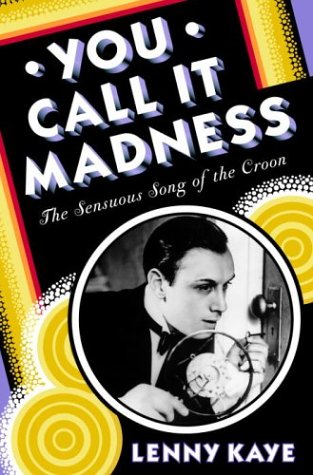



Crosby, Vallee, Columbo. They are their own trinity. Bing is the universal dad. Rudy the misbehaving son. That leaves Russ. The holy ghost. New York, 1931: The curtain falls on the Ziegfeld Follies, a victim of the rising popularity of talking pictures; Rudy Vallee, radio’s wildly popular “Vagabond Lover,” worries that increasingly sophisticated microphones and Hollywood-minted heartthrobs will make his megaphone-amplified vocals passé; a pugnacious, hard-drinking baritone named Bing Crosby cleans up his act, preparing to take America by storm on CBS radio; and handsome twenty-three-year-old Russ Columbo, a former violinist dating a Ziegfeld girl, makes his debut on NBC radio. In an America poised to take its dominant place on the world stage, the Crooner points the way forward. With his heated core of sex appeal wrapped in well-tailored layers of cool distance and cigarette smoke, the Crooner brings something new to the country’s self-image: this is no Yankee-Doodle Dandy, but a suave and seductive figure, sophisticated as any European, flush with youthful strength and energy. It’s all there in his voice, his croon: a soft, intimate, sensual form of singing that combines jazz sensibilities with the smooth and danceable rhythms of the Big Band sound and Swing. But who would embody the new archetype? Vallee crooned too soon. That left Crosby and Columbo to duel it out over the airwaves. Hailed as “The Romeo of Radio” and “The Valentino of Song,” romantically linked to actresses Pola Negri and Carole Lombard, Columbo is all but forgotten today, his limitless promise cut short in a tragic and controversial accident as he stood on the verge of winning the stardom that Crosby, his great rival, would soon achieve. In this impressionistic tour-de-force–a musical history combining the drama of a bestselling novel and a soundtrack from the Golden Age of Broadway and Hollywood–master musician and critic Lenny Kaye trains a spotlight on Columbo while crooning a love song to an earlier America–a pitch-perfect evocation of one of the most romantic, creatively exuberant periods of our past–an era whose influence still burns brightly in the music and popular culture of today. For a while in the nineteen-thirties, the crooner Russ Columbo was known as Bing Crosby's biggest rival. Now he is remembered chiefly for the bizarre circumstances of his death, when he was twenty-six: while his best friend was fiddling with an antique gun, it went off, hitting Columbo in the head. Columbo's family concealed this event from his mother for years, writing her letters in his name. Kaye, a guitarist for Patti Smith, is evidently a Columbo fanatic; his meticulously researched text is adorned with photographs and memorabilia from his own collection. His breathless, free-associating style occasionally compromises the clarity of the story, but it lets him under the skin of a fellow-musician. In Kaye's telling, Columbo is a cautious craftsman, quietly absorbing influences from Chopin to drag acts in order to arrive at his own inimitable style. Copyright © 2005 The New Yorker “Lenny Kaye is uniquely qualified to write on the art of the croon. He is a musician, an archivist and historian of various musical troves, a journalist and DJ. He knows more about the music biz and musicians then almost anyone I know. He ranks with the magnificent Hal Willner and Bill Bentley in knowledge of fact not fancy as regards both peers and forefathers of the pop /blues culture of the American Dream. Lenny passes this knowledge on in his wonderful new book, You Call it Madness .” --Lou Reed “Lenny Kaye chooses the unlikely subject of the 1930s music scene--the era of the crooner--and without a wasted word, transforms it into essential reading. This is ardently researched journalism that reads like a novel. It's all here with a cast of hundreds: the herculean infidelities, mysterious deaths, endless parties, wild sex, and backstabbing businessmen - a page-turner that entertains, informs, amuses, and breaks your heart. Lenny Kaye has moved into a whole new literary league.”--Jim Carroll "Reading it is like wandering through a darkening woods with only haunted melodies to guide you home." --Nick Tosches “A bravura performance. . . It's a symphony of yellowed Variety clips, old sheet music, recording-studio notes, and movie dialogue. What might have been a lot of moonshine coming over a mountain of words ultimately works like a loving riff in a June moon canoe down a stream of consciousness.” — Kirkus Reviews Crosby, Vallee, Columbo. They are their own trinity. Bing is the universal dad. Rudy the misbehaving son. That leaves Russ. The holy ghost. New York, 1931: The curtain falls on the Ziegfeld Follies, a victim of the rising popularity of talking pictures; Rudy Vallee, radio's wildly popular "Vagabond Lover," worries that increasingly sophisticated microphones and Hollywood-minted heartthrobs will make his megaphone-amplified vocals pas