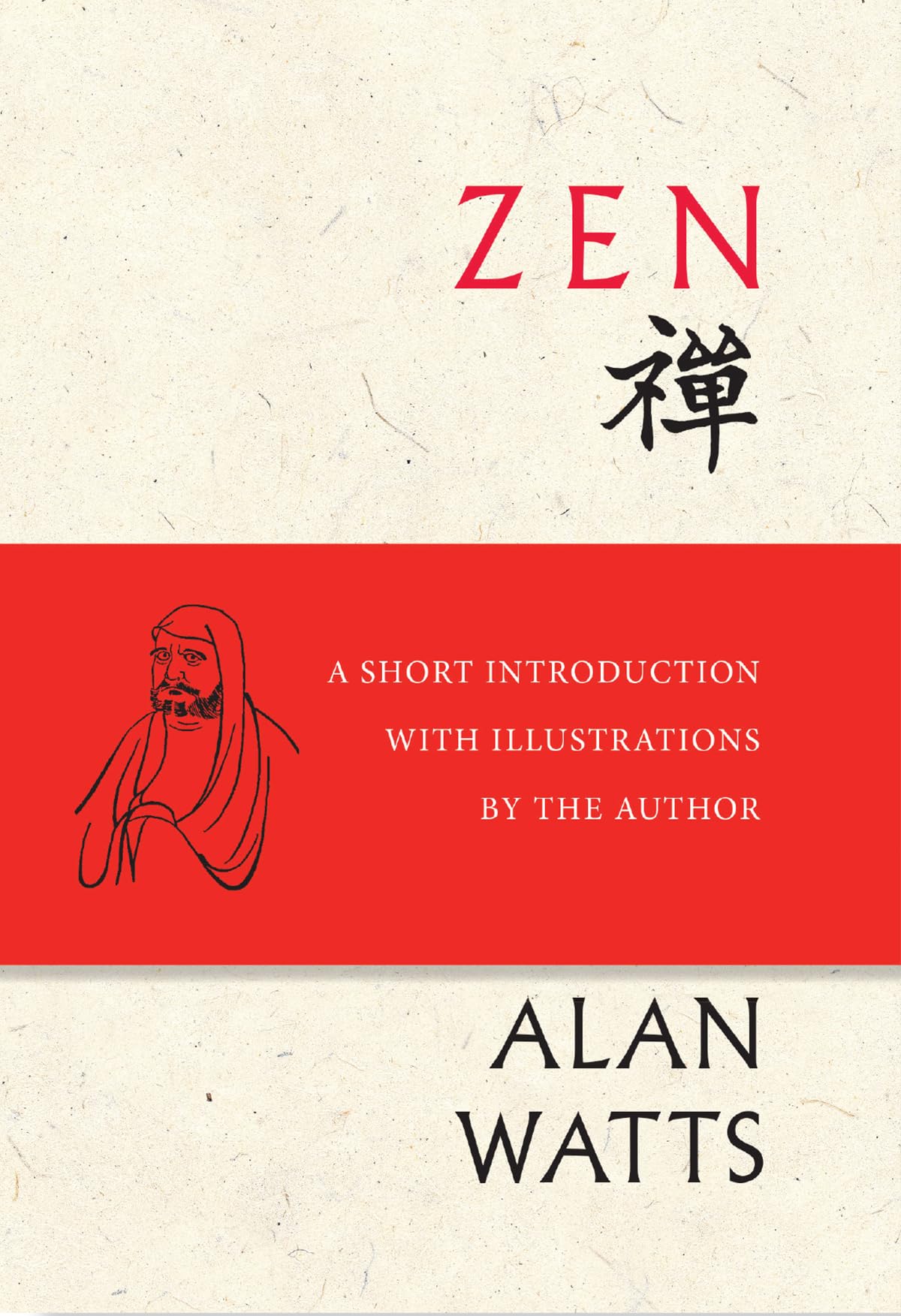



According to Alan Watts, “Zen taste deplores the cluttering of a picture or of a room with many objects.” In that sense, this minimalist book embodies the aesthetic of Zen itself. As with brushstrokes in a Japanese ink painting, the words have been used sparingly and arranged precisely, with no unnecessary detail. In seven brief chapters, Watts captures the essence of Zen Buddhism as a religion and a way of life. He explains fundamental Zen concepts, introduces revered Zen thinkers, places Zen within the broader context of Eastern religion, and traces the influence of Zen in the arts. Illustrated with calligraphy and drawings by the author, this reprint of an old classic will delight fans of Alan Watts, while introducing new readers to a legendary author who infused groundbreaking scholarship with literary brilliance. “Perhaps the foremost Western interpreter of Eastern thought for the modern world.” — The New York Times “An essential book by a great religious thinker.” — San Francisco Book Review Through his books and lectures, Alan Watts (1915–1973) introduced millions of Westerners to Eastern philosophies such as Vedanta, Taoism, and Zen Buddhism. Born in England, Watts immigrated to the United States in his twenties, worked as a chaplain and teacher, and wrote more than twenty books, including the bestselling The Wisdom of Insecurity . Zen A Short Introduction with Illustrations by the Author By Alan Watts New World Library Copyright © 2019 Joan Watts and Anne Watts All rights reserved. ISBN: 978-1-60868-588-2 Contents Preface by Shinge Roko Sherry Chayat, Foreword, Introduction, The Background in Indian Religion, The Background in Chinese Religion, The Momentous Harmony, Direct Pointing, Zen Meditation, The Cultural Effects of Zen, Conclusion, Bibliography, The Drawings and Symbols, About the Author, CHAPTER 1 THE BACKGROUND IN INDIAN RELIGION Indian religion has ever been characterized by the quest for "that One thing, knowing which we shall know all." In the Upanishads this "One thing" is termed Brahman, the absolute Reality of the universe beyond all opposites. All ordinary things and experiences have opposites; life is opposed to death, pleasure to pain, joy to sorrow, light to darkness. These opposites are necessary to one another, so that life is always limited by death, and joy by sorrow. But Reality itself has no opposite; it is advaita, non-dual, and the soul of man is only delivered from death and sorrow by realizing its identity with Reality. For the Upanishads taught that Brahman is the true nature of ourselves and of all things. Not to realize this is ignorance ( avidya ) and unhappiness, but to know it is true knowledge ( vidya ) and a transcendental happiness which is eternal because, strange to say, it too has no opposite. Thus the religion of the Upanishads was more or less monistic, believing that all forms and objects were in fact manifestations of the One Absolute. Primitive Indian Buddhism also sought this Reality, but its way of approach was purely psychological. The Buddha felt that philosophical speculation about Reality was a waste of time and even a positive hindrance. Reality or Nirvana lay beyond all definition, and nothing was of importance but an immediate and intimate experience of it, and this could only be had by getting rid of trishna. Reality is here and now, but it is concealed by attempts to grasp it in this form or that. Later Indian Buddhism, which is to say Mahayana, linked both the psychological approach of primitive Buddhism and the metaphysical tradition of the Upanishads. But whereas the Upanishads described the non-dual Reality as the One, Mahayana felt this term misleading. One is opposed to Many and None, for which reason Reality must transcend even oneness. Mahayana went beyond monism, and certainly beyond any trace of that Spinozist pantheism so often, and, it may be said, erroneously, attributed to the Upanishads. To say that all things are one is to reduce everything to something which is still short of non-duality, since, as we have seen, one-ness has an opposite and so cannot be the Absolute. Furthermore, the very statement, "All things are Reality," contains an implied opposition between "all things" and "Reality." In making such a statement we are uniting two things which are in no need of union. They are already united, and to try to create the union in thought or in feeling is to imply to oneself that it does not already exist. Nirvana (the state of Reality) is Samsara (the state of ordinary life) and the very act of trying to realize that they are one implies that they are not. In any case, Reality is not one; it is non-dual, having no opposite at all. Therefore Mahayana spoke of Reality as Tathata, or Thusness, and as Sunyata, or the Void, considered not as mere emptiness but as "solid emptiness." Sunyata resembles a crystal ball, which is visible to our eyes only because of wha