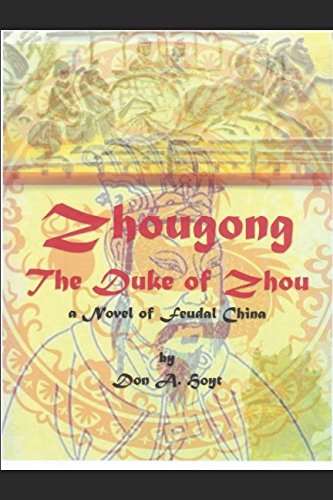



Approximately 1045 BCE the ruler of an independent province on the frontier of ancient China named Ji Fa defeated the reigning Emperor Di Xin's vast forces to found China's 3rd dynasty, the Zhou. The rise of the Zhou with their military, scientific, cultural, and economic superiority and their triumph over the Shang dynasty is the subject of this novel. For the most part, Ji Fa's conquest was made possible by three extraordinary men: (1) Ji Chang- Ji Fa's father, primary author of the world's oldest book, founder of the world's first public school system and citizen's college, the Thomas Jefferson of his age; (2) Ji Dan (Zhougong)- Ji Fa's younger brother, a political and administrative genius, significant contributor to the oldest book, the Ben Franklin of his age; (3) Lu Shang (Taigong)- an immigrant to Zhou, China's greatest military leader, the Robert E. Lee of his age. These three men are still today considered among China's most revered heroes, as they were by the great sage himself, Confucius, five centuries later. Indeed, much of what has become Chinese culture as now known originated, not with Confucius, but with Ji Chang and Ji Dan, whom Confucius admired greatly. The I Ching (The Book of Changes) was written by Ji Chang during a seven year captivity by the last Shang emperor, an atrocity that contributed crucially to the downfall of the Shang. After the Zhou conquest, Ji Dan added significantly to the book even during a post-conquest period of terrific instability and authored several other ancient volumes that have had vast influence on Chinese society and thought. Except for an appendix added by Confucius and other miscellaneous latter day scribbling, The Book of Changes has come to us through the ages just as the two leaders wrote it. The story of their conquest concerns itself with conflicts of values: morality versus practicality, independence versus social propriety, self-restraint versus the exercise of power, and so on. This period is prior to Confucianism, Taoism, Buddhism, even Judaism (perhaps even Hinduism). Viewing the world from 3,000 years ago as China emerged from the stone age, some of our most respected modern attitudes become suspect. Through their eyes nature and primitivism were a lifelong threat, virtue and social propriety were a practical necessity, and ritual and sacrifice was vital to cultural progress. Indeed, as modern China increasingly considers itself in “exceptionalist” terms, the Zhou concept of “tianxia” (all under heaven) is being proffered by Chinese thinkers as an alternative to the current, prevailing “nation state” model of civilization [Banyan: “Nothing New Under Heaven.” The Economist, Vol. 399, No. 8738 (6-18-2011), p.50]. The drama of the story arises from the contrast between Ji Chang, one of China's finest men, and the corrupt and decadent Shang Emperor, Di Xin, one of China's worst (whose depravity, incidentally, pales in comparison to well known latter day despots). This contrast is extended to the men around the two leaders and ultimately to their cultures as a whole as the characters are swept into the maelstrom of civil war. ABOUT THE AUTHOR Don A. Hoyt was reared in New Orleans after his mother and father divorced when he was four. Most of his formative years were spent living in New Orleans public housing projects. He enlisted in the Navy at 17, abandoning high school in the 10thgrade, just as the Vietnam conflict was getting under way. Shortly after his military service, he married his wife Charlotte, and earned two different Masters Degrees from two different Louisiana universities. He retired in 2013 from a 35-year career in local government administration, his last position being the City Manager of Anniston, Alabama (population 23,000). Other work by Don A. Hoyt includes: Commerce of the Undesirable (50 Poems) A New Kerygma (15 Poems) Tribal Magic (39 Poems) The Mausoleum on the Levee (55 Poems) Rejecting the New Millennium (33 Poems) Cousin Toby and the Preacher and other Stories (flash fiction) The Duke of Zhou (a novel) Hoyt's poems and short stories have appeared in numerous literary journals in the US, Canada, and the UK. Some notable literary journal credits include: Florida Review Univ. of Houston FORUM Louisiana Review Louisiana English Journal Wisconsin Review Black Mountain Review Kansas Quarterly Roanoke Review Whiskey Island Oxford Magazine