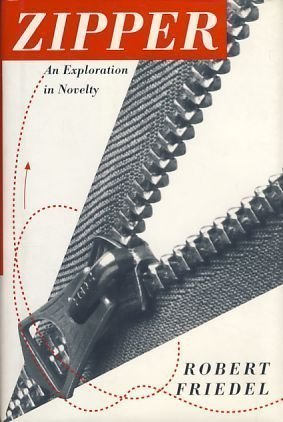



Recounts the invention of the zipper and describes how a useless technological novelty worked its way into daily life and took its place as one of the defining artifacts of the twentieth century. Today the zipper seems a commonplace if not insignificant piece of our lives. Behind this tiny piece of technology, however, lies a story rich in manufacturing, economics, fashion, engineering, and , most importantly , personalities. Friedel, a historian of technology, examines all these topics in this tale of the "hookless fastener" (a.k.a., the zipper) from its 1890s origin through the 40 years of refinement and eventual acceptance in the 1930s and up to the present day. Enjoyable and readable, Friedel's saga of the zipper provides him with the perfect means to peer inside technology's origin, revealing its capacity to fill needs and showing how novelty pushes us to the future. Recommended for all collections. - Michael D. Cramer, Virginia Polytechnic & State Univ. Libs., Blacksburg Copyright 1994 Reed Business Information, Inc. A peer of Thomas Edison and Alexander Graham Bell, Whitcomb Judson was an inventor with numerous patents, yet this man who created the zipper died relatively unknown. He backed the wrong horse, so to speak--putting his efforts into pneumatic (rather than electric) streetcars and shoe fasteners. Friedel pursues the erratic path of the Fastener Manufacturing and Machine Co. from the late nineteenth century into the middle of the next, when the company became Talon, Inc., manufacturer of zippers. Friedel's history traces fashion fluctuations, patent wars, and marketing struggles as well as the personalities of the individuals enmeshed in the fastener/zipper evolution. An interesting sidebar in the history of inventions. Denise Perry Donavin Last year marked the centenary of the zipper, or at least of the date on which the US Government granted Whitcomb L. Judson two basic patents for this exemplary bit of Yankee ingenuity. In honor of the occasion, Friedel (History/Univ. of Maryland) has stitched together an uncommonly engaging account of how a technological curiosity became a ubiquitous, all-purpose fastener that now touches many, if not most, lives. The zipper traveled a long road from drawing board to marketplace and yielded its inventor precious few rewards. At the outset, in fact, it was a solution in search of a problem. Though sustained by the lonely passion of Lewis Walker, founder of the Hookless Fastener Co. (HFC), the zipper did not become a commercial success until the mid-1930s, when clothiers followed the lead of high-fashion designers like Schiaparelli and began incorporating slide fasteners in popularly priced apparel. Nor did the zipper make a name for itself; the word was coined (and trademarked) in 1925 by B.F. Goodrich for a short-lived line of galoshes. Engineering setbacks and price resistance apart, the author argues, the zipper has never ranked among life's basic necessities. Buttons, clasps, laces, and other contrivances, he points out, can still handle virtually any of its applications. Even so, Friedel recounts, the two-track closure has become a near universal artifact--and more. By way of example, he cites the zipper's centerpiece role in urban legend and modern literature, most notably, perhaps, Erica Jong's riffs on the pleasures of ``the zipless fuck.'' In the meantime, Talon Inc. (HFC's corporate name since 1937) twice lost its independence after WW II, most recently to Coats Viyella plc, a British multinational. The only evidence that the firm was once an economic mainstay of Meadville, Pa., lies in the local radio station's call letters--WZPR. A nicely calculated blend of cultural and business perspectives. (Photos--not seen) -- Copyright ©1994, Kirkus Associates, LP. All rights reserved.