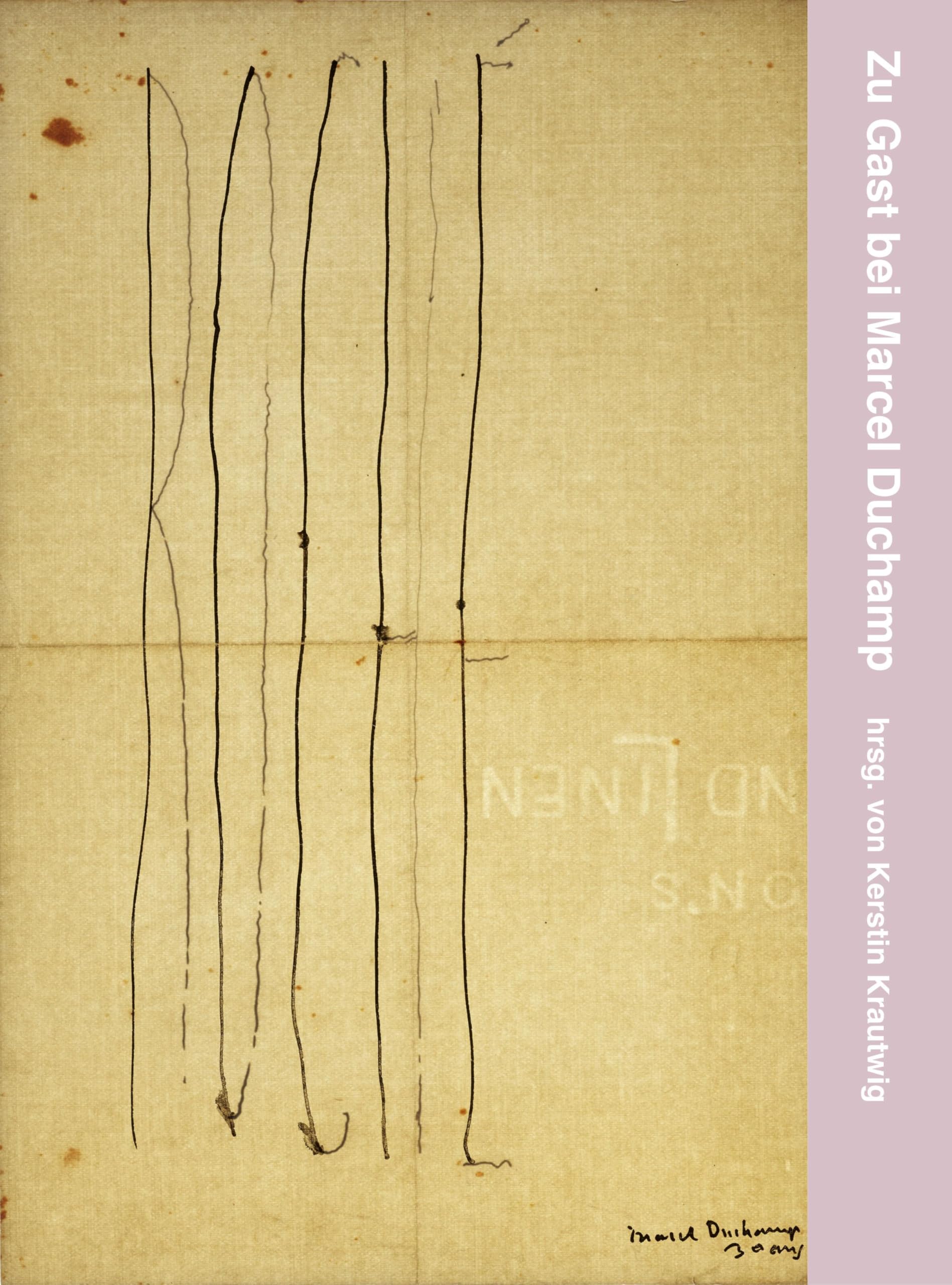
À table with Marcel Duchamp: Four extraordinary place cards and their history
$29.95
by Kerstin Krautwig



Two seemingly abstract scribbles – one on the front, one on the back – when held up to a light source they reveal legible names: Carlo for Carl Van Vechten, Fania for Fania Marionoff (Van Vechten’ s wife), Picabia for Francis Picabia, and Roché for Henri-Pierre Roché , who later gained fame for his novel » Jules et Jim« , adapted into a film by Truffaut. And just like that, the place cards were born. What makes these small paper works so extraordinary is not just their context but also Marcel Duchamp’ s signature approach. Guests had to hold the cards up to a light source to decipher their names, and some could only be read at a specific angle, in keeping with the principles of anamorphic vision. This party trick seamlessly aligned with the optical experiments Duchamp conducted in the 1910s, which he himself considered preliminary studies for his most famous work, » The Large Glass« . By the time Marcel Duchamp arrived in New York in 1915, he was already a celebrity. His painting » Nude Descending a Staircase, No. 2« had caused a scandal at the 1913 Armory Show, earning him immense admiration in artistic and intellectual circles. Duchamp was welcomed as a celebrity and introduced to New York high society, staying with the Arensbergs, who most nights hosted artist salons. The daughters of the wealthy Stettheimer family organized Duchamp’ s 30th birthday party and reportedly asked him to create the place cards in question for his friends. Three of these place cards – for Van Vechten, Marionoff, and Picabia – were already part of the Staatliches Museum Schwerin’ s collection, which, with 90 works by Duchamp, ranks among Europe’ s largest and most significant Duchamp holdings. The fourth and final surviving card – for his closest friend and companion, Henri-Pierre Roché – was acquired by the museum in 2024, completing a globally unique ensemble. For the first time since their creation, all four cards are reunited and presented to the public at the museum’ s reopening in Schwerin. Kerstin Krautwig has meticulously researched the history of these remarkable place cards. Kerstin Krautwig is the curator oft he Marcel Duchamp Research Centre at Staatliches Museum Schwerin. The oeuvre of Marcel Duchamp still bears an impact on art history today and will continue to do so in the future – its reception is unbroken. The Staatliches Museum Schwerin regards its Duchamp holdings, comprising 91 works, as an obligation and a challenge to explore the questions raised by Duchamp on an ongoing basis. Since 2009, it has pursued this aim with the Duchamp Research Centre, Schwerin. Marcel Duchamp (1887– 1968) was French painter, sculptor, chess player, and writer whose work is associated with Cubism, Dada, Futurism and Conceptual Art. He is together with Picasso and Matisse responsibel for the significant development in painting and sculpture in the 20th century. He is all times remembered as a pioneering figure with his » Fountain« , a signed urinal displayed in the 1917 Society of Independent Artists exhibition in New York.