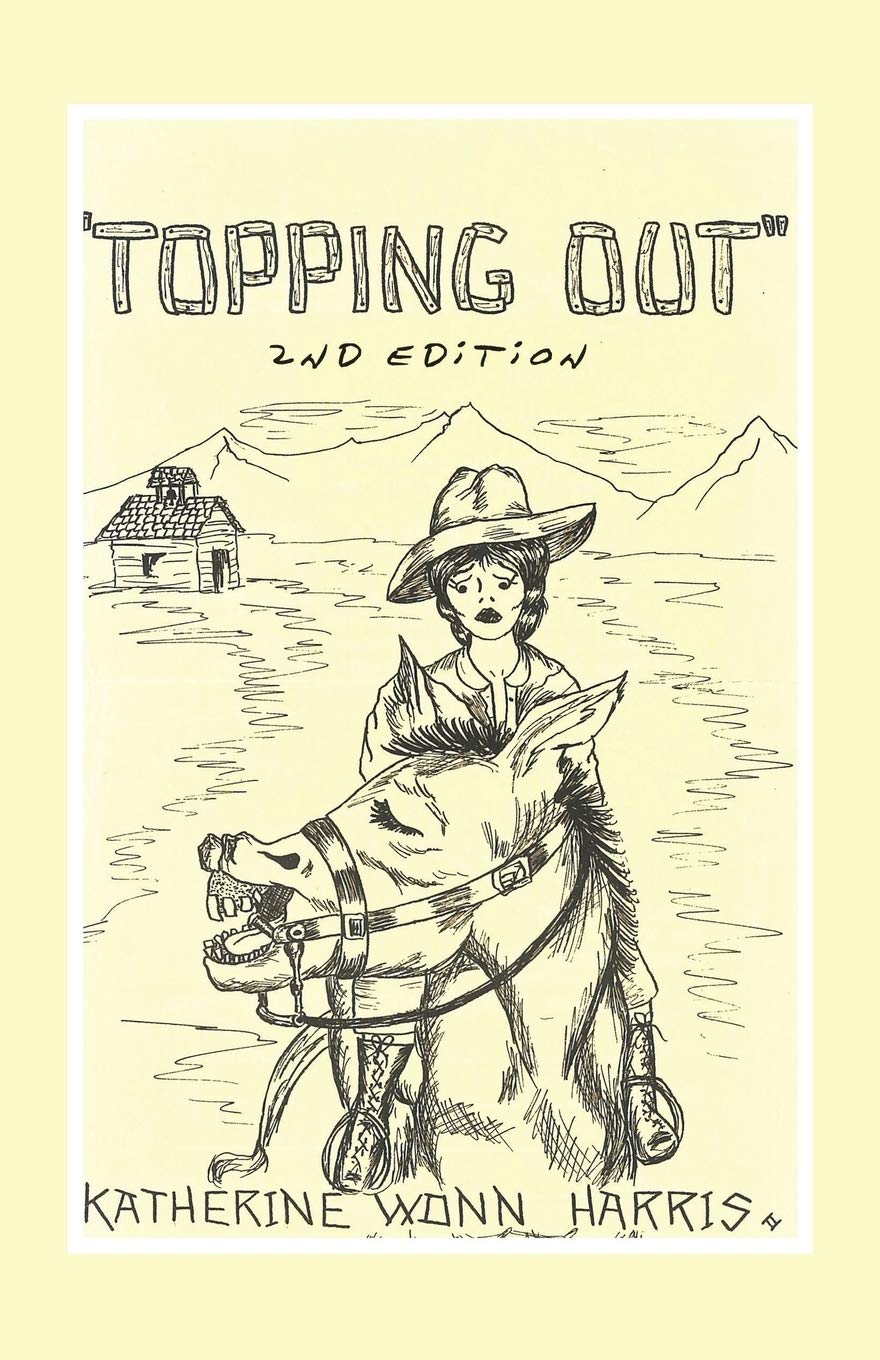



Topping Out is a story of adventure, heartaches, and challenges for a young pioneer woman who teaches the children of hardworking Idaho ranchers. The hardships included crossing the hazardous Salmon and Snake Rivers, managing horses and Smoky Mule, traversing narrow trails with pack animals, and fighting a forest fire. As a sixteen-year-old, Kay had to prove herself and earn respect during the seven years in the high primitive country. A wonderful descriptive story. Reader can truly envision the places. At one point, I felt myself feeling the colors of dawn and longing to be in the spot she wrote of. The characters, too, are a strong featurewell drawn out and easy to fall in love with (Holly S., editor for Balboa Press). She was a credentialed teacher, womans counselor and newspaper feature writer. She wrote Topping Out to describe the life and the terrain of that great big beautiful country of the Salmon and Snake Rivers, and what is now called Hells Canyon. "Topping Out" By Katherine Wonn Harris Balboa Press Copyright © 2018 Marilyn Allen All rights reserved. ISBN: 978-1-5043-9564-9 Contents Preface, vii, Idaho Map, ix, Acknowledgements, xi, Prologue, xiii, Chapter 1 Down to the Salmon, 1, Chapter 2 The Sanson Ranch, 9, Chapter 3 Smoky Mule, 17, Chapter 4 Pocket of Peace, 23, Chapter 5 Pay Day, 27, Chapter 6 Wilderness Water, 33, Chapter 7 Thaddeus of Horn Creek, 37, Chapter 8 A Bachelor Entertains, 47, Chapter 9 "Slick Weather", 55, Chapter 10 Rider from the Seven Devils, 59, Chapter 11 Cow Creek Episode, 65, Chapter 12 Vertical Grasslands, 69, Chapter 13 Spring and a Young Man's Fancy, 75, Chapter 14 Day of Days, 83, Chapter 15 Cleft of the Snake, 89, Chapter 16 Shanghaied, 93, Chapter 17 High and Dry, 105, Chapter 18 Manners, Morals, and Diet, 113, Chapter 19 The Summer Camp, 121, Chapter 20 Men of the Fading Frontier, 129, Chapter 21 The Sagebrush Years, 139, Chapter 22 Forever Packhorse, 147, Chapter 23 "EE-DA-HOW", 151, Chapter 24 Old Sugar, 157, Chapter 25 The Big Brass, 169, Chapter 26 White-Water Runners, 179, Chapter 27 Zero Week, 187, Chapter 28 The Battle for Water, 205, Chapter 29 Beef Tally, 209, Chapter 30 Passage Out, 227, Afterword, 239, Glossary, 243, About the Author, 245, CHAPTER 1 Down to the Salmon "There she lays," the stage driver said as he pointed. "Yonder's a big hunk of the Salmon River country." The panorama suddenly revealed from the rim of Idaho's high Camas Prairie was a fantasy in dimensions. I gazed out over the nation's greatest continuous expanse of blue peaks and rugged gorges, many unexplored. Here, within a fifty-mile radius, lay the three deepest river canyons on the continent — Hells Canyon of the Snake, the Salmon River Gorge, and that of its Middle Fork. From ridge to ridge, the immensity rose and fell into the mist of its own purple horizon. Out to our right, grand in its dusky depth, one predominant chasm coiled into the tapestry of distance. "That's part of the lower Salmon gorge." The driver followed its sweep of fantastic color and distance with a wide gesture. "I had no idea it was so wide! So deep!" I exclaimed. "This don't hold a candle to the upper Salmon country," he explained. "Don't suppose you'll ever see it though. Most schoolma'ams get mighty river shy after the first year, especially if they come from the city, and I'd guess you do." His glance flicked over my velvet toque; tailored tricotine suit and high-heeled, buttoned shoes. "My folks live in Boise," I said. "I'd guess this is your first school too," he announced. Uneasily I admitted this, wondering if, in spite of my grown-up lady's costume, I looked as young as my sixteen years. I wanted desperately to look eighteen, the minimum age required by Idaho for teaching. Feeling guilt for the false statements made to the examining board and in various applications for schools, I wanted no discussion on the subject of age. He spoke some more. "And I'd guess again that you don't know much about this country, or you'd have left that trunk at home. A big box thing like that can cause a sight of misery traveling like you'll have to do from now on." I didn't like my shiny new trunk called "a big box thing," but I had to admit that it had already caused considerable trouble, for in order to load it that morning, the rear stage seat had to be removed. Fortunately, I was the only passenger for the canyon country. I glanced back at my treasure surrounded by mailbags and sundry freight items. Already its glossy surface was coated with dust. "I wouldn't have brought it if I'd come straight through by stage from Boise," I apologized. "But they said part of the road was out from a cloud burst, and I couldn't get to White Bird that way. Had to come by train around through Oregon and Washington to Lewiston and take that jerkwater line up to Grangeville. Just think — three days to get a hundred miles from home." "Just as well, though," remarked t